
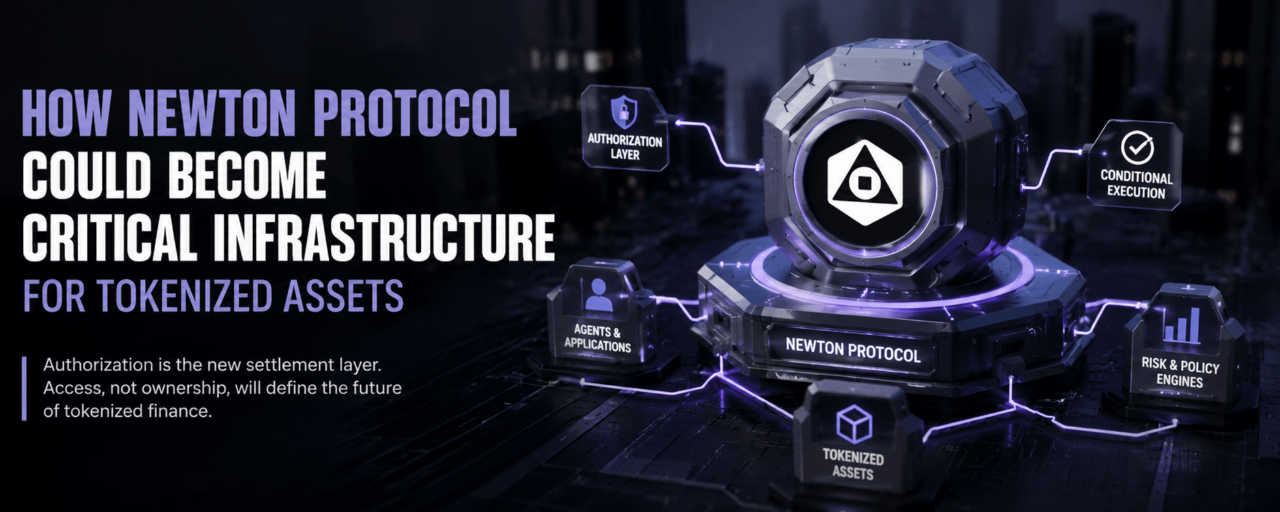

The more time I spend inside Newton Protocol, the less I think about tokenization itself and the more I think about authorization. That sounds like a small distinction until you start following what actually breaks when tokenized assets move beyond simple transfers and into systems that make decisions on behalf of users.
One thing that became obvious while testing workflows around Newton Protocol is that the hardest problem is not creating a tokenized asset. The hard part is deciding who gets to act on it, under what conditions, and how many times they can try before the system begins absorbing risk on behalf of everyone else.
A tokenized treasury bill, a tokenized real estate share, or a tokenized revenue stream all look straightforward when viewed from the asset layer. The operational friction appears one level deeper. Someone wants an agent, application, or automated strategy to interact with that asset. Permissions become dynamic. Conditions change. Failures happen. Suddenly authorization becomes infrastructure rather than administration.
A useful way to think about Newton Protocol is not as a place where tokenized assets live, but as a place where actions against those assets are continuously filtered.
That distinction matters more than it initially appears.
I kept noticing the same pattern. Systems become fragile when they assume every approved action deserves execution. Newton seems to assume the opposite. Every action must continuously justify itself.
Consider a simple mechanical example. An automated strategy receives authority to rebalance a portfolio containing tokenized assets. Without a structured authorization layer, a temporary routing failure can trigger repeated transaction attempts. The system may eventually succeed, but only after generating unnecessary cost, congestion, or exposure. Inside Newton's model, retry behavior can be bounded by explicit authorization conditions rather than delegated entirely to the application layer.
The immediate consequence is not better elegance. It is a narrower failure surface.
The failure mode shifts from "agent keeps trying until something works" to "agent remains constrained even when conditions become uncertain."
That sounds restrictive because it is.
And that is where the tradeoff appears.
Every authorization boundary introduces latency, verification overhead, and operational complexity. A workflow that previously required one approval may now require multiple checkpoints. A user who wants speed will occasionally experience this as friction. The protocol absorbs risk by making certain actions harder to execute.
I am not completely convinced users always appreciate that distinction.
In fact, I suspect many won't notice it until something goes wrong elsewhere.
A second example made this clearer to me. Imagine an agent authorized to deploy capital from a pool of tokenized assets. The authorization permits transactions below a certain threshold but requires additional validation above it. A $5,000 allocation passes automatically. A $500,000 allocation triggers extra scrutiny.
The interesting part is not the rule itself.
The interesting part is where the friction lands.
Instead of pushing risk assessment onto the asset issuer, the wallet provider, or the end user, the authorization layer absorbs it. The system effectively says: execution is not the default state. Qualification is.
Try this thought experiment. If transaction volume increased tenfold tomorrow, would your confidence in a tokenized asset depend more on the asset itself or on the quality of the authorization framework governing actions around it?
I am increasingly leaning toward the second answer.
Another test is even simpler. Remove ownership records from a tokenized asset system and it collapses immediately. Remove authorization controls and the collapse takes longer, but it still arrives. It simply arrives disguised as operational instability.
That is why Newton Protocol increasingly feels less like middleware and more like infrastructure.
Not because it stores value.
Because it decides which actions deserve access to value.
There is a subtle governance implication hiding underneath all of this. Open systems eventually discover that unrestricted participation creates its own form of centralization. Actors with better routing, better automation, or larger operational resources quietly gain advantages that were never formally granted.
Authorization becomes a way of defining admission boundaries.
Who gets access.
How often.
Under which conditions.
What looked open from the outside begins revealing layers of qualification underneath.
That realization made the protocol's token feel less like an economic add-on and more like a structural component. If authorization becomes critical infrastructure, then mechanisms that determine participation, validation responsibility, or security commitments eventually need economic alignment. The token enters the picture because the authorization layer requires accountability from participants, not because the asset layer needs another speculative instrument.
Maybe my bias here is showing. I have spent too much time looking at systems through the lens of failure rather than growth. That naturally makes authorization seem more important than expansion.
Still, I keep returning to the same question whenever tokenized asset discussions focus exclusively on issuance and distribution.
What happens when millions of authorized actions begin competing for execution quality at the same time?
The answer probably determines which systems become infrastructure and which remain applications.
Newton Protocol seems to be building around that question.
I am just not sure yet whether the future bottleneck will be asset creation, transaction throughput, or the invisible layer deciding who is allowed to do what in the first place.