
The longer I spend in crypto, the less impressed I become by loud announcements. Years ago, I used to refresh charts every few minutes, convinced that the next breakout would reveal the future of the industry. Today, I find myself paying much closer attention to the quiet things—the projects that spend more time building infrastructure than generating headlines.
That shift didn’t happen overnight. It came after watching several market cycles unfold. I watched periods where excitement outran reality, where billion-dollar narratives disappeared almost as quickly as they emerged, and where genuinely useful technology often developed quietly in the background while speculation occupied most of the conversation.
Those experiences changed the questions I ask whenever I encounter a new protocol. Instead of wondering how quickly a token might appreciate, I ask something much simpler. What problem is this network actually trying to solve? Does the architecture make sense? Are the trust assumptions reasonable? And perhaps most importantly, will anyone still find this infrastructure useful years after the current narrative fades?
Those questions are what led me to spend time examining Newton Protocol (NEWT).
At first glance, Newton Protocol sits at the intersection of two of today’s most discussed technologies: artificial intelligence and blockchain. That combination immediately attracts attention, but it also deserves extra scrutiny. AI has become a convenient marketing label, while blockchain projects have occasionally promised more automation than their underlying technology could realistically support. Whenever those two worlds merge, skepticism becomes a healthy starting point.
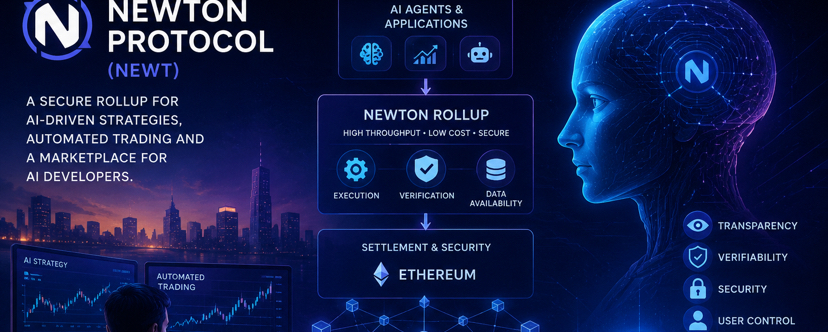
After looking more closely, however, I found that Newton Protocol appears less interested in chasing the AI narrative itself and more focused on solving an infrastructure challenge that may become increasingly important over time. The protocol aims to establish a secure rollup environment for AI-driven strategies, automated execution, and a marketplace where AI developers can publish and monetize intelligent agents.
That distinction matters.
Many discussions around AI in crypto focus almost entirely on what artificial intelligence can generate. Newton Protocol instead raises a different question: how should autonomous systems execute financial or blockchain-related actions in a way that remains transparent, verifiable, and accountable?
That may sound like a technical detail, but I think it is actually one of the more important infrastructure questions emerging today.
The reality is that AI systems are becoming increasingly capable of making recommendations. Generating text, analyzing markets, identifying patterns, and even designing software are all tasks modern AI models can already perform reasonably well.
Execution, however, is different.
Once an AI system begins moving assets, interacting with smart contracts, or managing financial strategies, trust becomes significantly more complicated. Suddenly it is no longer enough for an AI to produce useful outputs. Users need confidence that actions occur according to clearly defined rules, that permissions remain limited, and that every important decision can be independently verified.
Blockchain has always been about creating trust without relying entirely on centralized institutions. AI introduces new forms of automation. Bringing those two together requires infrastructure that respects both transparency and security.
That appears to be the niche Newton Protocol is attempting to occupy.
One aspect I appreciate is that the protocol frames itself around secure execution rather than replacing human decision-making altogether.
There is sometimes a misconception that AI should eliminate people from the process. I have never found that argument particularly convincing, especially in finance. Markets are influenced by politics, psychology, regulation, and unpredictable events that even sophisticated algorithms struggle to anticipate consistently.
Instead, I think AI works best when viewed as an assistant rather than an unquestionable authority.
If Newton’s infrastructure allows AI agents to execute predefined strategies within transparent boundaries while maintaining user control, that feels considerably more realistic than promising autonomous systems that never require oversight.
Another interesting element is the concept of a dedicated marketplace for AI developers.
Software marketplaces are hardly new. Mobile app stores transformed smartphones. Open-source repositories accelerated software collaboration. Cloud platforms simplified deployment.
An AI marketplace built around blockchain introduces different incentives.
Rather than simply distributing software, developers may eventually distribute intelligent agents capable of interacting with decentralized applications, executing strategies, performing research, or automating workflows.
Of course, that possibility introduces difficult questions.
How should users evaluate the reliability of AI agents?
How are malicious strategies identified?
Who becomes responsible if an autonomous agent behaves unexpectedly?
These questions have no simple answers, and Newton Protocol will ultimately be judged not by the marketplace itself but by the governance, verification mechanisms, and security standards surrounding it.
In many ways, infrastructure projects succeed precisely because they spend enormous effort preparing for situations that users hope never occur.
Security is another area where I find Newton’s architecture particularly interesting.
Rollups have become one of the most widely discussed scaling approaches across blockchain ecosystems because they attempt to improve efficiency without abandoning the security guarantees of the underlying chain.
Instead of processing every operation directly on the base network, rollups bundle transactions together before submitting compressed proofs back to the primary blockchain.
The result is generally lower costs, improved throughput, and greater scalability while still inheriting much of the security from the settlement layer.
Applying this concept to AI-driven execution introduces another layer of complexity.
AI systems may eventually perform thousands or even millions of automated interactions. Recording every intermediate computation directly on-chain would be expensive and inefficient.
A secure rollup architecture offers a practical compromise.
Heavy computational work can occur in a scalable environment while critical verification remains anchored to blockchain security.
That design reflects something I increasingly value in crypto projects: engineering trade-offs rather than ideological purity.
No blockchain architecture is perfect.
Every system balances decentralization, scalability, latency, developer experience, and cost.
The projects I trust most are usually the ones willing to acknowledge those compromises openly instead of pretending every design choice is universally optimal.
Transparency also deserves attention.
Crypto has gradually matured from an environment dominated by anonymous promises toward one where documentation, open-source development, security audits, and public roadmaps carry much greater weight.
Users have become more careful.
Developers have become more accountable.
Infrastructure projects can no longer rely solely on ambitious narratives.
Newton Protocol’s long-term credibility will likely depend less on marketing announcements and more on whether its technical documentation remains understandable, whether its development progress stays visible, and whether independent builders choose to contribute voluntarily.
Open ecosystems rarely succeed because people are persuaded.
They succeed because developers find them useful.
Another point worth considering is composability.
One of blockchain’s greatest strengths has always been that protocols can interact with one another. Lending platforms connect with decentralized exchanges. Identity systems integrate with wallets. Oracles feed data into smart contracts.
If AI agents become another building block within that ecosystem, interoperability becomes increasingly valuable.
Rather than existing as isolated products, intelligent agents could eventually cooperate across multiple decentralized applications while remaining subject to transparent execution rules.
That possibility is exciting, but it also increases systemic complexity.
As interconnected systems grow larger, unexpected interactions become more likely.
Finance has repeatedly demonstrated that individually sound components can collectively produce unforeseen outcomes.
Crypto is unlikely to be any different.
For that reason, careful architecture may prove more important than rapid expansion.
Governance is another topic that deserves thoughtful discussion.
Decentralization is often treated as a binary concept, but reality tends to be more nuanced.
Every protocol involves governance decisions somewhere.
Parameters change.
Software upgrades occur.
Security patches become necessary.
Treasury allocations require discussion.
The important question is not whether governance exists but whether governance remains transparent, accountable, and resistant to concentrated control.
As AI infrastructure becomes increasingly influential, governance decisions could have even broader consequences.
Changing execution permissions, modifying security assumptions, or altering marketplace incentives may directly influence thousands of automated agents operating simultaneously.
That places significant responsibility on protocol governance.
Regulation also remains impossible to ignore.
AI and blockchain are each receiving growing attention from policymakers worldwide.
Combining them creates additional uncertainty.
Protocols facilitating autonomous financial execution may eventually face evolving compliance expectations depending on jurisdiction.
No one can confidently predict how those regulatory frameworks will develop.
Projects building today must therefore balance innovation with sufficient flexibility to adapt as legal environments change.
This uncertainty should not necessarily discourage development.
It simply reminds us that technological progress rarely occurs independently of public policy.
One observation I continue returning to is that trust itself may become the defining infrastructure challenge of the AI era.
People often discuss AI accuracy.
Others focus on computational performance.
Important as those topics are, I suspect trust will ultimately matter even more.
Can users understand why an AI system performed a particular action?
Can they verify permissions?
Can they audit execution?
Can they intervene when necessary?
Blockchain cannot solve every AI problem.
It cannot eliminate model bias.
It cannot guarantee correct predictions.
It cannot magically produce intelligence.
What it can offer is a transparent record of actions, programmable permissions, and verifiable execution.
Those characteristics become increasingly valuable as automation expands.
From an investment perspective, many participants naturally focus on the NEWT token itself.
I understand why.
Tokens often dominate crypto conversations because they provide measurable market data.
Yet I increasingly believe token performance should be viewed as an outcome rather than the starting point.
Healthy infrastructure generally precedes sustainable network value.
Developer adoption.
Meaningful applications.
Reliable security.
Growing transaction activity.
These foundations tend to matter more over long time horizons than temporary excitement surrounding listings or short-term market sentiment.
Whether Newton Protocol eventually achieves widespread adoption remains uncertain.
Every infrastructure project faces significant competition.
Developer attention is limited.
User expectations continue rising.
Technology evolves rapidly.
Success is never guaranteed.
Still, I find projects like Newton valuable because they attempt to address practical infrastructure questions rather than relying solely on speculative narratives.
They ask how autonomous systems should interact with decentralized networks responsibly.
They consider execution rather than simply generation.
They emphasize architecture instead of marketing language.
Those priorities feel increasingly relevant as AI becomes integrated into more aspects of digital life.
Looking ahead, I suspect the conversation around AI in crypto will gradually become less about replacing humans and more about defining productive collaboration between people and intelligent software.
Automation works best when it extends human capabilities rather than removing human judgment entirely.
Blockchain, meanwhile, provides mechanisms for establishing transparent rules within increasingly complex digital systems.
The intersection of those ideas is where Newton Protocol appears to be positioning itself.
Whether it ultimately succeeds will depend on execution far more than vision.
Strong architecture must survive real-world stress.
Security assumptions must withstand determined attackers.
Developers must find genuine reasons to build.
Users must feel confident enough to trust automated systems with meaningful responsibilities.
Those milestones require patience.
As someone who has watched enough market cycles to recognize how quickly narratives evolve, I have become increasingly comfortable admitting uncertainty.
I do not know which AI infrastructure protocols will dominate five or ten years from now.
I do not know which technical standards will become industry norms.
I do not know how regulators, developers, enterprises, and everyday users will collectively shape this emerging landscape.
What I do know is that thoughtful infrastructure deserves more attention than speculative excitement.
Projects attempting to solve trust, transparency, verification, and secure automation are engaging with questions that extend well beyond today’s market cycle.
Perhaps that is the most interesting part of Newton Protocol.
Not because it promises certainty, but because it encourages us to think more carefully about how intelligent software should operate in open financial systems.
As AI grows more capable and automation becomes increasingly common, we may eventually care less about whether machines can make decisions and more about whether those decisions remain understandable, accountable, and verifiable.
Blockchain alone cannot answer those questions.
Artificial intelligence cannot answer them either.
But together, if designed carefully and governed responsibly, they may offer a framework worth exploring.
For me, that is the conversation that matters most—not where a token trades next month, but what kind of digital infrastructure we are quietly building for the decade ahead. If autonomous software becomes part of everyday financial life, what standards of trust should we demand? How transparent should automated decision-making be? And how much responsibility should we ever be willing to delegate to machines, even when the technology continues to improve?