
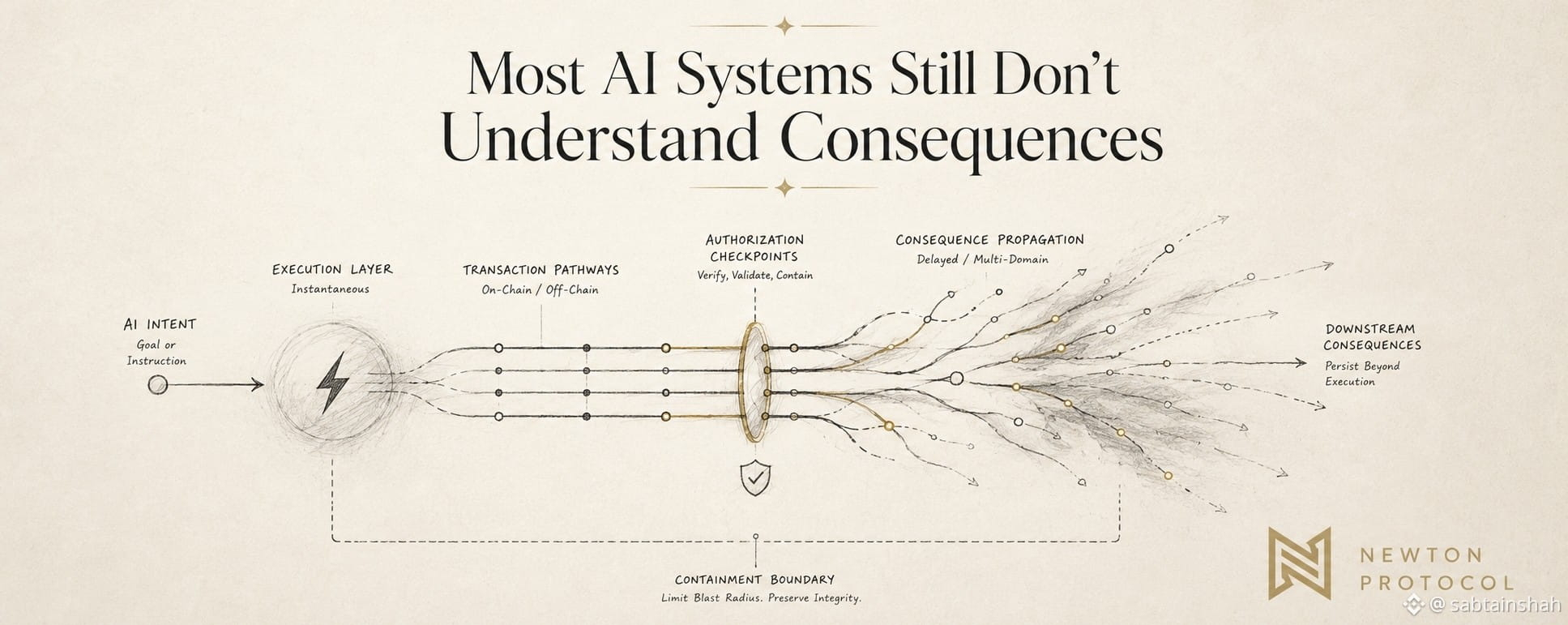
I’m starting to think autonomous systems may understand execution far better than consequences.
That difference sounded small when I first noticed it.
Now I’m not sure it is.
For a long time I assumed the hardest problem in automated finance would be execution itself.
Better coordination
Better models
Faster decisions moving across financial environments without human delay slowing them down.
That part still matters.
But lately I keep coming back to something more uncomfortable.
Execution ends extremely quickly.
Consequences usually don’t.
“The transaction finished.
The consequence kept moving afterward.”
That sentence has been sitting with me for days because modern infrastructure is incredibly good at preserving execution history.
Transactions survive
State changes survive
Outputs survive.
Consequences behave differently.
They rarely stay where execution leaves them.
Sometimes nothing looks dangerous at the moment execution happens. The instability only becomes visible later once behavior scales across environments the original system never fully anticipated.
I keep wondering whether autonomous systems are actually learning consequences or simply learning successful execution patterns.
I don’t think those are the same thing anymore.
Because institutions were never built only from correct execution.
They were built from surviving what execution eventually caused afterward.
“The system remembered the transaction.
The institution remembered the aftermath.”
That distinction feels increasingly important once AI agents begin operating continuously across financial systems without natural pauses for human hesitation to interrupt behavior before it compounds.
At first I thought post-execution monitoring would eventually compensate for most of this.
Now I’m less convinced.
Monitoring still assumes consequences remain visible long enough for systems to react after execution already happened.
Autonomous environments compress that reaction window aggressively.
By the time downstream effects become legible, execution may already be repeating itself across connected systems continuously.
That part feels structurally unstable in ways I don’t think we fully understand yet.
Because some permissions only become dangerous once scale touches them.
Nothing changes inside the transaction.
The environment changes around it.
And suddenly behavior that once looked acceptable begins compounding into something else entirely.
“But what exactly does an autonomous system remember once execution disappears from view?”
I keep coming back to that question because blockchains are exceptionally good at preserving finalized actions.
I’m not sure they preserve consequence awareness the same way.
And maybe that becomes the harder infrastructure problem once autonomous finance starts coordinating itself faster than human institutions can interpret downstream effects manually.
That’s partly why I keep returning to @NewtonProtocol
The more I look at authorization layers, the less they feel like access control and the more they start feeling like consequence containment before irreversible behavior spreads across environments.
Not just validating execution.
Validating whether downstream uncertainty is acceptable before execution becomes systemic.
Maybe future infrastructure doesn’t compete only on execution quality.
Maybe it competes on how intelligently systems understand what execution eventually turns into.
Execution ends quickly.
I’m starting to think consequences may be the part autonomous systems never fully stop negotiating with.