
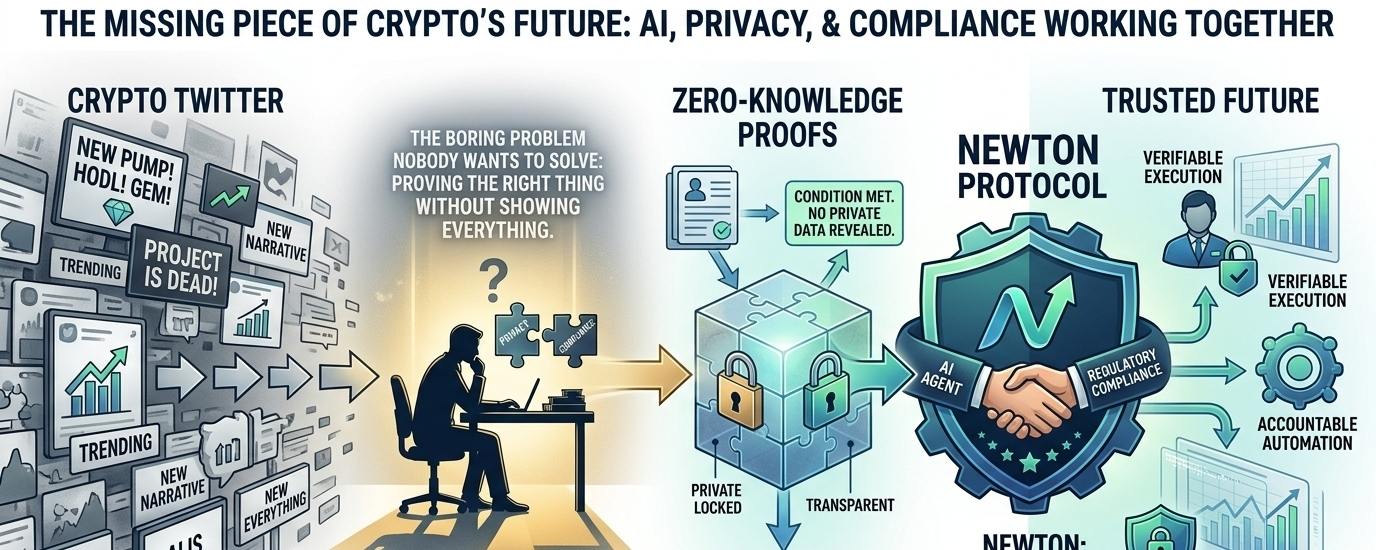
I’ve started noticing that every time I open Crypto Twitter, it feels like I'm walking into the same conversation. Someone's celebrating a pump. Someone else is calling a project dead. A new narrative shows up, everyone piles into it, and a few weeks later nobody even mentions it anymore. Honestly, I still enjoy watching it all happen, but these days I find myself paying more attention to the things people aren't talking about.
That's usually where I get curious.
Lately, I've been thinking a lot about trust.
Not the kind people throw around in marketing posts. I mean the boring kind. The kind nobody gets excited about until something breaks. When money is involved, trust suddenly becomes everything, and that's what keeps sitting in the back of my mind.
The funny thing is, crypto has solved a lot of problems already. Sending money across the world is easier than it used to be. We have decentralized exchanges, lending protocols, staking, AI agents... the list just keeps growing.
But one problem never really goes away.
How do you prove you're doing the right thing without showing everyone everything?
I don't know why, but that question keeps coming back every time I read about where this industry is heading.
Most people seem to think privacy and compliance are enemies. If you want privacy, regulators won't like it. If you want compliance, then you have to give up your privacy. That's been the story for years.
Maybe.
But the more I think about it, the less convincing that sounds.
I mean, in real life we don't share every detail about ourselves just because someone asks. We lock our phones. We use passwords. We don't hand our bank statements to strangers.
That's normal.
At the same time, I also understand that businesses and institutions can't just ignore regulations. Whether people like it or not, crypto isn't growing in a vacuum anymore. If it's going to become part of everyday finance, it has to find a better balance.
That's where I stumbled into reading about zero-knowledge proofs.
I'll be honest—I avoided the topic for a while.
Every explanation I saw looked like a university lecture full of cryptography terms that made my brain switch off after two minutes.
Then someone explained it in a much simpler way.
Instead of revealing your data, you prove that your data meets certain conditions.
That was it.
And somehow, that tiny idea completely changed the way I looked at it.
The more I sat with it, the more interesting it became.
Because maybe the goal isn't choosing between privacy and compliance.
Maybe the goal is proving what needs to be proven while keeping everything else private.
That feels... different.
It's also probably why Newton caught my attention.
Not because it was making the loudest promises. There are plenty of projects doing that already. Every other week another platform claims AI will change everything.
Maybe it will.
But AI without trust feels incomplete.
If an AI agent is making decisions with your assets, how do you know it followed the rules? How does someone verify that without exposing every piece of private information behind the scenes?
Those questions don't get nearly as much attention as token prices.
But honestly, I think they're more important.
From what I've been watching, Newton is trying to use zero-knowledge proofs to bridge that gap. Instead of treating privacy and compliance like two opposite goals, it tries to make them work together.
I actually find that idea more interesting than another blockchain claiming to be a little faster than the last one.
Speed matters.
Cheap transactions matter.
But eventually those things become expected.
Trust is harder to build.
And once people trust a system, they stop thinking about it. It just becomes part of the background.
That's probably the biggest lesson technology keeps teaching us.
Nobody thinks about HTTPS before opening a website.
Nobody sits there wondering how encryption works before sending a message.
People only notice when those systems fail.
Maybe privacy in crypto ends up being the same.
Of course, none of this means Newton automatically succeeds.
That's the reality.
Crypto has never been short on good ideas.
Execution is where things get difficult.
Developers still have to build on it.
Users have to actually use it.
Institutions have to believe it solves a real problem.
Those are big hurdles.
And honestly, I'd rather admit that than pretend every project I find interesting is guaranteed to win.
Still, I can't shake the feeling that this conversation is becoming more relevant every month.
AI is improving fast.
More institutions are exploring blockchain.
Governments aren't stepping away from regulation.
At the same time, people care more about privacy than ever before.
Those trends are all happening together.
That doesn't feel random.
Maybe I'm wrong.
Maybe another narrative comes along and everyone forgets about this too.
Crypto has surprised me before.
But if I've learned anything from watching this market for long enough, it's that the biggest opportunities usually don't look exciting at first. They're often hidden inside boring problems that nobody wants to spend time thinking about.
And right now, privacy, compliance, and trust feel like exactly those kinds of problems.
That's probably why I keep coming back to Newton.
Not because I expect magic.
Not because I think it's guaranteed to succeed.
Simply because it's trying to solve a problem that I think will matter a lot more tomorrow than most people realize today.