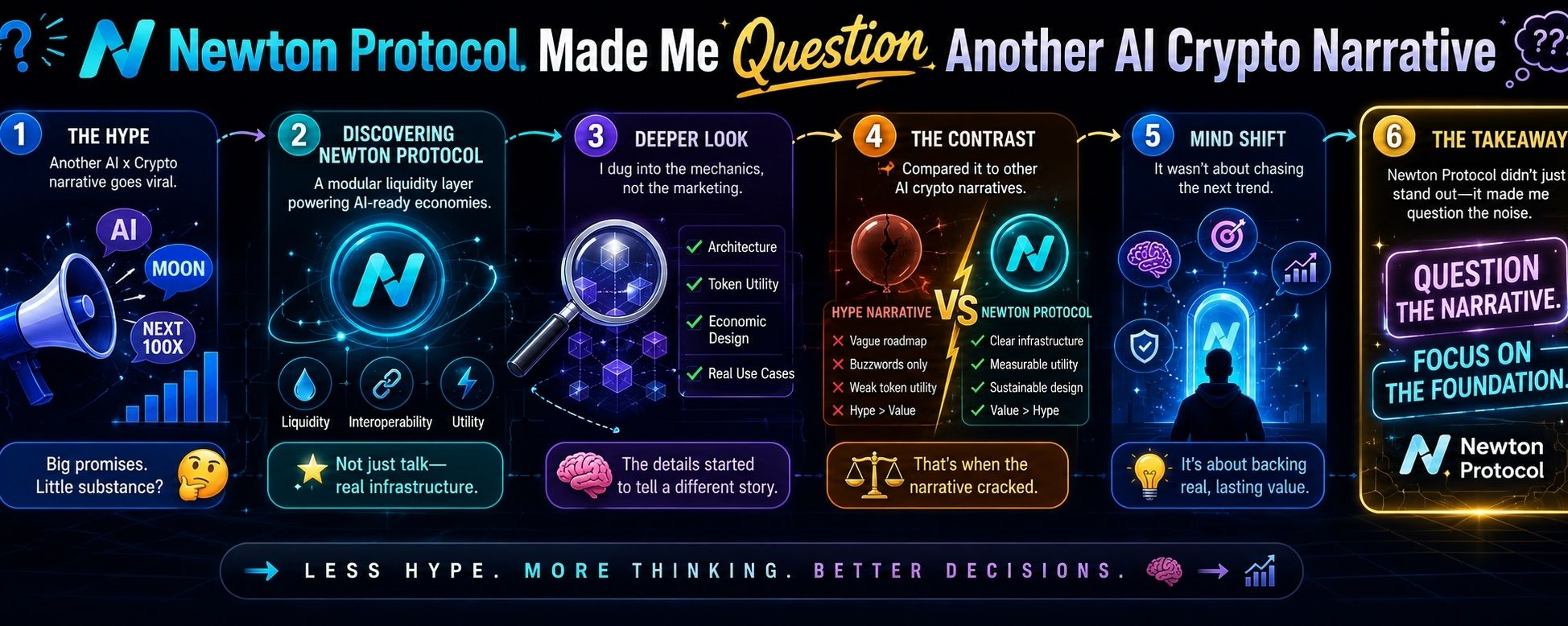
I found myself reading about Newton Protocol again tonight, and honestly, my first reaction was to roll my eyes a little. Not because the idea sounded bad, but because crypto has trained me to be skeptical before I'm ever excited. Every cycle seems to come wrapped in a brand-new narrative.
I've watched the market move from smart contracts to DeFi, then NFTs, then modular chains, restaking, and now AI. Somehow every new project manages to fit the latest trend, even when the technology underneath hasn't changed much.
That's why I almost ignored Newton Protocol at first. The words "AI," "automated strategies," and "developer marketplace" have become so common that they barely mean anything to me anymore. We've all seen those promises before.
But instead of closing the page, I kept reading. The more I looked into it, the less it felt like another AI trading story and the more it looked like infrastructure trying to solve a real coordination problem.
What caught my attention wasn't the AI narrative itself. It was the idea of creating an environment where automated systems can operate under transparent rules instead of blind trust. That's a much harder problem than simply attaching AI to a whitepaper.
Maybe that's what spending years in crypto does to you. You stop caring about impressive words and start wondering what happens when real people actually show up.
It's easy to build something that works with a few thousand users. The real test begins when millions arrive, transactions pile up, and the network has to deal with pressure instead of presentations.
That's the part I think the industry still underestimates.
Crypto loves celebrating before the difficult work even starts. A protocol launches, TVL climbs, social media gets excited, and everyone starts talking about the next revolution.
Then adoption finally arrives.
Fees increase. Infrastructure struggles. Bridges become bottlenecks. RPC providers get overloaded. Suddenly all those clean diagrams from launch day collide with messy reality.
Technology rarely breaks because it's poorly designed.
More often, it breaks because people actually start using it.
That's why I spend far more time looking at infrastructure than catchy slogans. Marketing tells you what a project wants to become. Infrastructure tells you what it can survive.
The same thing happens with liquidity.
Everyone says they're building for the long term until the market turns red. Confidence disappears surprisingly fast when prices fall and yields shrink. I've watched that happen enough times to stop pretending it's unusual.
The longer I'm around this industry, the more I realize technology and human psychology are constantly pulling in different directions.
Developers think in years.
Markets think in minutes.
Price usually reacts long before fundamentals ever have a chance to matter.
Looking at NEWT today, I notice that same balance between promise and uncertainty. The circulating supply is still relatively small compared to the total supply, and future unlocks are something worth paying attention to because tokenomics have changed the story for plenty of projects before.
None of that automatically makes Newton Protocol a success or a failure.
It just reminds me that building good infrastructure and building a healthy token economy are two completely different challenges.
I've seen brilliant engineering attached to disappointing tokens.
I've also seen average products deliver incredible returns simply because they captured attention at the right moment.
Crypto has never been perfectly rational.
Another thing I've noticed over the years is how quickly the industry changes its vocabulary. Yesterday everyone talked about middleware. Then it became orchestration. Then intent layers. Now it's policy engines.
Sometimes the technology really evolves.
Sometimes we just rename familiar ideas until they sound fresh again.
I'm not saying Newton falls into either category yet. I'm just careful not to confuse new terminology with genuine progress.
Execution always matters more than branding.
People also underestimate how difficult autonomous systems actually are.

It's easy to imagine AI agents moving funds across chains, interacting with protocols, making decisions, and handling transactions without human intervention.
Actually making that reliable is a completely different challenge.
Every extra dependency introduces another point of failure.
One oracle has issues.
One chain slows down.
One bridge pauses.
Suddenly the automated system isn't so autonomous anymore, and developers are explaining delays on Discord while everyone else wonders what happened.
That's simply the reality of distributed systems.
Which is exactly why I find infrastructure more interesting than flashy demos these days.
Nobody talks about verification until something goes wrong.
Nobody cares about security assumptions until trust disappears.
The boring parts of crypto usually become the most important parts when markets get stressful.
That's one reason Newton Protocol keeps sitting in the back of my mind. If automated software really becomes a bigger part of crypto over the next few years, then proving actions and enforcing clear rules could matter far more than making everything look intelligent.
Still, experience keeps making me cautious.
I've seen too many technically impressive projects fade away because they solved problems that very few people actually cared about.
Great architecture doesn't automatically create demand.
Beautiful documentation doesn't guarantee users.
Crypto has never suffered from a lack of talented builders.
If anything, it's always struggled to find sustainable adoption.
People don't always choose the best technology.
Most of the time they choose what's easiest, cheapest, or simply where everyone else already is.
Liquidity attracts developers.
Developers attract applications.
Applications attract users.
And somehow people later pretend the entire process was obvious from the beginning.
Sometimes I wonder whether we're building financial infrastructure or simply creating increasingly sophisticated ways to speculate on future narratives.
Maybe it's both.
Honestly, it's probably both.
The competition certainly isn't slowing down either. Projects working on modular execution, AI infrastructure, privacy, rollups, and decentralized identity are all moving toward similar goals from different directions.
That's not necessarily a bad thing.
Innovation has always been messy, and history usually decides much later which ideas actually mattered.
Maybe that's why I'm comfortable admitting I don't have all the answers anymore.

The market has humbled me enough times that certainty feels far more dangerous than curiosity.
So I keep watching Newton Protocol with interest, but not with blind optimism.
I don't dismiss it because AI is part of the conversation.
I don't believe in it simply because the vision sounds ambitious either.
I just keep asking myself the same question I've learned to ask every project.
Will this still matter after the narrative changes?
Because eventually it always does.
Today's attention belongs to AI.
Tomorrow it might be robotics, agent economies, quantum computing, or something none of us are talking about yet.
Narratives come and go.
Infrastructure either survives them or it doesn't.
Maybe Newton Protocol quietly becomes one of the projects that lasts.
Maybe it fades into the long list of ambitious ideas that couldn't escape the cycle.
At this point, I'm honestly comfortable living with that uncertainty.
After everything I've seen in crypto, not knowing feels far more genuine than pretending I already know how the story ends.
#SKHynix2xLongETFFallsOver30% $M