
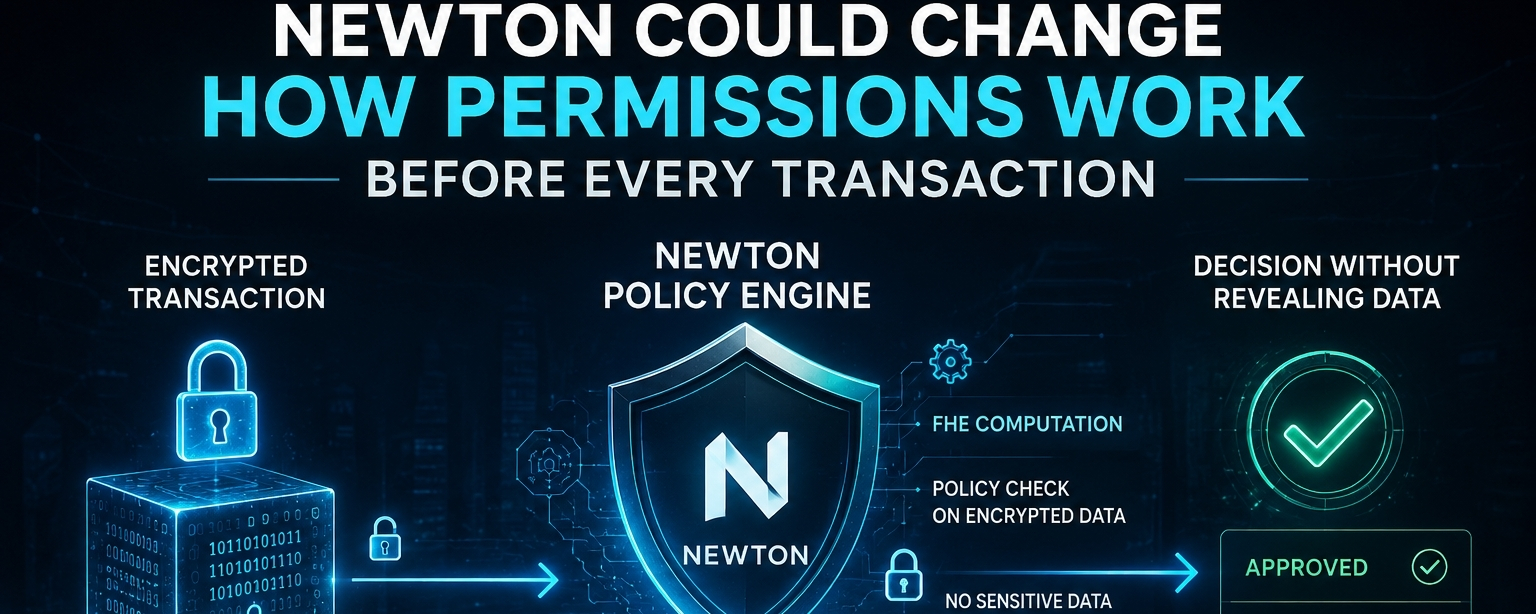
This morning, I was only one click away from increasing my $NEWT position.
Then I stopped.
Not because I suddenly turned bearish, but because I've learned that adding more capital should always come after gaining deeper conviction. That habit has saved me from plenty of bad entries over the years—even if it has also caused me to miss a few fast-moving opportunities.
This time, what pulled me back into research was Newton Protocol's long-term vision around Fully Homomorphic Encryption (FHE).
At first, I assumed the story was simple: encrypt data so nobody can read it.
The more I dug into it, the more I realized that the real innovation isn't privacy itself—it's how decisions could be made without exposing the underlying financial data.
One question kept running through my mind:
Can a policy engine decide whether a transaction should be approved without ever seeing the transaction itself?
If the answer is yes, then we're not talking about another privacy feature. We're talking about a completely different security architecture.
Today's policy systems typically require visibility before they can make decisions. Transaction amounts, wallet relationships, jurisdictions, timestamps, risk scores, and application context are often exposed so compliance rules can be evaluated.
The problem is that the policy layer gradually becomes another repository of sensitive financial intelligence.
Newton's long-term vision challenges that assumption.
Instead of revealing information first and evaluating it afterward, computation happens directly on encrypted data. The system only needs to prove whether a policy has been satisfied. It doesn't need unrestricted access to the underlying transaction details.
That distinction may sound subtle, but I think it fundamentally changes how authorization should work.
For years, we've assumed that granting permission requires seeing everything.
Maybe it doesn't.
Maybe all a system really needs is proof that the required policy has been satisfied.
That's an entirely different design philosophy.
What makes this even more interesting is that Newton already places its policy layer before execution. If encrypted policy evaluation eventually becomes practical at scale, it would operate at the exact point where authorization decisions are made—not as another analytics platform explaining what happened after the fact.
Of course, none of this is guaranteed.
FHE is computationally expensive. Performance, latency, and scalability remain real engineering challenges. If preserving privacy makes every authorization painfully slow, adoption will suffer.
That's one of the reasons my $NEWT allocation remains measured. Conviction should be built on execution, not just vision.
Still, one thought keeps coming back to me.
Financial transactions reveal far more than balances. They expose urgency, business relationships, liquidity needs, trading behavior, and strategic intent. If every compliance decision requires revealing all of that information, compliance slowly turns into another form of surveillance.
I suspect the strongest policy engine of the future won't be the one that collects the most data.
It will be the one that learns only what's absolutely necessary to make a decision—and nothing more.
That's the part of Newton Protocol that has become increasingly interesting to me.
At this point, I'm honestly more fascinated by the long-term infrastructure thesis than by the short-term price action.
So here's my question:
If encrypted policy evaluation becomes practical in the future, would you trust a system that can prove compliance without ever revealing your underlying financial data?@NewtonProtocol $NEWT #Newt