
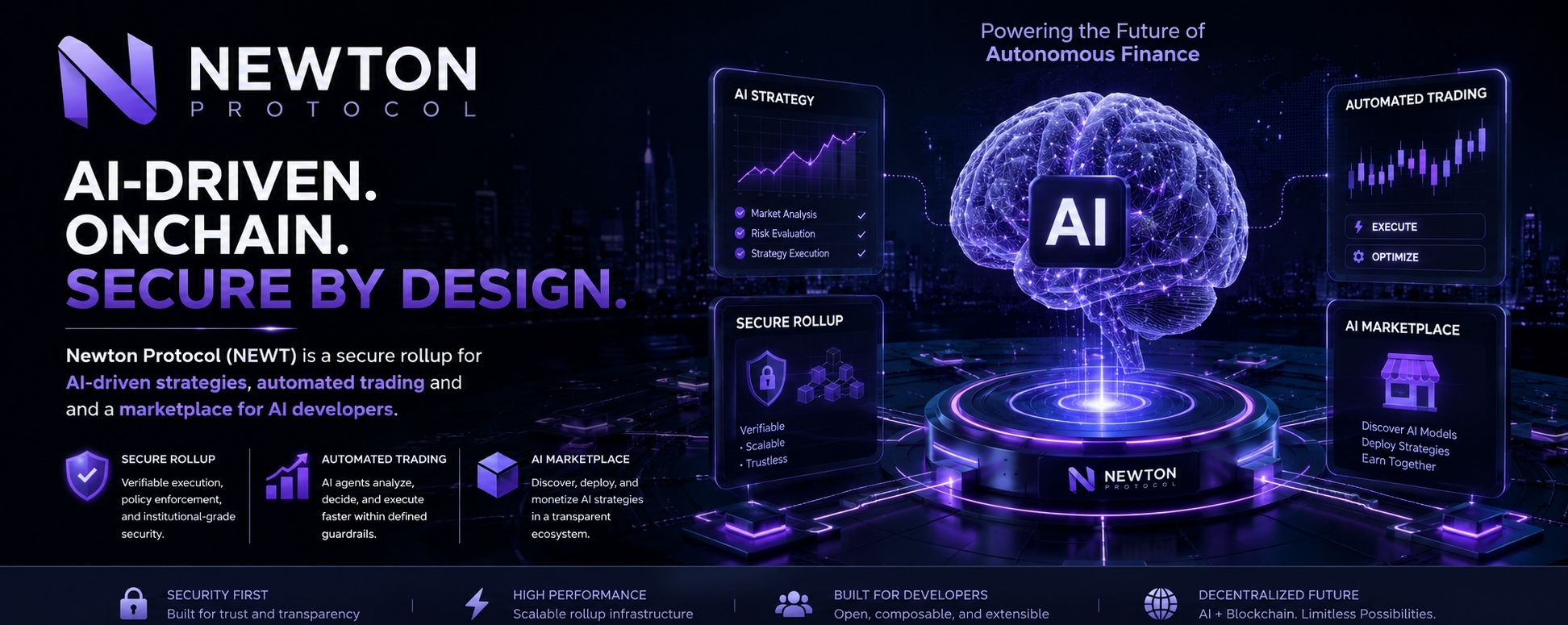
Artificial intelligence is rapidly expanding beyond analysis and decision support into systems capable of executing real financial actions. As automation becomes more sophisticated, the challenge is no longer simply creating smarter algorithms.it is ensuring those algorithms operate within transparent, verifiable, and secure boundaries. Newton Protocol ($NEWT ) is designed around this critical shift, introducing a secure rollup architecture that aims to make AI-driven execution more trustworthy while supporting automated trading and a marketplace for AI developers.
Traditional blockchain applications rely on users to authorize every important action. AI-powered systems, however, introduce a different reality where software agents may need to react instantly to changing market conditions, rebalance portfolios, execute complex strategies, or coordinate multiple onchain operations without constant human intervention. While this creates significant opportunities for efficiency, it also raises important questions about security, accountability, and governance. Newton Protocol seeks to address these concerns by embedding programmable authorization and verifiable execution into the infrastructure itself rather than treating them as optional application features.
At the heart of the protocol is the concept of a secure rollup optimized for autonomous financial activity. Instead of focusing solely on transaction throughput, Newton Protocol emphasizes confidence in execution. Every automated action can be evaluated against predefined rules before it reaches the blockchain, helping ensure that AI systems remain aligned with user-defined permissions and operational limits. This model introduces an additional layer of protection that becomes increasingly valuable as autonomous agents gain greater control over digital assets.
Automated trading represents one of the most immediate use cases for this approach. Financial markets move continuously, often creating opportunities that disappear within seconds. AI systems are capable of monitoring vast amounts of market data and responding far faster than manual traders, but speed alone is not enough. Without clearly enforced safeguards, automated execution can expose users to unintended risks. Newton Protocol aims to combine rapid decision-making with verifiable policy enforcement, allowing automation to operate within carefully defined boundaries rather than unrestricted authority. #NEWT
Another important component of the ecosystem is its marketplace for AI developers. Instead of building isolated applications with limited interoperability, developers can contribute specialized AI strategies, tools, and services that integrate into a shared environment. This encourages innovation while providing a framework where users can discover, evaluate, and deploy AI-powered solutions with greater confidence. A structured marketplace also creates opportunities for collaboration, enabling developers to focus on improving intelligence while relying on standardized infrastructure for secure execution. #newt
Transparency is a defining principle throughout the protocol's design. Blockchain technology has always promised verifiable records, but autonomous AI introduces additional complexity because decisions may occur before transactions are submitted onchain. Newton Protocol attempts to bridge this gap by making execution policies transparent and auditable, allowing users to understand not only what actions occurred but also why those actions were permitted. This level of accountability may become increasingly important as decentralized finance evolves toward more autonomous systems. $BOS
The protocol also reflects a broader evolution in blockchain infrastructure. Early decentralized applications primarily focused on transferring assets between users. Today's emerging ecosystem increasingly revolves around intelligent software capable of managing assets, coordinating workflows, and adapting to real-time information. Infrastructure built specifically for AI-driven execution acknowledges that future blockchain activity may involve autonomous agents interacting with one another as frequently as humans interact with decentralized applications today. $RE
Security remains the defining factor separating experimental automation from production-ready financial infrastructure. The more authority delegated to AI, the greater the need for deterministic controls, policy validation, and transparent oversight. Newton Protocol positions these requirements as foundational design principles rather than optional enhancements, recognizing that trust must extend beyond transaction validation to include the decision-making processes that initiate those transactions.
As artificial intelligence and decentralized technologies continue to converge, protocols capable of balancing automation with accountability may play an increasingly significant role in the next generation of digital finance. Newton Protocol represents an effort to move beyond simple automation by building infrastructure where intelligent systems can operate responsibly, verifiably, and securely. If successful, this approach could help establish a stronger foundation for autonomous applications, allowing AI to become a practical participant in blockchain ecosystems without compromising the transparency and security that define decentralized networks.