
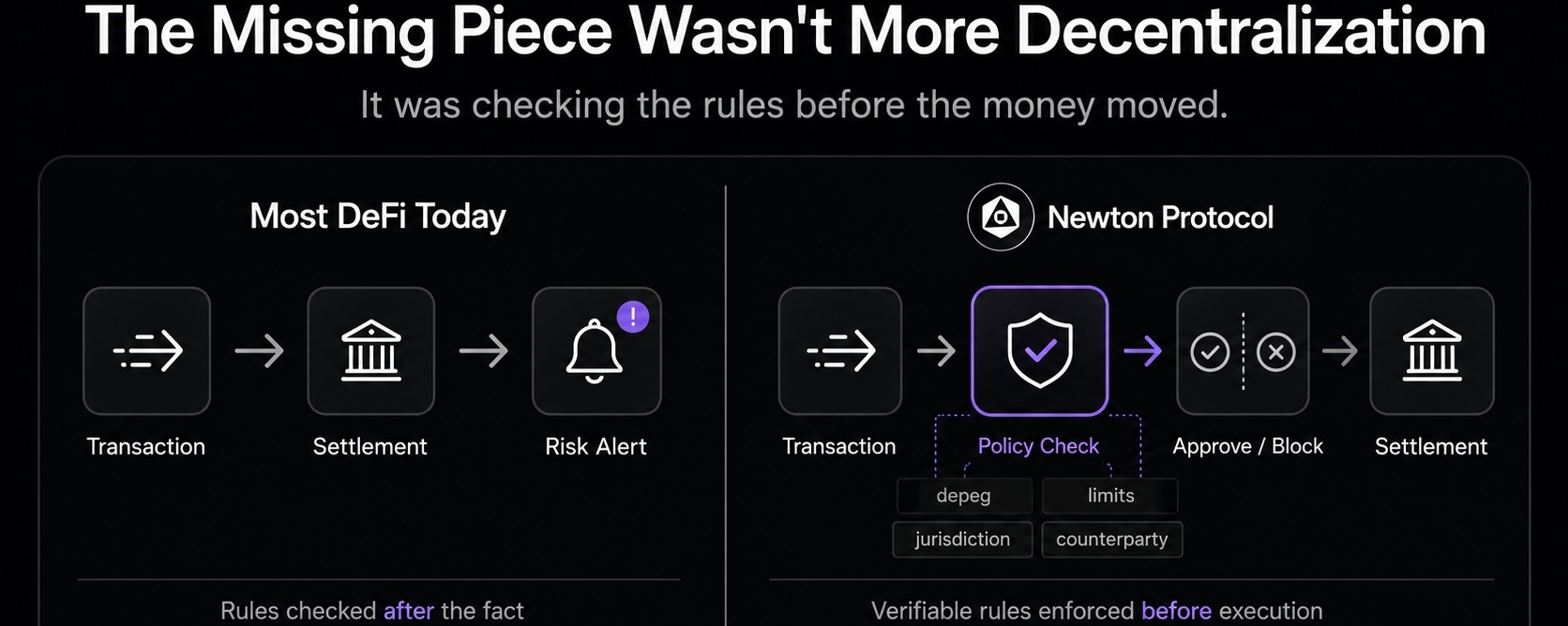

A few months back I moved a chunk of stablecoins into a vault strategy that looked clean on paper audited contract, reasonable APY, nothing exotic. Then the depeg scare hit one of the underlying assets, and I watched my funds sit there for a few hours with zero recourse. Not because the contract was hacked. Because nothing in the system was designed to check *before* the transaction settled whether the conditions I actually cared about exposure limits, counterparty risk, that specific depeg trigger were still true. By the time anyone could react, the trade had already gone through.
That sat with me longer than I expected. I kept assuming the fix was "better risk dashboards" or "faster alerts." It wasn't until I started digging into Newton Protocol that I realized I'd been framing the problem wrong.
Newton bills itself as an authorization layer for onchain transactions it evaluates policies (identity checks, jurisdictional rules, spending limits, vault-risk triggers like depegs or concentration limits) *before* a transaction executes, not after. Built by Magic Labs, the team behind the embedded wallet used across a lot of consumer crypto apps, it runs policy checks through a decentralized operator network secured with EigenLayer restaking, and every decision produces a signed onchain receipt anyone can verify.
My first instinct, honestly, was skepticism. "Compliance layer for DeFi" sounds like exactly the kind of thing that reintroduces gatekeepers into a system that was supposed to remove them. That's the common read I keep seeingpeople treat Newton as a KYC bolt-on, something institutions need and degens can ignore. A regression toward TradFi wearing a zero-knowledge costume.
But here's the part that made me stop and reconsider: the assumption that DeFi's core value proposition is *removing intermediaries* might be slightly off. What actually keeps serious capital and honestly, what would've saved me in that vault situation isn't the absence of rules, it's the ability to *prove* rules were enforced without trusting a single company to enforce them. That's a different axis entirely. Permissionless versus permissioned is one debate. Verifiable versus opaque is a completely separate one, and I think Newton is playing on the second axis while everyone's still arguing about the first.
Think about how card networks actually work not the myth of them, the mechanics. Visa doesn't care who you are philosophically; it runs a rules engine before the payment settles and produces a record either side can point to later. Nobody calls that "centralizing" payments. It's just the layer that lets millions of untrusted parties transact without individually vetting each other. Newton's pitch is basically that DeFi never really had that layer enforcement always happened after the fact, via audits, post-mortems, and Twitter threads dissecting exploits. Pre-transaction, programmable, decentralized enforcement is a genuinely different category from "add compliance."
I'll admit I'm not fully sold on the execution yet. The policies are written in Rego, which is expressive but not exactly something the average protocol team is fluent in, so a lot depends on how good the prebuilt template library actually gets. And there's a real question of whether a network of operators checking transactions before settlement becomes a new kind of chokepoint under different branding decentralized doesn't automatically mean uncapturable, and I haven't seen enough live stress-testing to know how it behaves during actual chaos, not just clean demo conditions. The NEWT token's utility is tied to fees and staking on a network that's still early, so usage growth matters more than the token narrative does.
What I keep coming back to, though, is that my vault problem wasn't a decentralization problem. It was a "nobody checked before the money moved" problem. If that framing holds up, the interesting question isn't whether Newton makes DeFi more compliant it's whether "trustless" was ever really the goal, or whether "verifiable" was the thing we wanted the whole time and just didn't have good words for.