
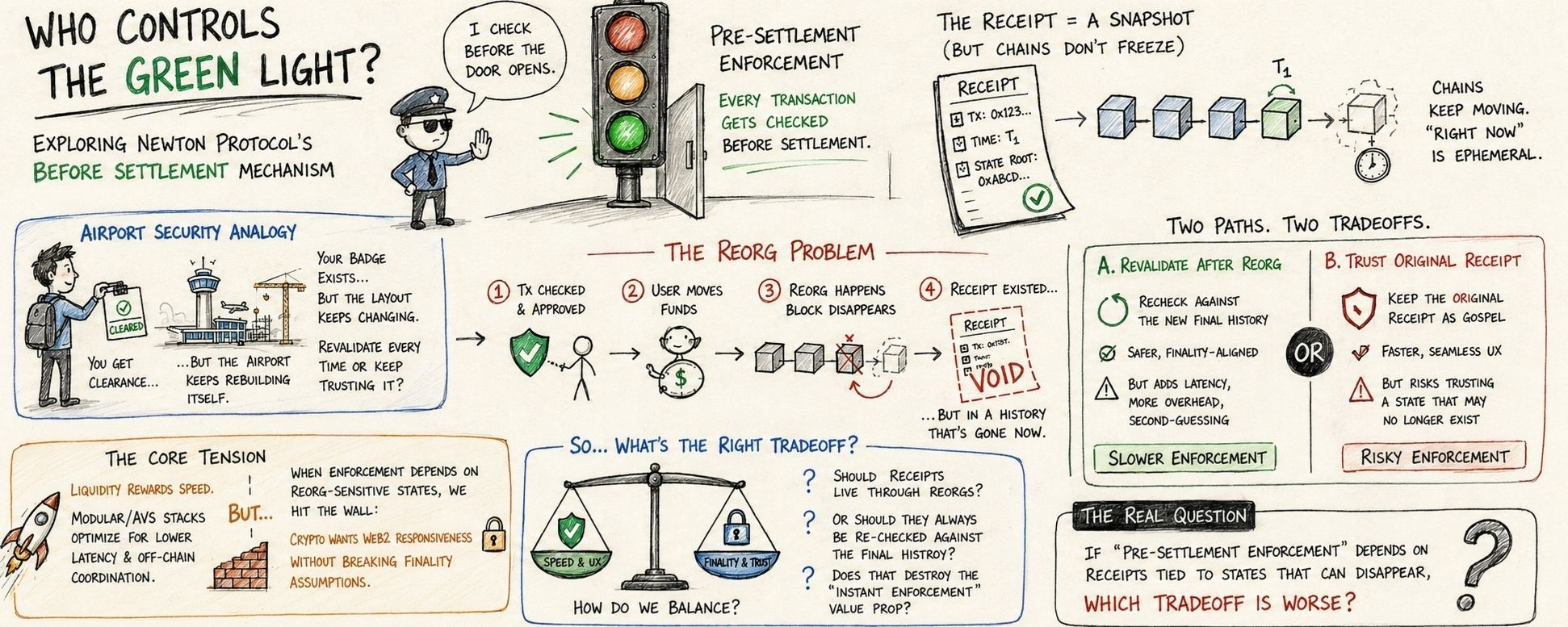

I went through Newton Protocol’s “before settlement” mechanism and ended up on the part people usually avoid talking about.
So here’s what kind of stuck with me:
Newton keeps saying every transaction gets checked *before* settlement. Imagine a guard standing right before the door swings open. I get that. Makes sense on paper.
But then there’s the “receipt” each check produces—a snapshot of the chain at a specific moment… except, obviously, chains don’t really freeze.
Honestly, this might be the real direction the modular/AVS narrative is drifting toward now. The sector just keeps chasing faster execution and off-chain coordination because liquidity basically rewards speed. But the second enforcement depends on chain states that can still reorganize underneath you, the industry runs straight into the same wall: crypto wants Web2 responsiveness without weakening finality assumptions.
Here’s where I started spiraling: in real-world chains, “right now” is ephemeral. A reorg can just wipe the block your approval depended on, along with whatever state it was tied to. Wild.
So what happens to the receipt? Say a transaction gets approved, the user moves funds, then a reorg wipes out the block that approval came from. The receipt existed… but only in a version of history that’s gone now.
Okay, let’s get weird—I’m picturing airport security. You get clearance, but the airport keeps rebuilding itself. Your badge still exists—but everything it depends on keeps changing. So do you revalidate every time, or keep trusting something tied to a layout that no longer exists?
That’s the part I can’t really shake.
Here’s my hot take, and I wish more folks tossed this around: If Newton’s big promise is “enforce before settlement,” the real debate isn’t just about security. It’s about *what* you’re anchoring that enforcement to. When the chain rearranges itself, does Newton flush all those receipts and re-validate, adding lag and second-guessing? Or does it just trust the original receipt like gospel—even if that state is already kind of dead? Because those are two totally different tradeoffs.
If receipts are revalidated after reorgs, enforcement slows. If they aren’t, you’re trusting approvals tied to states that may no longer exist. Neither outcome feels clean.
Enforcement speed and state-finality confidence feel like they move in opposite directions when chains get unstable.
So, chime in: If you want “pre-settlement enforcement,” do you want those receipts to live through chain reorgs, or should they always get re-checked against whatever ends up being the “final” history? Or does that just nuke the whole “instant enforcement” value prop Newton’s selling?
The modular/AVS stack is converging toward lower latency because liquidity rewards speed, but once enforcement depends on reorg-sensitive states, it hits a constraint: crypto wants Web2 responsiveness without breaking finality assumptions.
Because if “pre-settlement enforcement” depends on receipts tied to states that can just disappear, I still don’t really know which tradeoff is worse.