
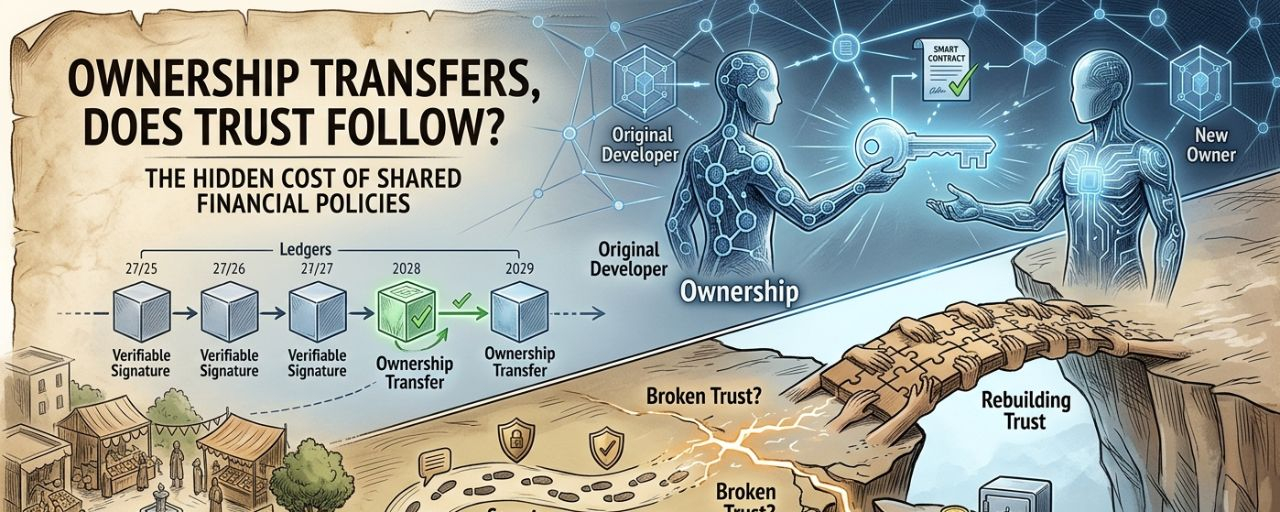

For a long time, I assumed ownership and trust naturally moved together.
If a piece of infrastructure changed hands without breaking, I expected users to keep relying on it. The software still worked. The interfaces stayed the same. The documentation remained available. From a technical perspective, nothing important had changed.
Lately, I'm not so sure.
While reading about Newton Protocol, I found myself paying attention to something I hadn't expected.
The protocol allows developers to publish reusable policies that other applications can adopt. Policy ownership can also change over time. A Policy Client can be updated, ownership transferred, and configurations migrated as systems evolve.
Technically, that makes perfect sense.
Real infrastructure needs continuity. Teams change. Companies are acquired. Contributors leave. Long-lived systems need ways to survive beyond their original creators.
Newton appears to recognize that reality.
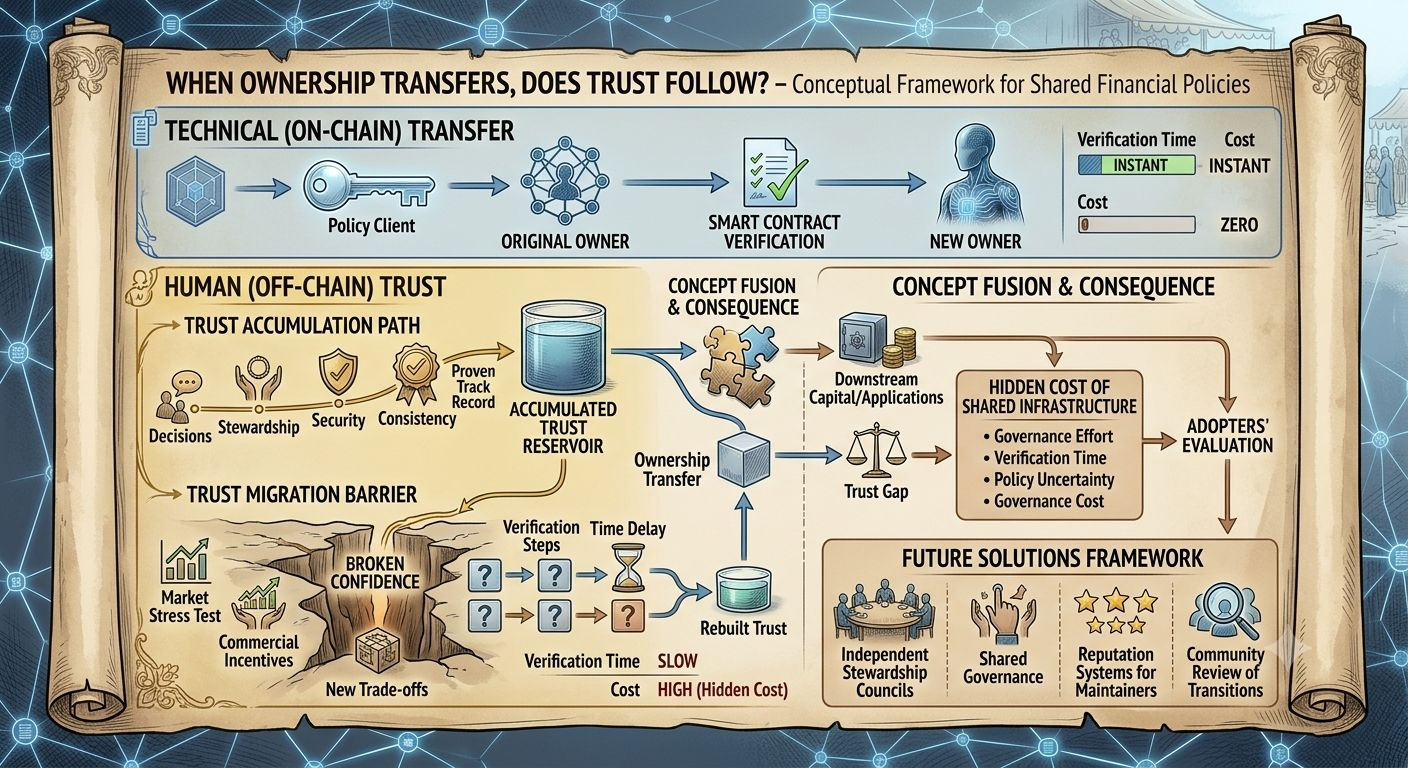
What caught my attention wasn't the transfer itself.
It was everything the transfer doesn't automatically move.
Ownership is recorded onchain.
Trust isn't.
That distinction feels small until you imagine what success actually looks like.
Suppose one financial policy becomes widely adopted.
Not because anyone is forced to use it, but because years of reliable behavior convince developers that it consistently protects capital under difficult conditions.
Vaults integrate it.
Treasuries depend on it.
AI agents execute within its boundaries.
Institutions become comfortable relying on it.
Eventually, the policy becomes less like an individual project and more like shared infrastructure.
Then one day, ownership changes.
Maybe the original developer sells the company.
Maybe the founding team moves on.
Maybe maintenance is handed to another organization.
The blockchain can record that transition perfectly.
Every signature can verify it.
Every registry entry can reflect the new owner.
Nothing about the technical system is broken.
But an uncomfortable question quietly appears.
Did trust transfer too?
I'm not convinced that it does.
History suggests otherwise.
Open-source software has taught us that code and credibility are related, but they are not identical.
Developers rarely trust a critical dependency simply because it has an active maintainer.
They trust it because that maintainer has earned confidence over years of careful decisions, transparent communication, and responsible stewardship.
Those qualities cannot be transferred with a transaction.
They have to be rebuilt.
Financial policies may prove even more demanding.
Unlike a software library, a policy doesn't simply determine whether an application functions correctly.
It helps determine whether money is allowed to move.
If a trusted policy changes ownership, developers may naturally begin asking questions that no smart contract can answer.
Will the new team make the same trade-offs?
Will updates remain equally conservative during periods of market stress?
Will commercial incentives eventually reshape decisions that users previously trusted?
None of those questions have cryptographic proofs.
They belong to human judgment.
That observation changed how I think about reusable financial infrastructure.
Much of blockchain innovation has focused on removing the need to trust individual people.
Consensus reduces dependence on validators.
Smart contracts reduce dependence on intermediaries.
Cryptographic proofs reduce dependence on promises.
Newton extends that philosophy into authorization by making financial policies verifiable before execution.
That's an important step forward.
Yet verification has natural limits.
A protocol can prove who currently owns a policy.
It cannot prove whether the market should grant that owner the same confidence accumulated by their predecessor.
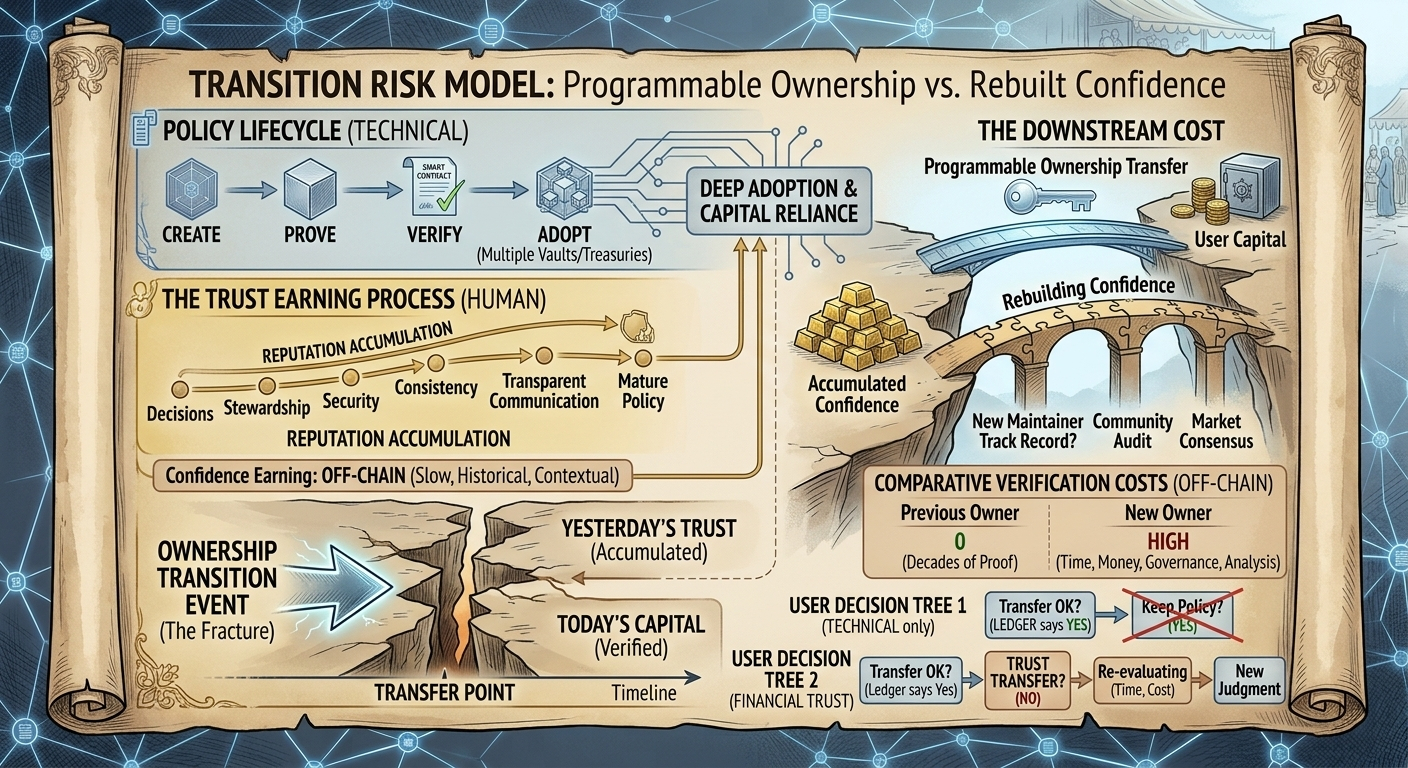
Trust remains something communities build gradually rather than something protocols migrate automatically.
Ironically, success may make this question more important, not less.
If only a handful of applications share policies, ownership changes affect relatively few participants.
But if reusable financial policies become common infrastructure, a single transfer could influence hundreds of independent systems built on top of years of accumulated confidence.
At that point, continuity becomes more than a technical problem.
It becomes an economic one.
Every ownership transfer may force downstream adopters to spend time, money, and governance effort deciding whether yesterday's trust still deserves today's capital. These verification costs never appear onchain, yet they become a real, recurring expense of maintaining confidence across shared financial infrastructure.
The blockchain can transfer control instantly.
But it cannot transfer confidence without cost.
Perhaps future ecosystems will develop new ways to address it.
Independent stewardship councils.
Shared governance.
Reputation systems for policy maintainers.
Community review before major ownership transitions.
I don't know which approach, if any, will become standard.
What I do suspect is that programmable ownership may arrive before programmable trust.
Those are different achievements.
One belongs to protocol design.
The other belongs to human behavior.
The more I study Newton Protocol, the less I think its most interesting contribution is simply making authorization programmable.
It may also force us to confront a question that software has wrestled with for decades, but finance has rarely needed to ask at this scale.
When the infrastructure everyone depends on changes hands...
who pays the cost of deciding whether it still deserves the same trust?