
I still remember the feeling of watching one promising crypto narrative replace another almost overnight. One month it was smart contracts. Then NFTs dominated every conversation. After that came DeFi, GameFi, Layer 2 networks, restaking, modular blockchains, and now artificial intelligence. Every cycle introduces a new story that seems impossible to ignore.
After spending years following this industry, I’ve learned that the loudest narratives rarely tell the whole story. Markets reward attention in the short term, but infrastructure quietly shapes the long term. That’s why I’ve become more interested in the systems underneath the headlines than the excitement surrounding them.
That shift in perspective is what led me to spend time studying Newton Protocol (NEWT). Rather than asking whether it could become the next popular token, I found myself asking a different question: if AI agents eventually become active participants in digital economies, what kind of blockchain infrastructure would they actually need?
That question feels much more interesting than any discussion about market prices.
The conversation around artificial intelligence has expanded far beyond chatbots and content generation. Today, developers are experimenting with autonomous software capable of researching markets, executing trades, managing treasury operations, coordinating workflows, and interacting with decentralized applications without constant human supervision.
Whether these systems eventually fulfill their potential remains uncertain.
What seems increasingly likely, however, is that automation will become a larger part of digital finance. If that happens, blockchain networks designed primarily around human users may need additional infrastructure to support autonomous agents safely.
This appears to be the problem Newton Protocol is attempting to address.
Instead of positioning itself as another AI application, Newton focuses on creating an environment where AI-driven strategies can operate with stronger security guarantees, transparent execution, and verifiable accountability.
That distinction matters.
Many projects combine AI and blockchain simply by attaching the two concepts together. Newton’s design appears to begin with a practical question: how can autonomous software interact with financial infrastructure without asking users to trust invisible decision-making?
Trust has always been one of cryptocurrency’s central themes.
Bitcoin reduced reliance on centralized monetary authorities.
Ethereum extended that idea to programmable agreements.
Decentralized finance attempted to replace financial intermediaries with transparent code.
The emergence of AI introduces a new layer of complexity.
Even when AI systems perform well, they often function as black boxes. Users may see outputs without fully understanding how decisions were produced. That uncertainty creates friction, especially when financial assets are involved.
Blockchain technology offers transparency, while AI often introduces opacity.
Bringing these two technologies together requires balancing those opposing characteristics rather than pretending they naturally complement one another.
This is where Newton’s architectural direction becomes interesting.
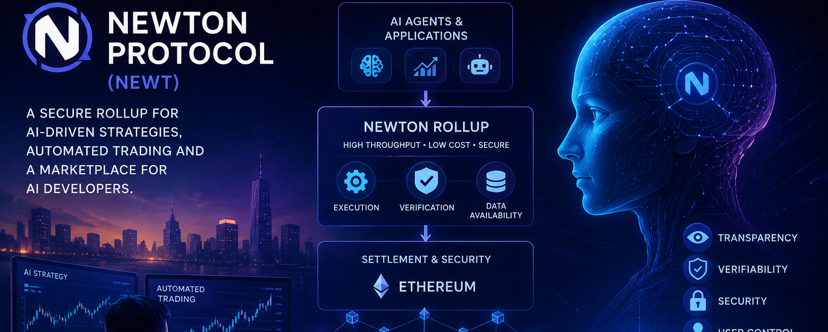
The protocol aims to establish a secure rollup specifically designed for AI-driven strategies, automated execution, and a marketplace where developers can deploy AI agents within an accountable framework.
Instead of asking users to trust algorithms blindly, the infrastructure attempts to create mechanisms that allow important actions to remain observable and verifiable.
That may sound like a subtle distinction, but infrastructure decisions often determine whether a protocol remains useful long after initial excitement fades.
Rollups themselves are not new.
They have become one of the most widely discussed scaling approaches within Ethereum because they process activity more efficiently while relying on Ethereum’s security for settlement.
Rather than every transaction competing for limited block space directly on the main chain, rollups bundle activity together before submitting verified results.
For ordinary users, that generally means lower costs and higher throughput.
For autonomous AI systems, those improvements become even more significant.
An AI agent might perform dozens or even hundreds of operations that would be impractical if every action carried high transaction costs or long confirmation times.
Infrastructure designed around efficient execution therefore becomes more than a convenience—it becomes a practical requirement.
Yet scalability alone isn’t enough.
An efficient system that lacks transparency merely shifts risk elsewhere.
This is why Newton’s emphasis on secure execution deserves attention.
When people hear “AI trading,” many imagine software making investment decisions automatically.
That certainly represents one possible application.
But autonomous agents could eventually perform many different tasks beyond speculation.
They might monitor decentralized lending positions.
They could rebalance treasury allocations.
They might optimize liquidity provisioning.
They could automate DAO operations.
Some may coordinate supply chains or manage digital identities.
Others might interact with decentralized marketplaces in ways that reduce repetitive manual work.
Each of these activities involves trust.
Not necessarily trust in the AI’s intelligence, but trust that the surrounding infrastructure accurately records actions, enforces permissions, and prevents unauthorized behavior.
This distinction is easy to overlook.
People often focus on whether AI can make good decisions.
Equally important is whether those decisions occur inside systems with clear rules and transparent accountability.
Newton appears to prioritize that second challenge.
One aspect I appreciate is that the protocol doesn’t seem to assume artificial intelligence automatically deserves authority.
Instead, it recognizes that autonomous systems require boundaries.
In traditional finance, regulations, audits, and institutional oversight create those boundaries.
In decentralized systems, smart contracts, cryptographic verification, and transparent execution increasingly serve similar purposes.
Neither approach eliminates risk entirely.
Both attempt to reduce uncertainty through different mechanisms.
The marketplace component of Newton also caught my attention.
If AI development continues expanding, developers will likely need environments where autonomous agents can be deployed, discovered, evaluated, and integrated into broader applications.
Creating such marketplaces introduces interesting opportunities.
Developers gain distribution.
Users gain access to specialized tools.
Communities may contribute improvements over time.
Yet marketplaces also introduce difficult governance questions.
How should quality be evaluated?
How should malicious behavior be detected?
Who determines acceptable standards?
Can reputation systems remain resistant to manipulation?
These questions extend beyond Newton.
Every decentralized ecosystem eventually encounters similar challenges.
Technology provides infrastructure, but governance determines how communities navigate inevitable disagreements.
That leads into another consideration that I think deserves more discussion: transparency.
Transparency is frequently advertised across crypto projects, but genuine transparency requires more than open-source repositories or public dashboards.
It involves making system behavior understandable.
Users should know what an AI agent can do.
They should understand permission boundaries.
They should be able to verify important actions independently.
Most importantly, transparency should reduce reliance on assumptions.
This remains one of blockchain’s greatest strengths.
Data recorded on-chain becomes independently verifiable rather than dependent on institutional promises.
Integrating AI into that environment doesn’t automatically create trust, but it does create opportunities for stronger accountability than traditional closed software systems.
Still, challenges remain.
AI models evolve rapidly.
Blockchain infrastructure evolves more slowly.
Balancing flexibility with security is unlikely to be straightforward.
Systems designed today may require substantial adaptation as AI capabilities improve.
Protocols that remain overly rigid risk becoming obsolete.
Protocols that prioritize flexibility excessively may compromise security.
Finding the right balance is rarely easy.
Another issue worth considering involves incentives.
Crypto networks succeed when participant incentives remain reasonably aligned.
Validators secure networks because they receive rewards.
Developers build applications because ecosystems create opportunities.
Users contribute liquidity because incentives encourage participation.
Introducing AI agents adds another participant category.
How should autonomous software be rewarded?
How should poorly performing agents lose credibility?
What happens when optimization objectives conflict with broader community interests?
These questions become increasingly important as automation expands.
One lesson history repeatedly teaches is that incentives often matter more than intentions.
Well-designed systems acknowledge this reality rather than assuming participants will always behave responsibly.
Newton’s long-term relevance may depend less on technical sophistication alone and more on how effectively it aligns incentives across developers, users, validators, and autonomous agents.
Security naturally remains another major consideration.
Every blockchain ultimately confronts adversarial environments.
Attackers continuously search for weaknesses.
Financial incentives encourage exploitation whenever vulnerabilities appear.
Adding AI introduces additional attack surfaces.
Prompt manipulation.
Model exploitation.
Malicious automation.
Unexpected behavioral loops.
None of these risks necessarily invalidate the broader vision.
They simply reinforce why infrastructure deserves careful engineering instead of optimistic assumptions.
One encouraging aspect is that Newton’s focus appears centered on secure environments rather than unrestricted autonomy.
That approach feels more realistic.
Technology generally matures through gradual expansion of trust rather than immediate decentralization of every decision.
Real-world adoption raises another interesting dimension.
Many blockchain discussions remain confined within crypto communities.
Yet automation increasingly extends into businesses, financial services, logistics, research, and enterprise operations.
If AI agents eventually interact across these sectors, infrastructure capable of providing verifiable execution could become valuable beyond cryptocurrency itself.
Whether Newton reaches that point remains uncertain.
Infrastructure projects often require years before their significance becomes fully visible.
Ethereum itself was underestimated during its earliest years because many observers focused primarily on immediate applications instead of long-term programmability.
That historical lesson doesn’t guarantee Newton’s success.
It simply reminds me that infrastructure frequently compounds value slowly.
Another reason I find Newton interesting is that it addresses coordination rather than individual applications.
Applications inevitably change.
New trends emerge.
Consumer preferences shift.
Underlying infrastructure tends to persist longer.
Roads remain useful regardless of which vehicles become popular.
Internet protocols survived countless website trends.
Likewise, blockchain infrastructure may ultimately matter more than today’s most fashionable decentralized applications.
If AI becomes deeply integrated into decentralized finance, reliable coordination layers may prove more important than individual algorithms.
Of course, none of this removes execution risk.
Building infrastructure is exceptionally difficult.
Developer adoption cannot be assumed.
Competing protocols continue innovating rapidly.
Regulatory landscapes remain uncertain across multiple jurisdictions.
User expectations evolve constantly.
Technical excellence alone rarely guarantees network effects.
Communities matter.
Developer ecosystems matter.
Documentation matters.
Tooling matters.
Interoperability matters.
These less glamorous factors frequently determine long-term adoption.
One aspect I appreciate after observing several market cycles is that genuine progress often looks surprisingly ordinary.
The biggest technological advances usually arrive gradually.
People notice them only after they become dependable.
Speculation tends to focus attention on dramatic announcements.
Infrastructure rewards consistency instead.
Newton seems positioned closer to the second category than the first.
Whether that ultimately becomes an advantage remains impossible to know today.
Another thought continues returning as I examine projects connecting AI and blockchain.
The future probably won’t belong to either technology independently.
Artificial intelligence excels at generating decisions, predictions, and adaptive behavior.
Blockchains excel at recording state, enforcing rules, and establishing verifiable ownership.
Neither replaces the other.
Instead, they appear complementary under the right circumstances.
AI may determine what should happen.
Blockchain may verify that it happened according to transparent rules.
If that relationship develops responsibly, it could create systems combining automation with accountability rather than sacrificing one for the other.
Still, responsible skepticism remains healthy.
Crypto history contains countless examples where ambitious visions exceeded practical implementation.
Investors, developers, and researchers alike benefit from separating architectural potential from proven adoption.
At this stage, I view Newton primarily as an infrastructure experiment worth watching rather than a certainty.
That perspective keeps expectations grounded while remaining open to future progress.
Perhaps the most meaningful takeaway isn’t Newton itself but the broader direction it represents.
As autonomous software becomes increasingly capable, society will inevitably confront difficult questions about delegation.
How much decision-making should machines control?
How should responsibility be assigned?
How can transparency coexist with increasingly complex algorithms?
Blockchain alone cannot answer those questions.
Neither can artificial intelligence.
But carefully designed infrastructure may help create environments where those conversations become more practical rather than purely theoretical.
Looking back over multiple crypto cycles, I’ve become less interested in predicting winners and more interested in understanding the problems different protocols attempt to solve.
Some ideas disappear because the problems never truly existed.
Others survive because they quietly address needs that become increasingly obvious over time.
Newton Protocol sits within that second category of questions for me.
Not because success is guaranteed, but because the challenge it addresses feels increasingly relevant.
If autonomous AI systems eventually become participants in decentralized economies, they will require infrastructure built around transparency, security, accountability, and verifiable execution rather than blind trust.
Whether Newton ultimately becomes a leading solution remains uncertain.
The future will depend on execution, developer adoption, governance, security, and the ability to evolve alongside rapidly changing AI technology.
For now, what interests me most isn’t the token or the market narrative.
It’s the underlying idea that as software grows more autonomous, trust cannot become less important—it must become more carefully engineered.
Perhaps that’s the real question worth considering.
As artificial intelligence takes on greater responsibility and blockchain continues redefining digital trust, what kind of infrastructure will allow humans to remain confident in systems they no longer operate directly? And when automation becomes ordinary rather than exceptional, will transparency become a competitive advantage—or simply the minimum expectation we all demand?