

Newton became more interesting to me when I stopped looking at it like a normal new protocol trying to find users.
Most new crypto infrastructure has the same early problem.
The idea may be strong.
The mechanism may be useful.
The docs may be clean.
The token may get attention.
But the protocol still has to answer one hard question:
How does it reach the places where real transactions begin?
That is why Magic Labs matters for @NewtonProtocol .
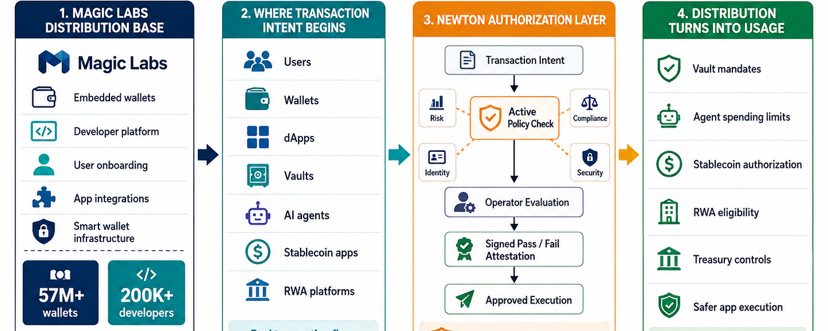
Newton is not starting from a silent corner of crypto. Its core developer is Magic Labs, a team already connected to wallet infrastructure, developers, embedded wallets, and user onboarding. The numbers around Magic are not small either: 57M+ wallets and 200K+ developers.
For me, those numbers are not just campaign decoration.
They explain why Newton may have a stronger starting path than many cold-start infrastructure projects.
Newton’s core idea is pre-settlement authorization. Before a transaction executes, it can be checked against an active policy. That policy can decide whether the action is allowed, whether it violates a rule, whether it should move forward, or whether it should be blocked before capital moves.
That is the mechanism.
But a mechanism alone does not win.
It needs distribution.
A policy layer only matters if builders actually place it near real transaction flow. It has to reach wallets, vaults, agents, stablecoins, RWAs, and apps before users and systems send actions onchain.
That is where Magic Labs becomes important.
Magic already sits near the place where crypto becomes usable for normal apps. It is not only a name attached to Newton. It gives Newton a route into the developer and wallet layer, which is exactly where transaction intent is formed.
This is the part many people underrate.
Newton is not trying to be a destination app where users go manually every day. The better version of Newton is infrastructure that quietly appears inside the transaction journey.
A user wants to move funds.
A vault wants to rebalance.
An agent wants to spend.
A stablecoin flow wants to transfer.
An RWA platform wants to check eligibility.
Before that action becomes final, Newton can help ask: does this action pass the rule?
That kind of product does not spread only through hype. It spreads through integration.
And integrations depend on developers.
This is why the 200K+ developer base matters more than a simple marketing number. Developers are the people who decide whether a policy check becomes part of an app, wallet, vault, or smart account. If Newton can reach builders through Magic’s existing developer ecosystem, it does not have to explain itself from zero every time.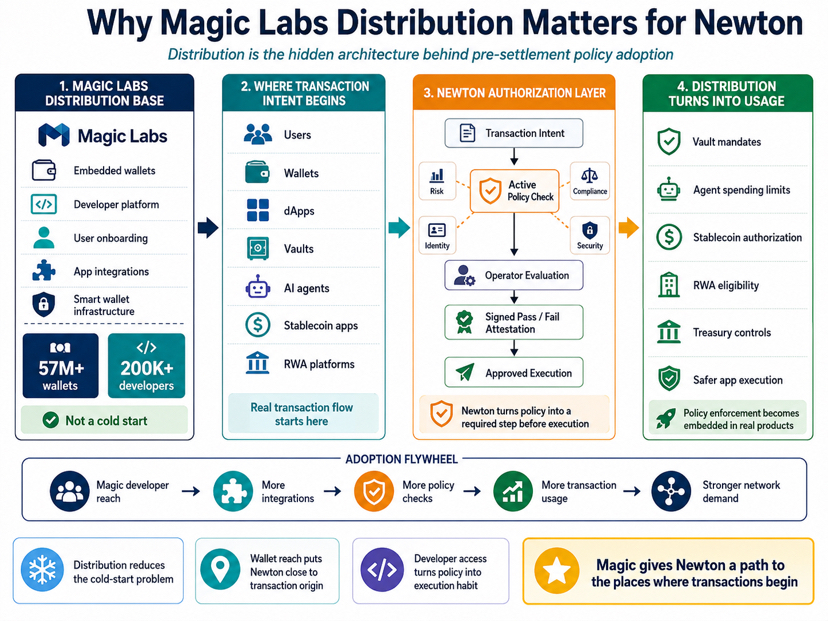
It can enter where builders are already working.
That changes the adoption story.
A cold-start protocol has to build awareness, trust, tooling, examples, integrations, and user confidence all at once. That is difficult. Many technically strong projects fail because they live too far away from real builder behavior.
Newton has a better route because Magic already has developer trust in the wallet layer.
That does not guarantee success, but it removes one of the biggest early frictions.
The strongest infrastructure usually wins when it becomes easy to adopt before people fully realize they are depending on it.
That is what Newton needs.
Not only attention.
Habit.
Developers should not have to treat policy enforcement like a separate world. They should be able to bring it into the normal transaction flow. That is the real distribution advantage Magic can give.
I see it like this:
Magic helped make wallet access easier.
Newton can help make wallet action safer.
One brings users into onchain apps.
The other helps decide what those users, apps, agents, or vaults are allowed to do before execution.
That is a natural next step.
Because the next phase of crypto is not only about onboarding more wallets. We already have millions of wallets across the industry. The harder question is what those wallets can safely do when they start controlling more value, more automation, and more complex financial actions.
A basic wallet can send a transaction.
A smarter transaction environment needs rules.
Spending limits.
Risk limits.
Eligibility checks.
Counterparty controls.
Vault mandates.
Agent permissions.
Stablecoin restrictions.
RWA compliance conditions.
These are not “nice extras” once capital becomes serious. They become part of the product.
This is where Newton’s position makes sense.
Newton is not just building another layer around DeFi. It is trying to make policy enforcement available before settlement. If Magic can help put that capability closer to wallets and developers, Newton gets a much stronger path to real usage.
The wallet layer is especially important because it is where intent begins.
A transaction does not start at a block explorer. It does not start at a post-mortem. It does not start when a dashboard alerts someone. It starts when a user, app, vault, or automated system decides to act.
That first decision is the valuable point.
Newton wants to be near that point.
If the policy check happens too late, it becomes monitoring.
If the policy check happens before execution, it becomes authorization.
This is why distribution is not separate from the product. Distribution decides whether Newton can appear at the right moment.
Magic gives Newton access to the right moment.
Not every app will need Newton. Not every transaction needs policy enforcement. But the high-value categories do.
Vaults need rules around where capital can move.
Agents need boundaries before they spend.
Stablecoins need authorization logic in sensitive flows.
RWAs need eligibility checks before transfer.
Treasuries need spending controls.
Apps handling user funds need safer execution paths.
These are not random use cases. They are the exact places where crypto is becoming less about simple transactions and more about controlled financial activity.
Newton’s opportunity is to become the policy layer those systems call before action.
Magic’s opportunity is to help Newton reach the builders creating those systems.
That is why this partnership angle is strong.
It is not only “Magic has many wallets.”
It is that Magic’s wallet and developer base gives Newton a path toward becoming embedded infrastructure.
There is a big difference between a protocol being seen and a protocol being embedded.
Being seen creates impressions.
Being embedded creates dependency.
For $NEWT, the second one matters more.
If Newton becomes part of real app flows, the story moves beyond speculation. The token narrative becomes tied to whether policy enforcement creates actual network demand. More policy checks, more operator work, more app integrations, more developer usage, more enforcement activity.
That is the serious version.
A lot of projects can create short-term mindshare. Fewer projects can create repeat usage inside transaction infrastructure.
Newton’s advantage is that it is not trying to build that path alone.
Magic gives it a distribution base that many infrastructure protocols would want badly: existing developers, wallet experience, embedded onboarding, and proximity to app-level transaction flow.
This is why I would not judge Newton only by social attention.
I would watch builder adoption.
How many developers test Newton policy flows?
How many vault teams use policy checks before rebalancing?
How many agent products add permission rules?
How many smart wallet experiences bring authorization into the user journey?
How many stablecoin or RWA apps treat policy approval as part of execution?
Those are the metrics that matter.
Because if Newton’s policy layer stays outside developer habits, it remains a good idea.
If it enters developer habits, it can become infrastructure.
That is the difference Magic Labs can help create.
The cleanest way I can explain it is this:
Newton has the control layer.
Magic has the route to the places where control is needed.
That combination matters.
A policy engine without distribution is like a rulebook with no one using it.
A wallet network without stronger authorization leaves users and apps exposed as activity gets more complex.
Together, they point toward a better transaction model: easier access, but with stronger rules before execution.
That is the part I find important.
Crypto spent years making transactions possible.
Now the next step is making transactions more controlled without making the user experience worse.
Newton’s policy layer can help with the control.
Magic’s developer and wallet reach can help with the experience.
This is why I see the 57M+ wallets and 200K+ developers as more than big numbers. They show that Newton is not trying to push a new authorization idea into an empty market. It is being built by a team already connected to the wallet and developer surface where onchain behavior starts.
That gives Newton a better chance to become part of the flow instead of standing outside it.
My personal take is simple.
The strongest thing about Newton is the mechanism, but the most underrated thing may be the route to adoption.
A new policy layer does not win just because it is correct. It wins when builders can actually use it, wallets can surface it, apps can depend on it, and transactions can pass through it naturally.
That is why Magic Labs distribution matters.
Newton is not only building a rule layer.
It is starting close to the places where rules can become execution habits.
And if $NEWT becomes connected to that kind of repeated transaction-level usage, the project story becomes much bigger than a launch narrative.
It becomes an infrastructure adoption story.
