
I realized something this week that completely changed how I think about Newton's automation flow.🤔
I had always assumed that once I submitted an automation intent and saw the zkPermission written to the Keystore Rollup, everything was basically ready to go. The state updated, the transaction looked successful, and I took that as confirmation that the agent was live.
Looking back, I realize I was combining two different steps into one.
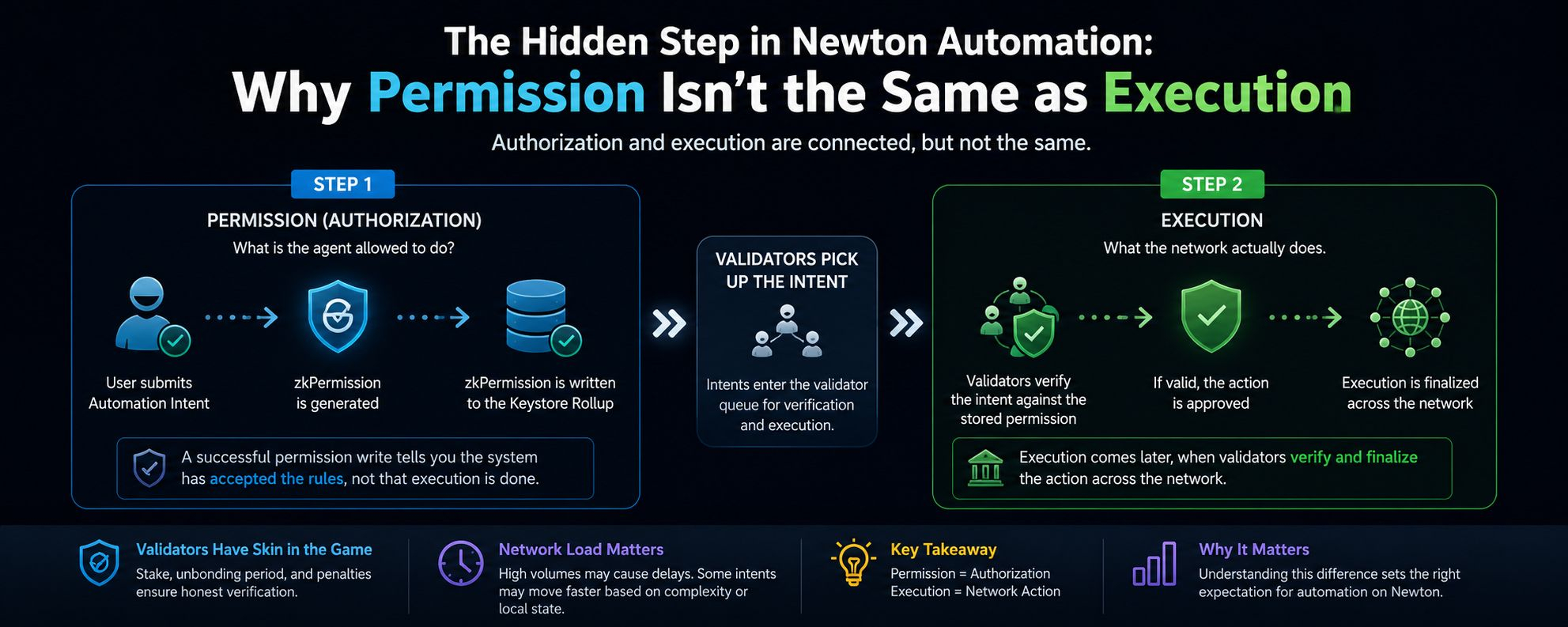
The Keystore only answers one question: What is this agent allowed to do? It records the permission and makes it verifiable. But that isn't the same as the agent actually doing anything. Execution comes later, when validators pick up the intent, verify it against the stored permission, and finalize the action across the network. They're two separate parts of the process, and they don't always happen at the same time.
That might sound like a small distinction, but I don't think it is.
A successful permission write tells you the system has accepted the rules. It doesn't tell you the automation has already been executed. There's still a network of validators involved before anything actually happens, and I think that's an important part of the picture.
The validator side is what really made me look at this differently. In Newton's dPoS model, validators have their own stake in the network. They're not just checking requests at random. They have capital committed, an unbonding period, and penalties for misbehavior. That gives them a real incentive to verify intents correctly, which is exactly what you'd want from a security standpoint.
At the same time, it made me wonder what execution looks like when the network gets busy.
If a large number of intents arrive at once, does every request experience roughly the same delay? Or do certain types of intents naturally move through the queue a bit faster because they're easier to verify or already exist in a validator's local state? I don't know the answer, but it feels like a worthwhile question because it could have a real impact on the user experience.
The more I think about it, the more I believe there's an important difference between authorization and execution. One tells you your agent has permission to act. The other tells you the network has actually acted on that permission.
Those two events are connected, but they're not the same thing.
For people setting up their first automation, that's probably something worth making as clear as possible. Seeing a successful permission update can easily create the impression that everything is already running, when in reality there's still a verification and execution step happening behind the scenes.
It's a small detail in the architecture, but understanding it completely changed the way I look at what's happening on the dashboard.
