
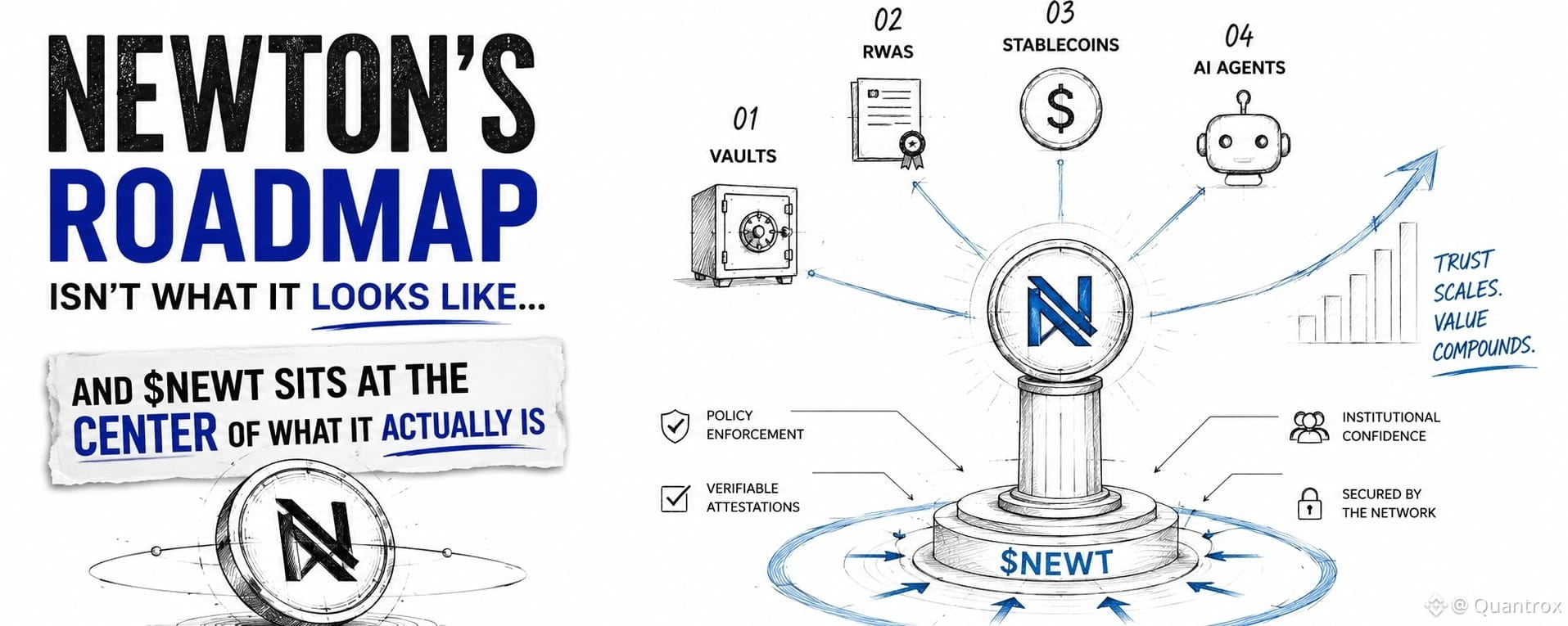
I almost read Newton's expansion path as a standard go-to-market sequence.
Vaults first because they're the lowest-friction entry point. Then RWAs because the market is growing. Then stablecoins because the dollar amounts are largest. Then AI agents because that's where the narrative is heading. A logical progression from one adjacent market to the next, the kind of roadmap every infrastructure project publishes because it signals ambition without committing to a timeline.
I read it that way the first time. Then I started thinking about what actually has to be true before the second step is possible.
RWAs are not a larger version of vaults. They carry a different kind of risk and a different kind of regulatory requirement. A vault breaching its leverage limit is an onchain problem with onchain consequences. A tokenized treasury bond failing its compliance check is a legal problem with legal consequences — counterparty liability, regulatory exposure, potential enforcement action against the protocol and the institution behind it. The stakes attached to a failed policy check are categorically different.
That difference changes what "enforcement" has to mean before institutional capital will actually route through it.
For a vault, a signed attestation that a risk check ran before settlement is a useful feature. It gives auditors something to point to, gives counterparties something to verify, gives the protocol a way to demonstrate that its rules are real rather than aspirational. Useful. Not yet load-bearing.
For a tokenized RWA, the attestation isn't a feature. It's the minimum requirement for the asset to be legally transferable under the frameworks being built around it. The policy check doesn't just have to run — it has to have run verifiably, with proof accessible to regulators, in a way that holds up under scrutiny from parties who weren't present when it happened and have no reason to take the protocol's word for it.
That's a much higher bar. And it's a bar that can only be met by infrastructure that has already proven itself at scale doing something simpler.
I kept thinking about something outside crypto while sitting with this. Bridge construction follows a similar logic. Engineers don't test a new load-bearing design on the largest bridge they plan to build. They prove the design on smaller structures first — not because the smaller bridges are more important, but because the proof of performance under real conditions is what makes the larger structure trustable. The testing sequence isn't arbitrary. It's the mechanism by which trust gets built before it's required.
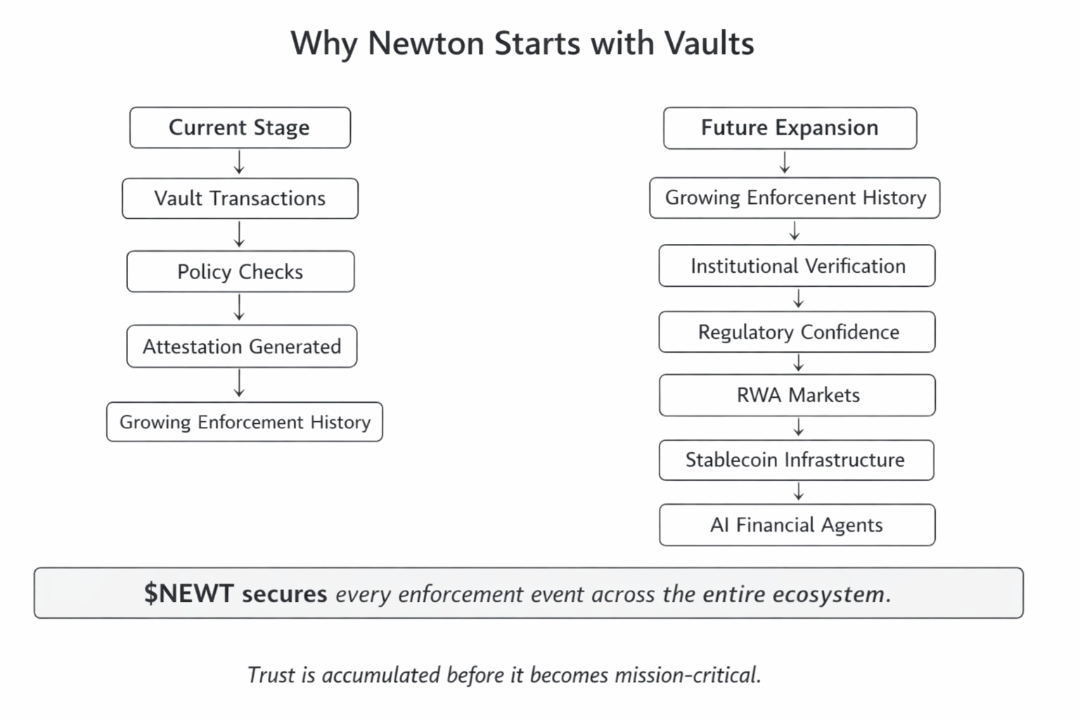
Newton's vault-first approach is doing something structurally similar.
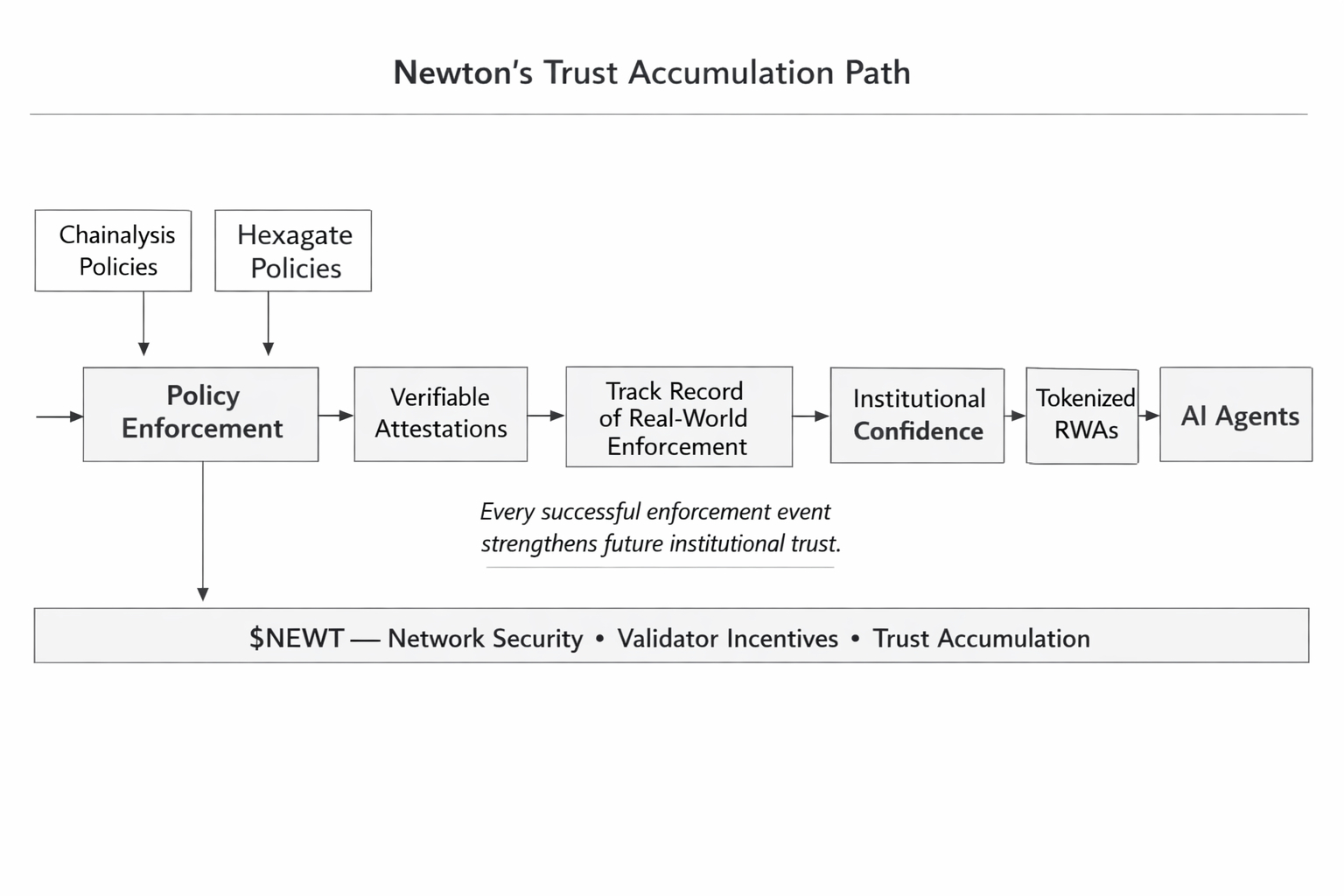
Every enforcement event that runs through VaultKit is producing something beyond just the pass/fail result. It's producing a track record — a body of attestations showing that the enforcement ran correctly, consistently, at scale, under real conditions with real capital. That track record isn't just useful for the vaults it came from. It's the evidence base that makes the RWA case credible to institutional counterparties who need to know whether this infrastructure has actually been tested before they route regulated assets through it.
The vaults are the proof surface. The RWA expansion is what the proof enables.
This also explains why the policy partner list reads the way it does. Chainalysis and Hexagate aren't just adding their sanctions data to Newton's enforcement layer. They're lending their existing institutional credibility to every attestation Newton produces. When a policy check runs using Chainalysis-backed compliance logic, the attestation carries Chainalysis's track record alongside Newton's. For a fund manager asking whether this protocol's compliance checks are real, "backed by Chainalysis" is a different answer than "we built our own screening tool." The credibility transfers through the policy, not just through Newton's own reputation.
I'm not certain the RWA transition happens on any particular timeline. Regulatory frameworks for tokenized assets are still being written in most jurisdictions, and the gap between "technically capable of enforcing these rules" and "recognized by regulators as sufficient enforcement infrastructure" is real and likely slow to close. The proof-of-performance Newton is building at vault scale is necessary for that transition. It's not sufficient on its own.
But the sequencing is deliberate in a way that's easy to miss if you're reading the roadmap as a market expansion plan rather than a trust-building sequence.
Vaults first because that's where Newton can accumulate the enforcement track record that RWAs require. RWAs next because that's where the attestation infrastructure becomes load-bearing rather than just useful. Stablecoins and AI agents after that because those markets inherit the trust that every prior enforcement event produced.
$NEWT sits underneath that entire sequence. Not as a reward for using one product in one market. As the asset securing the network accumulating the trust that each next market requires before it's reachable.
I don't think most people holding $NEWT are thinking about the token as a trust-accumulation mechanism. The frame is still mostly about the current product — VaultKit, mainnet beta, the enforcement check.
Underneath that frame, something slower is happening. A track record being assembled, one attestation at a time, that makes each next market in the sequence accessible in a way it wasn't before.
Most infrastructure gets valued when the trust is already obvious. Newton is building the trust now, in the market where the stakes are lowest, before the markets where it becomes the actual requirement.
$NEWT is the token sitting underneath that process, whether the price has noticed yet or not.