
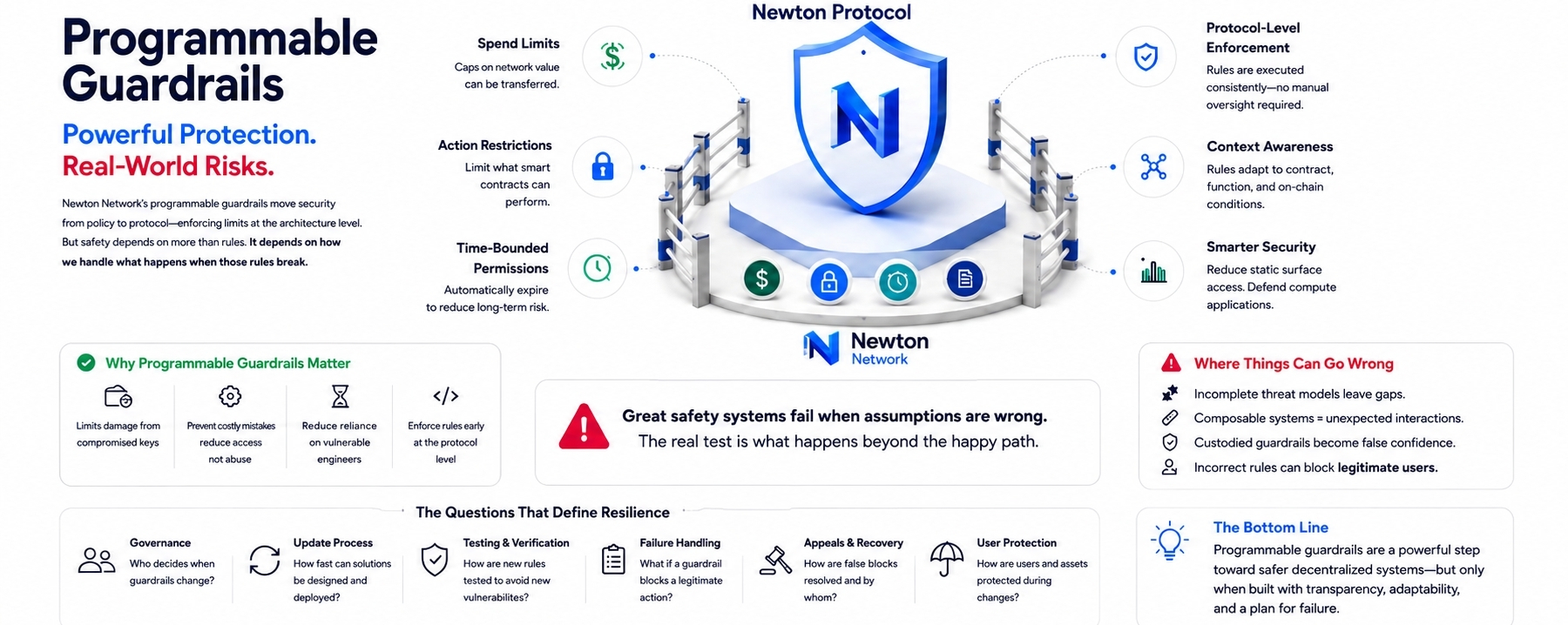
Programmable Guardrails Sound Secure. Their Failure Modes Matter More.
Security documentation has a habit of making difficult problems sound deceptively simple. Few words illustrate that better than guardrails.
The term immediately evokes confidence. Stay within the rails and you're safe. Add the word programmable, and the promise becomes even more compelling: safety that can adapt to different users, applications, and risk profiles.
But security isn't defined by the protections that work. It's defined by what happens when those protections encounter situations they weren't designed for.
That's why the first question I ask isn't "What can these guardrails do?" It's "What happens when they fail?"
Newton Network's programmable guardrails are embedded directly into its permission architecture. Instead of relying on developers to remember every security check—or organizations to enforce policies after the fact—the protocol itself can impose boundaries on what permissions are allowed to do.
Those boundaries can take several forms: transaction spending caps, restrictions on specific actions, contract-specific permissions, and authorizations that automatically expire after a predefined period.
Conceptually, this is exactly where security should be moving.
For years, decentralized applications have depended on developers implementing similar protections independently. Sometimes they do it well. Sometimes they don't. Moving these controls into protocol-level infrastructure creates consistency that individual applications often struggle to achieve.
The benefits are obvious.
A compromised session key with a spending limit can't empty an entire wallet.
A permission restricted to one contract can't easily be repurposed somewhere else.
Temporary permissions quietly disappear instead of lingering indefinitely as forgotten attack surfaces.
These are practical defenses against practical threats—not marketing features.
The challenge begins where every threat model eventually reaches its limit.
Security teams can only defend against scenarios they imagine. Attackers earn their reputation by imagining the ones nobody else did.
A guardrail doesn't eliminate uncertainty; it reflects the assumptions of the engineers who designed it. If those assumptions are incomplete, the protection is incomplete as well.
That's where confidence becomes dangerous.
A system that blocks nine familiar attack paths while leaving the tenth untouched may appear highly secure right up until the overlooked path becomes the one that matters.
In security, partial protection is often mistaken for comprehensive protection, and history has repeatedly shown how expensive that misunderstanding can become.
The issue becomes even more complicated in DeFi because nothing operates in isolation.
Protocols interact with protocols. Contracts call other contracts. Liquidity moves across ecosystems in milliseconds. Flash loans can transform economic conditions within a single transaction.
Under those conditions, guardrails designed for one environment may behave very differently once they become part of a much larger system.
Rules that appear flawless during isolated testing can produce entirely unexpected outcomes once composability enters the equation.
That is the challenge I would want Newton Network to address more explicitly.
The technical implementation matters—but so does the operational process surrounding it.
When researchers discover a new attack vector, who decides that existing guardrails need to change?
How quickly can those updates be deployed?
How are they tested before reaching production?
What safeguards ensure today's fix doesn't quietly become tomorrow's vulnerability?
Security controls must evolve as quickly as the threats they're designed to stop. Otherwise, yesterday's protection slowly turns into today's blind spot.
Where Newton deserves credit is in recognizing that enforcement belongs closer to the protocol than to policy.
Policies rely on people.
Code relies on execution.
People forget, misunderstand, or make exceptions. Properly written protocol rules don't.
That shift alone represents meaningful progress for an industry that has repeatedly learned the hard way that inconsistent security practices eventually become security incidents.
Still, I would like to see the documentation devote more attention to resilience than capability.
What happens if a legitimate transaction is blocked?
How are false positives resolved?
Can emergency changes be introduced without compromising decentralization?
How are new guardrails verified before they affect users?
Those aren't edge cases—they're part of the security model itself.
Programmable guardrails are a compelling idea, and Newton Network is moving in a direction that makes architectural sense.
But blockchain security has never been won by good ideas alone.
It has always been won by the quality of execution, the handling of edge cases, and the willingness to design not just for success—but for failure.
Because in security, the strongest guardrail isn't the one that never breaks.
It's the one whose failure has already been anticipated.