
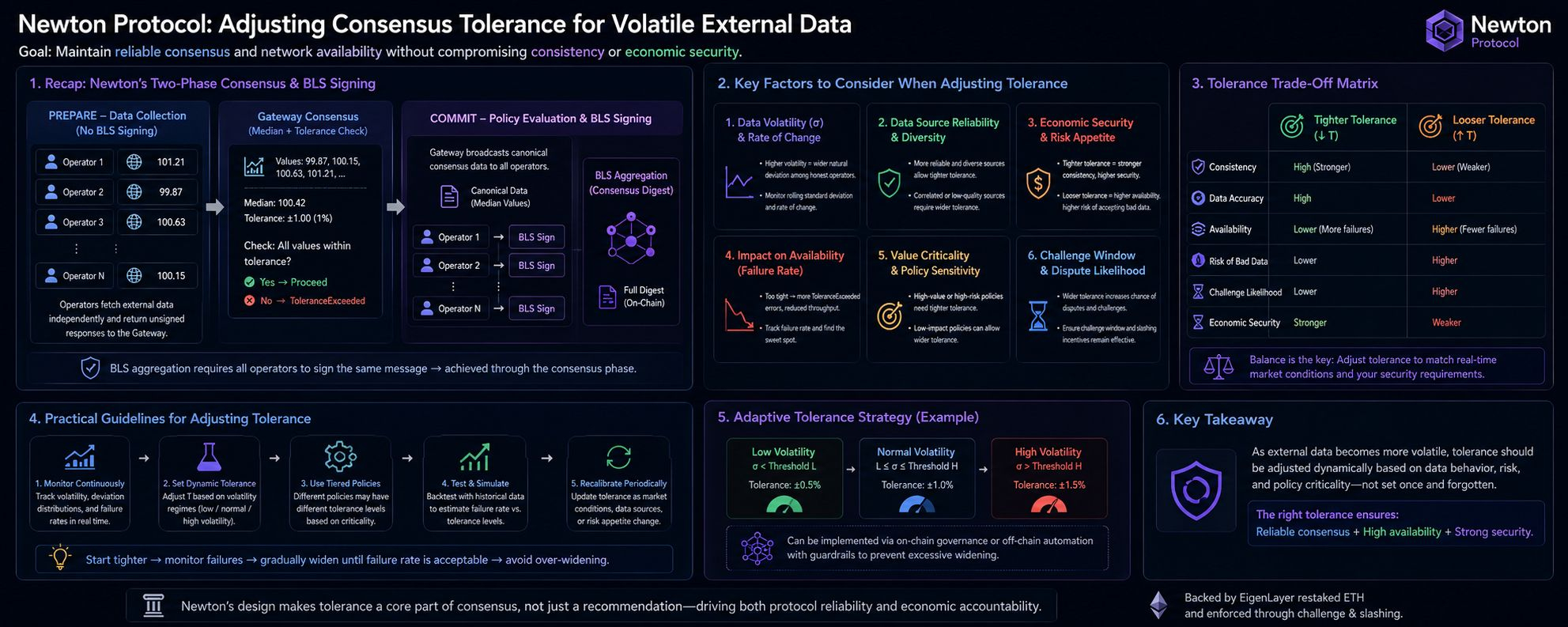

While reading Newton Protocol's Consensus & Security documentation, one implementation detail immediately caught my attention: operators do not begin BLS signing as soon as a task arrives. Instead, Newton inserts a dedicated consensus stage before policy evaluation.
According to the documentation, the process begins with the Prepare phase. Operators independently fetch external policy data and return unsigned responses to the Gateway. At this stage, no BLS signatures are produced.
The Gateway then computes median values across the collected responses for numeric data and checks them against the configured tolerance. If an operator's value exceeds the tolerance threshold, consensus fails with a ToleranceExceeded error. The documentation specifically notes that operators are not silently excluded when their values fall outside the allowed range.
Only after a common dataset has been established does the Commit phase begin. The Gateway broadcasts the canonical consensus data back to operators. Because every operator now evaluates the policy using identical inputs, they can generate BLS signatures over the same message.
This ordering appears closely connected to another documented implementation detail: Newton's two-digest system. The documentation explains that BLS aggregation requires every operator to sign exactly the same message. To satisfy this requirement, operators BLS-sign the Consensus Digest, while the Full Digest, which contains unique attestations, is stored on-chain for challenge verification.
Viewed together, these mechanisms form a coherent workflow. The Prepare phase aligns operator inputs. The median consensus process establishes a canonical dataset. The Commit phase performs policy evaluation using those shared values. Finally, BLS signature aggregation occurs only after operators are working from identical data.
Another detail worth noting is Newton's handling of disagreement. Rather than accepting the majority while ignoring outliers, the documentation states that values exceeding the configured tolerance cause consensus to fail. This makes the tolerance parameter part of the protocol's consensus behavior instead of merely a recommendation.
The documentation also connects this process to EigenLayer-backed economic security. Operators participate through restaked ETH, and incorrect evaluations can be challenged during the challenge window, potentially resulting in slashing. Combined with BLS aggregation, this provides both cryptographic verification and economic accountability for policy evaluations.
From an implementation perspective, the interesting aspect is not simply that Newton uses BLS signatures. The documentation shows that BLS aggregation is intentionally placed after a dedicated consensus process. By ensuring operators evaluate policies from the same canonical dataset, Newton creates the conditions required for aggregate signature verification while maintaining documented tolerance rules for external data.
Technical Question: As external data becomes more volatile, what considerations should guide adjustments to the consensus tolerance so that consensus remains reliable without unnecessarily increasing failed evaluations @NewtonProtocol #Newt $NEWT