
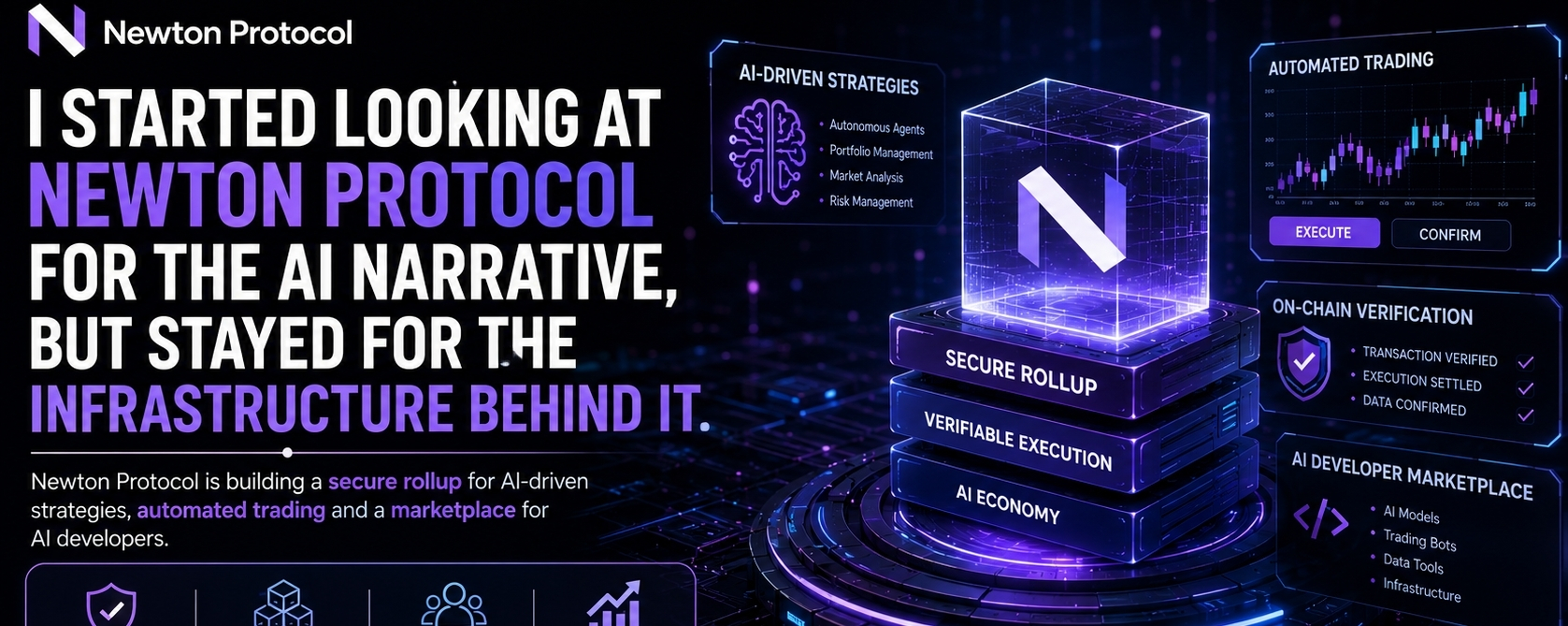
Today I ended up spending much more time reading about Newton Protocol than I planned. I thought I would skim through another AI-related crypto project, take a few notes, and move on. Instead, I kept reopening different documents because something wasn't fitting the usual pattern. The AI part was interesting, sure, but it didn't feel like the main point. I came away thinking the real idea behind Newton Protocol is building a place where AI can actually be trusted to execute financial actions, not just generate them.
That feels like a more difficult problem than making AI smarter.
A lot of projects are racing to build better AI agents that can trade, manage portfolios, or automate strategies. The assumption seems to be that if the models become capable enough, everything else will follow. I don't really buy that anymore. Once an AI starts interacting with real assets, the quality of its reasoning becomes only one piece of the puzzle. The bigger question becomes whether every action is executed inside a system people can verify and rely on.
That is where Newton Protocol started making more sense to me.
The secure rollup isn't simply another scaling layer attached to an AI narrative. From what I understood today, it acts more like an execution environment where AI-driven strategies can operate under predictable rules. Instead of asking users to blindly trust an autonomous agent, the protocol tries to make the execution layer itself accountable. That's an important distinction, and honestly I think many people overlook it because "AI" grabs all the attention.
I kept thinking about automated trading while reading through the architecture. Imagine an AI deciding to rebalance a portfolio based on changing market conditions. Most discussions stop at whether the model makes a good decision. Newton seems to care just as much about what happens after that decision. How is the transaction executed? Can builders verify what occurred? Can participants rely on the environment where those instructions become actual on-chain actions? It sounds less exciting than another benchmark for AI intelligence, but maybe it's the part that ends up mattering more.
The marketplace for AI developers also fits into that same direction. At first I thought it was simply another place where developers publish AI tools. After reading more, it looked more connected than that. If builders have a secure execution layer underneath their applications, they're not only creating smarter agents. They're building inside an environment designed around verification and consistent execution. That changes the incentives a bit. Users are evaluating not only what an agent claims it can do, but also the infrastructure supporting those actions.
I think that combination is where Newton becomes interesting. AI applications usually depend on trust that exists outside the system. Newton appears to be trying to move some of that trust into the protocol itself. It doesn't eliminate risk, and it doesn't magically guarantee correct decisions, but it narrows one very important uncertainty. That's a meaningful improvement if AI agents are expected to manage larger amounts of value over time.
The NEWT token also feels easier to justify when viewed through that lens. I don't see it as something added because every crypto network needs a token. If this execution environment coordinates validators, supports network security, aligns participants, and powers activity across the marketplace, then the token becomes part of the system's operating logic. Without an economic layer coordinating behavior, the infrastructure wouldn't function the same way. That's different from using a token mainly as a branding exercise.
Still, there are parts that remain unproven. Building secure infrastructure is one thing. Convincing developers to actually build there is another. The marketplace only becomes valuable if high-quality builders participate and if users see enough value to keep returning. Network effects are difficult to manufacture, and crypto has plenty of technically solid projects that struggled because adoption arrived slower than expected. Newton isn't immune to that reality.
Another dependency I kept thinking about is AI itself. If the demand for autonomous on-chain agents grows gradually instead of rapidly, infrastructure designed around that future may take longer to show its full value. Sometimes the timing matters almost as much as the technology. Maybe even more.
So what am I watching now? Not marketing campaigns or short-term price movements. I'm watching whether developers begin deploying meaningful AI-driven applications on the protocol, whether automated strategies start handling more complex workflows, and whether the marketplace develops real activity instead of just announcements. Those are the signals that would strengthen my current view.
On the other hand, if the ecosystem remains mostly theoretical and real usage doesn't appear, then my thesis weakens. Infrastructure only proves itself when people choose to depend on it. Reading architecture diagrams is one thing. Watching actual users trust the system is something else entirely.
After looking through Newton Protocol today, I left with a different conclusion than I expected. I don't think its biggest bet is on AI becoming smarter. I think its biggest bet is that trust, verification, and secure execution will become the bottleneck once AI starts moving real value on-chain.
If that turns out to be true, the infrastructure may end up being remembered long after the AI hype has changed.
