
Technology moves fast. Sometimes faster than our ability to question where it is taking us.
Artificial intelligence is now finding its place in blockchain, promising faster decisions, automated trading, and systems that can work around the clock without human intervention. It sounds exciting, but excitement alone has never been enough to build lasting trust.
At some point, every user asks the same simple question.
If an AI is making decisions with my assets, how do I know it will stay within the limits I choose
That question sits at the heart of Newton Protocol.
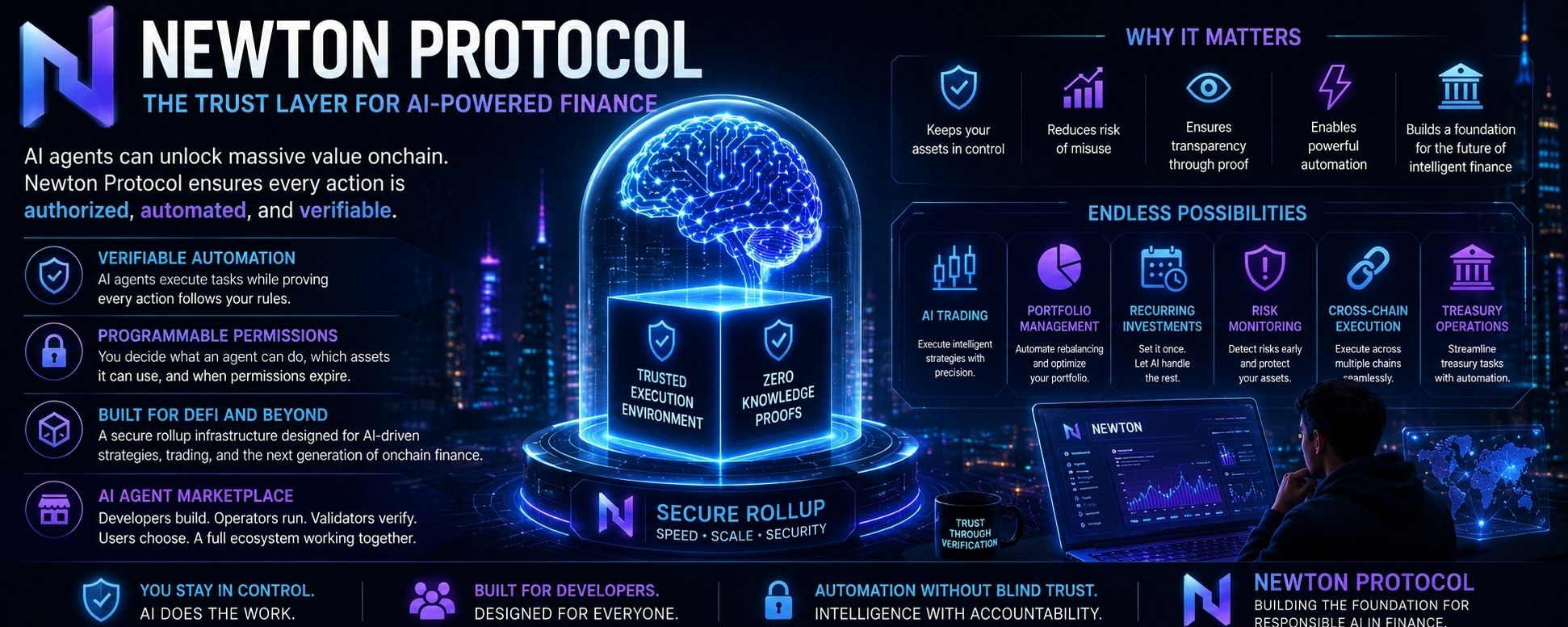
Rather than trying to build the smartest AI, Newton focuses on building an environment where intelligence can operate responsibly. Its vision is a secure rollup that supports AI powered strategies, automated financial execution, and a marketplace where developers can create specialized AI agents that users can rely on with confidence.
It is a subtle difference, yet it changes the entire conversation.
Many automation tools today ask users to hand over broad permissions and simply hope everything works as expected. They save time, but they also ask people to place a great deal of trust in software that often feels like a black box.
Newton takes another path.
By combining Trusted Execution Environments with Zero Knowledge Proofs, the protocol creates a system where AI agents can complete tasks while proving that every action follows rules approved by the user. Instead of giving away unlimited control, people decide exactly what an agent can do, which assets it may use, when its permissions expire, and the conditions that must be met before anything happens.
That idea feels less like replacing human judgment and more like protecting it.
Anyone who spends time in decentralized finance understands how repetitive many daily tasks become. Watching markets, adjusting portfolios, harvesting rewards, moving assets, or managing liquidity often requires constant attention. None of these actions are especially difficult, but together they demand time and discipline.
Imagine those routines happening automatically while still remaining inside boundaries that you created yourself.
That is a future worth paying attention to.
Another thoughtful piece of the project is its marketplace for AI developers.
Instead of limiting innovation to one team, Newton opens the door for builders to create specialized agents designed for different financial needs. Some may focus on trading. Others may manage recurring investments, treasury operations, portfolio balancing, or entirely new workflows that have not yet been imagined.
What gives those agents value is not simply their intelligence.
It is their ability to prove they acted exactly as expected.
In a world where automation is becoming more powerful every day, verification may become even more important than speed. People rarely fear technology because it is advanced. They fear it when they cannot understand what it is doing.
Newton recognizes that trust is built through transparency, not promises.
Its programmable permission system reflects that philosophy. Every authorization can include spending limits, approved assets, execution windows, and clearly defined policies. Automation becomes something users shape instead of something they surrender to.
As blockchain continues to evolve, these details may become increasingly important. Financial systems are growing more complex. AI is becoming more capable. Expectations around security continue to rise.
Those trends point toward a future where intelligence alone will never be enough.
It will need accountability.
Of course, building infrastructure is rarely the quickest way to gain attention. Most people notice the applications they use every day, not the technology quietly supporting them behind the scenes. Yet history often shows that strong foundations outlast short lived excitement.
Newton appears to understand that reality.
It is not trying to convince the world that AI should replace people.
It is working toward a future where AI becomes a tool that respects human decisions instead of overriding them.
Perhaps that is the real opportunity here.
The next chapter of decentralized finance may not belong to the fastest algorithms or the loudest promises.
It may belong to the systems that earn trust one verified decision at a time.