
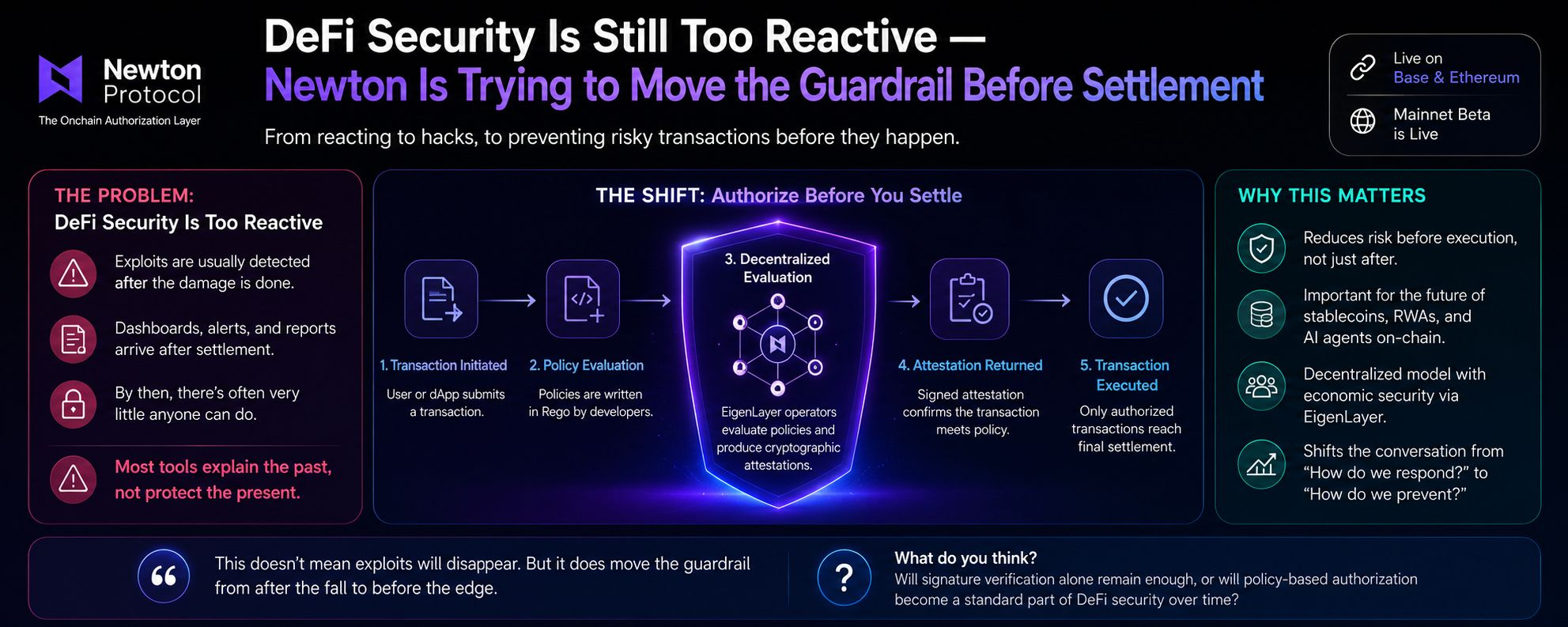
The more I learn about DeFi, the more I feel that most of our security tools are built to explain the past rather than protect the present.
When an exploit happens, we usually get detailed dashboards, transaction hashes, and post-mortem reports. Those are valuable, but they all arrive after the transaction has already been confirmed. By then, there's often very little anyone can do.
That made me curious about a different approach.
While reading through Newton Protocol's documentation, I noticed that the project isn't only focused on detecting suspicious activity. It's designed to evaluate whether a transaction meets predefined policies before it reaches final settlement.
According to the documentation, developers can define those policies using Rego, while a decentralized EigenLayer operator network evaluates them and returns cryptographic attestations before execution. The protocol's mainnet beta is also live on Base and Ethereum, where this authorization model is being introduced.
I don't think this means exploits suddenly disappear, and I wouldn't describe it as a complete solution. But it does shift the conversation from "How do we respond after something goes wrong?" to "Can we reduce certain risks before the transaction is finalized?"
As more stablecoins, RWAs, and AI agents interact with on-chain infrastructure, that feels like an increasingly relevant question.
What do you think? Will signature verification alone remain enough, or do you see policy-based authorization becoming a standard part of DeFi security over time?
