
I almost filed the GBBC handbook mention under marketing.
New project gets featured in institutional publication. Team puts it in the announcement thread. Community reposts it. The cycle runs for a day or two and then the feed moves on to whatever the next announcement is. I've seen that pattern enough times to develop a reflex for it. Noted the mention, categorized it as visibility rather than substance, and almost moved on.
Then I looked at what the Global Blockchain Business Council actually is and who reads its publications before I did.
The GBBC isn't a crypto media outlet. It isn't a rankings site or an ecosystem directory. It's the organization that governments, central banks, and institutional allocators consult when they're trying to understand what blockchain infrastructure actually exists and which of it is credible enough to build policy frameworks around. The 101 Real-World Blockchain Use Cases handbook isn't written for retail crypto participants. It's written for the people deciding which infrastructure categories deserve regulatory legitimacy before the regulations themselves get written.
That's a different audience than a Binance Square thread reaches. And it changes what being named inside that document actually means.
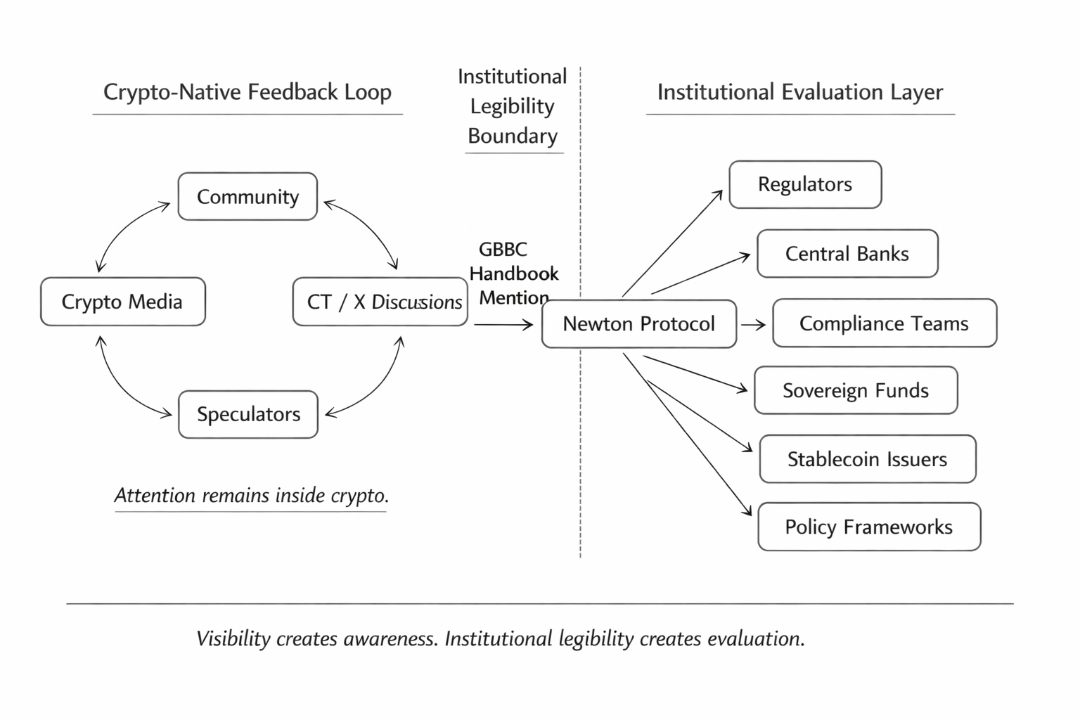
Most crypto projects exist entirely within a feedback loop of their own community. The people who know about the project are the people who were already looking for projects like it. The coverage lives on crypto-native platforms, read by crypto-native audiences, evaluated by crypto-native frameworks. That loop can produce enormous attention inside its own boundaries without ever touching the people who are actually writing the rules that will govern the space the project is building in.
Newton appearing in the GBBC handbook is a signal that something crossed that boundary.
Not because the mention itself changes anything about the protocol's technical architecture. But because the people who read that handbook before Newton's mainnet beta launched are a different category of reader than the ones tracking TGE dates and unlock schedules. They're reading it to understand which infrastructure is credible enough to build compliance frameworks around. Which onchain tools are mature enough to reference in policy discussions. Which projects are operating in the space seriously enough to be named alongside use cases that institutions are actually testing rather than just watching.
I kept thinking about something outside crypto while sitting with this. Academic citation works differently than most people assume. A paper getting cited in a foundational textbook doesn't mean the paper is proven correct. It means the field's organizing institutions have decided the paper is serious enough to include in the framework through which new researchers will learn to see the problem. That inclusion shapes how future researchers think before they've done their own work. The citation is an epistemological signal, not just a credibility badge.
Being named in the GBBC handbook operates similarly for institutional decision-makers approaching onchain compliance infrastructure for the first time.
The person at a sovereign wealth fund or a regulated stablecoin issuer who opens that handbook isn't looking for the most-hyped project in the space. They're looking for infrastructure that their organization's legal and compliance teams can point to when someone asks why they chose this rather than that. The handbook is the document that bridges between "something that exists in crypto" and "something an institution can justify evaluating seriously."
Newton's feature there doesn't guarantee adoption. It changes the conversation an institution has to have before dismissing it.
That distinction matters more than it sounds at this stage of the protocol's development.
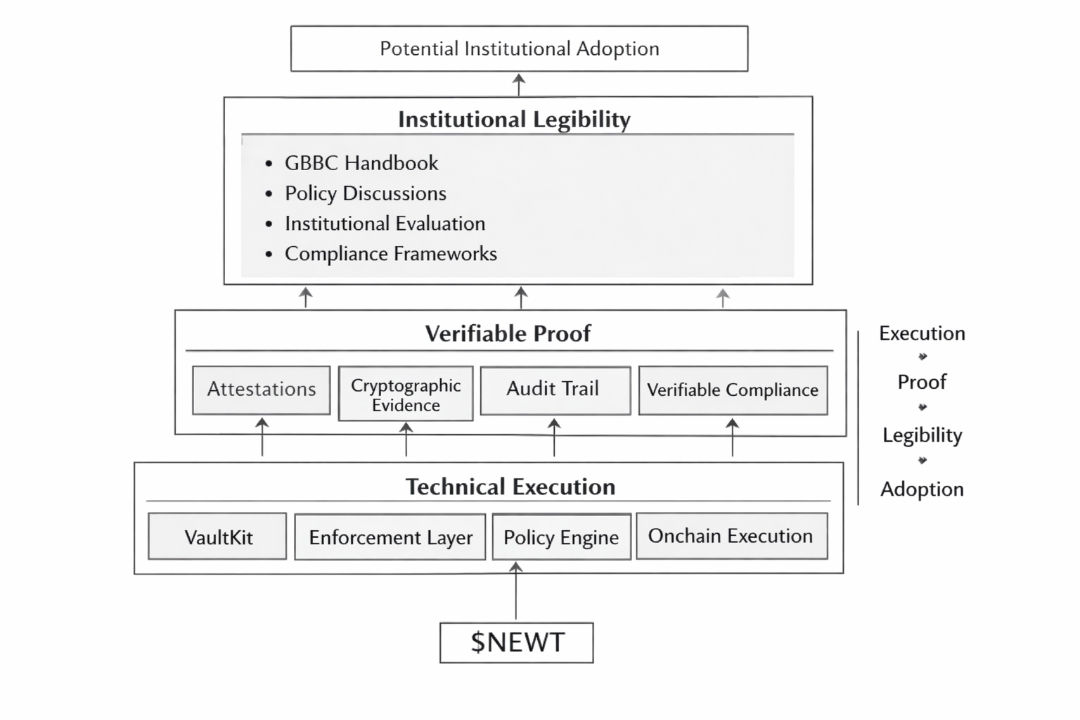
VaultKit is live. The enforcement layer exists. The attestations are running. But infrastructure that works technically still has to clear a completely separate bar before institutional capital routes through it — the bar of being taken seriously by the frameworks institutional decision-makers trust before they trust the technology itself. Most onchain compliance projects never clear that bar not because their technology fails but because they never become legible to the institutions whose adoption would actually matter.
The GBBC handbook is one of the places where that legibility gets established.
I'm not certain this translates into institutional adoption on any particular timeline. The distance between appearing in a policy framework document and actually processing institutional transaction volume is real and usually long. Legibility is necessary but nowhere near sufficient.
But the sequence matters. Newton's enforcement track record is being built at vault scale. Its attestation infrastructure is producing verifiable proof that the checks actually run. And now the institutional framework through which serious allocators learn to evaluate onchain compliance is naming it alongside real-world use cases worth examining.
Those three things happening together — technical execution, verifiable proof, institutional framework inclusion — is a less common combination than any one of them alone.
$NEWT sits underneath the infrastructure that earned all three simultaneously.
I don't think most people holding $NEWT are thinking about the token through the lens of institutional legibility. The frame is still mostly the crypto-native one — price, unlocks, TVL, developer adoption.
Underneath that frame, Newton has been quietly crossing a boundary that most onchain projects never reach — from infrastructure that the crypto community knows about to infrastructure that the institutions writing the rules are starting to name.
That boundary doesn't show up on a price chart the day it gets crossed.
It usually shows up much later, when the adoption that the legibility enabled finally becomes visible.