
Yesterday, I was close to increasing my $NEWT position, but one small detail in Newton's smart contract documentation made me stop and dig deeper.
It had nothing to do with price action or tokenomics.
The real question was how PolicyClients are initialized.
At first, I assumed that once a PolicyClient stored the correct Policy contract address, it was ready to validate attestations. That seemed perfectly reasonable. If the client knows where the Policy contract is, what else could it possibly need?
As it turns out, that's not how Newton is designed.
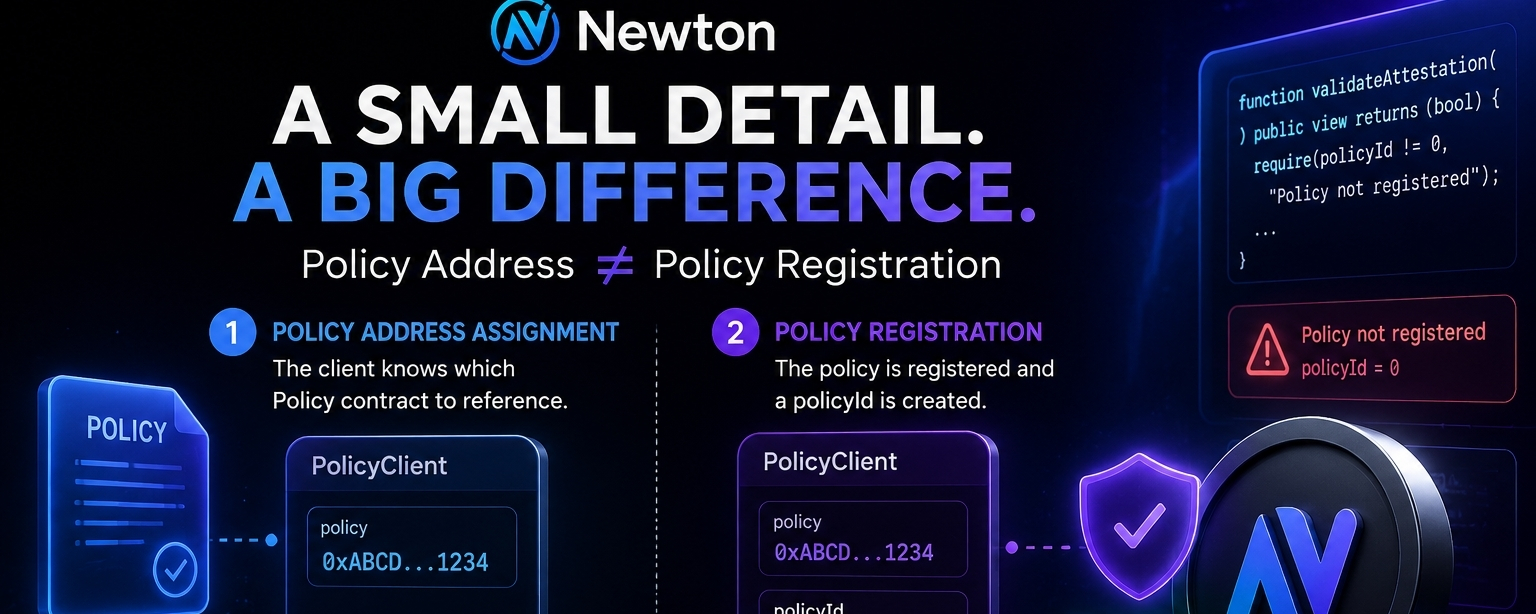
Setting the Policy contract address and registering a policy configuration are two completely different steps. The address only tells the client which contract to reference. It does not create the policy configuration or generate the policyId that every attestation is verified against. That only happens after the policy is explicitly registered.
Without that registration, the policyId remains zero.
What caught my attention is that everything can still appear perfectly deployed. The contract exists, the Policy address is visible on-chain, and anyone doing a quick review could easily assume the integration is complete.
In reality, every protected function that depends on attestation validation will continue to fail because no active policy configuration exists behind the scenes.
That's a very different kind of security design.
Most integration mistakes accidentally grant too much access. Newton takes the opposite approach. Everything may look connected, but nothing becomes operational until the final activation step is intentionally completed.
To me, that's one of the strongest engineering decisions in the protocol.
Newton clearly separates knowing which Policy contract to use from having an active policy that can actually validate attestations. That explicit activation boundary prevents the system from silently assuming it's ready when it isn't.
Of course, I can also see how this could confuse developers. If someone only checks whether the Policy address has been set, they may believe deployment is finished. The missing piece isn't an empty address or a reverted transaction—it's a zero-valued policyId that often doesn't become obvious until protected functions start rejecting seemingly valid attestations.
I only hold a small $NEWT position, so this wasn't a major investment decision. But implementation details like this tell me far more about a protocol's engineering philosophy than any marketing thread ever could.
Sometimes, the smallest design choices reveal the biggest commitment to security.
What do you think?
Does separating Policy address assignment from policy registration make Newton integrations safer through explicit activation, or does it create a higher risk of deployments that appear complete until protected actions begin to fail?