
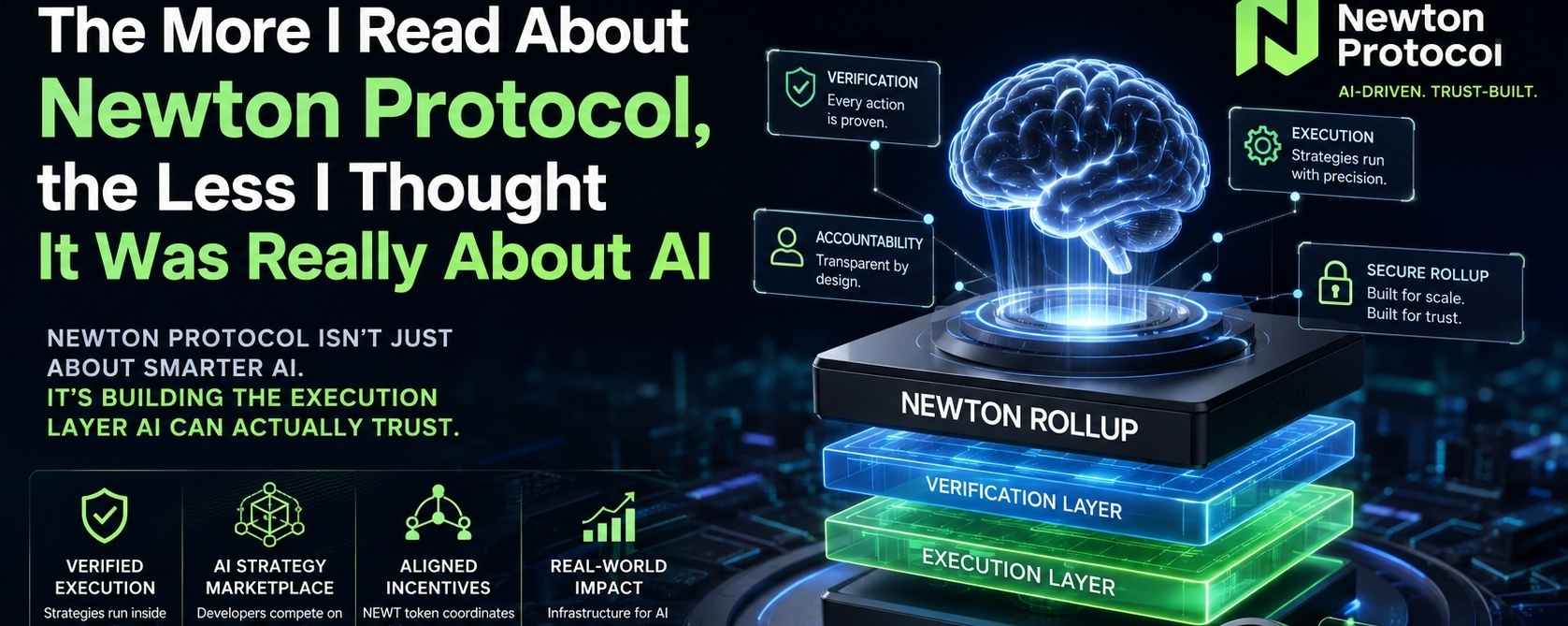
I ended up reopening my notes on Newton Protocol one more time today. Not because I didn't understand the AI angle, but because something about it kept feeling incomplete. Every project seems to be talking about smarter AI agents now, yet very few spend enough time explaining where those agents actually execute, who verifies them, or what happens when automated strategies start handling real value.
That's where my view shifted. I don't think Newton Protocol is mainly making a bet on AI. I think it's making a bet that AI needs its own execution environment before it can be trusted at scale. That feels like a much more interesting problem.
The obvious story is easy to sell. AI agents trade automatically, optimize portfolios, perform on-chain actions and developers can build new strategies through a marketplace. Those ideas attract attention because they are visible. People can imagine using them.
The part I kept thinking about sits underneath that. Newton Protocol is trying to build a secure rollup where those strategies don't just run quickly, but run inside a system designed around verification, execution and accountability. Maybe that sounds less exciting than another AI assistant. I actually think it's the harder problem.
If automated strategies become normal infrastructure, then users won't really care how clever the model is. They'll care whether execution is predictable, whether outputs can be verified, and whether operators can quietly change behavior after funds are already committed. AI becomes much less impressive when real money is involved.
That changes how I look at Newton.
Instead of asking people to trust an intelligent agent, the protocol is trying to reduce how much trust is required in the first place. The rollup becomes the operational layer where AI-driven strategies execute under defined rules rather than existing as isolated black boxes. It doesn't magically solve trust, and I don't think the team claims that either. But it moves part of the problem from reputation toward infrastructure.
I think that distinction matters more than people realize.
The marketplace for AI developers also looks different through this lens. At first glance it sounds like another place where builders upload strategies and users pick one. After reading more carefully, I started seeing it less as a catalog and more as an ecosystem where execution standards become shared. Developers aren't only competing on prediction quality. They're competing on whether their systems can operate inside an environment that users are willing to trust.
Those are not the same incentives.
Imagine an automated treasury manager for a DAO. The strategy isn't judged only because it earns slightly higher returns. It also needs reliable execution, transparent operational behavior and infrastructure that reduces uncertainty whenever the AI interacts with assets. Without that foundation, better predictions don't necessarily create better outcomes.
That's the tension I kept coming back to today. Crypto has become very good at discussing intelligence, but much less interested in discussing execution quality. Newton Protocol seems to spend more energy on the second question.
If that direction succeeds, it could quietly change how AI applications are adopted. Builders would have an environment designed specifically for automated execution instead of forcing AI into infrastructure that wasn't really built with those assumptions in mind. Users might still evaluate strategy performance, but they'd also evaluate the environment supporting that performance.
The NEWT token also makes more sense from this perspective. I don't really see it as something attached for narrative value. If a network coordinates execution, validates activity, supports participants and powers the economic layer around strategy deployment, then the token becomes part of how incentives remain aligned across developers, validators and network operators. Remove that coordination layer and the marketplace starts looking fragmented very quickly. The token isn't the product, but it helps keep the product functioning as a network instead of just a collection of software.
Still, there are conditions that shouldn't be ignored.
Building secure infrastructure is usually much slower than building attention. AI narratives move fast. Infrastructure adoption doesn't. Newton Protocol can design a thoughtful execution layer, but developers still have to build on it, users need reasons to trust it, and the marketplace has to reach enough activity that network effects begin appearing naturally. None of those happen automatically.
That may actually become the biggest challenge.
I've noticed that crypto sometimes rewards ambitious narratives before operational demand exists. Eventually those projects have to prove that real builders choose them because the underlying mechanics are genuinely better, not because AI happened to be the trend at the time. Newton will probably face exactly that test.
So what am I watching now?
I'm paying much more attention to developer behavior than headline announcements. Are builders creating strategies that actually depend on Newton's execution model? Does marketplace activity become meaningful rather than symbolic? Are validators and operators adding security that users can actually feel in practice? Those signals would strengthen my thesis far more than another AI partnership announcement.
On the other hand, if most activity ends up being ordinary automation that could have lived almost anywhere else, then the infrastructure advantage becomes much weaker than it currently appears.
After spending time with Newton Protocol today, I came away thinking the biggest idea isn't smarter AI.
It's making AI accountable enough that people are willing to let it keep operating after they stop watching.
