
I was scrolling through crypto updates way too late again, half awake, watching another wave of AI tokens appear on my timeline, and I caught myself thinking the same thing I've been thinking for months: everyone wants to sell me the future, but almost nobody wants to talk about the plumbing.
That's kind of where my attention landed with Newton Protocol. Not because it's another AI project. Honestly, if I see one more project slap "AI-powered" on a dashboard and call it innovation, I might lose interest completely. Crypto has become extremely good at creating narratives and extremely inconsistent at creating products people actually use.
We've gone through DeFi summer, NFT mania, GameFi, SocialFi, Real World Assets, AI agents, and probably ten other categories that looked revolutionary on a slide deck and then disappeared once incentives dried up. Every cycle feels like the industry discovers a new buzzword and collectively decides to repeat it until liquidity moves somewhere else.
The funny thing is that AI itself isn't the problem.
The problem is trust.
Everybody wants autonomous agents managing portfolios, rebalancing positions, chasing yield, executing trades, moving assets across chains, and doing all the complicated things that users are too lazy or too busy to do themselves. But the moment an AI agent touches money, the conversation changes.
Suddenly nobody cares how smart the model is.
People want to know what happens when it makes a bad decision.
People want to know who is responsible.
People want to know whether the system can be audited.
That's where Newton Protocol starts looking more interesting than most AI-related crypto projects I've looked at recently.
The core idea isn't really "look at our AI."
It's more like "how do we verify what AI is doing?"
That sounds subtle, but I think it's a massive difference.
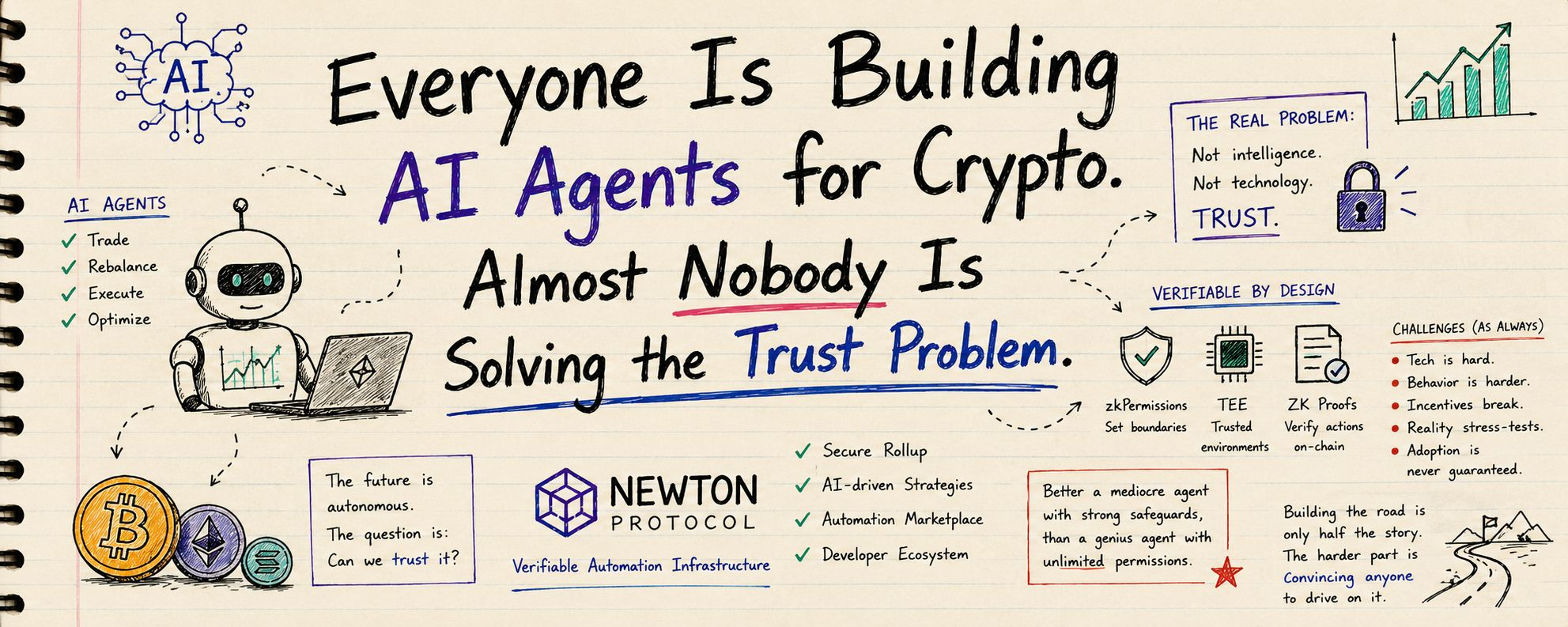
According to project materials, Newton is building a dedicated infrastructure layer and secure rollup focused on AI-driven strategies, automated trading, and a marketplace where developers can deploy automation services and AI agents. Instead of asking users to blindly trust autonomous systems, the protocol is built around verifiable automation, combining zero-knowledge proofs, trusted execution environments, and permission systems designed to limit what agents can actually do.
And honestly, that focus feels more realistic than a lot of AI narratives floating around crypto today.
Because if you've spent enough time in this industry, you know technology rarely breaks first.
Traffic breaks things.
Users break things.
Success breaks things.
I've watched chains brag about theoretical throughput numbers and then struggle when real demand arrives.
I've watched protocols advertise infinite scalability until thousands of users showed up simultaneously.
Infrastructure looks amazing until people actually use it.
That's why I usually care less about whitepaper promises and more about operational stress.
Can the system function when thousands of automated agents are competing for execution?
Can verification remain efficient during periods of heavy activity?
Can users understand what permissions they've granted?
Can developers build useful services that people are willing to pay for?
Those questions matter more than any AI marketing video.
Newton appears to understand this problem. Rather than trying to become another general-purpose blockchain, the project seems focused on a narrower mission: creating infrastructure specifically designed for verifiable automation. The protocol introduces concepts like zkPermissions, which allow users to define boundaries around what agents can do, while cryptographic proofs and trusted execution environments are intended to verify that automated actions stay within those limits.
Whether that works at scale is still an open question.
But at least it addresses a real problem.
One thing I've noticed is that crypto users consistently overestimate intelligence and underestimate constraints.
Everyone wants smarter agents.
Very few people ask for stricter controls.
That's backwards.
A mediocre agent with strong safeguards is usually safer than a brilliant agent with unlimited permissions.
Maybe that's not exciting enough for social media.
Maybe it doesn't generate viral engagement.
But risk management has a funny way of becoming important after things go wrong.
The protocol is also trying to create a marketplace where developers can publish automation models and agent strategies while users activate them with customized permissions and conditions. The broader vision seems to be a network where developers, operators, validators, and users interact around verifiable automation rather than blind delegation.
Again, interesting idea.
Not guaranteed success.
Just interesting.
Because marketplaces are harder than people think.
Building technology is difficult.
Building liquidity is harder.
Building trust is harder still.
Every crypto founder eventually learns that users don't magically appear because a product exists.
Users appear when the product solves a painful problem better than existing alternatives.
And that's where I think Newton faces its biggest challenge.
Not technology.
Behavior.
Most people don't want sophisticated automation.
They want profitable automation.
Those are not the same thing.
A user doesn't wake up hoping for better cryptographic verification.
They wake up hoping their portfolio goes up.
That's the uncomfortable reality every infrastructure project faces.
The better the infrastructure, the less visible it becomes.
Nobody celebrates a bridge because it didn't collapse.
Nobody tweets about security systems that worked correctly.
People notice outcomes.
Not architecture.
Looking at recent developments, Newton has expanded integrations around data oracles, identity verification systems, compliance tooling, developer documentation, staking infrastructure, and partnerships connected to automation workflows. The ecosystem has also emphasized programmable policies, onchain compliance controls, and enterprise-oriented guardrails for automated execution.
Those updates suggest a team thinking beyond token speculation.
That's a positive sign.
Still, crypto history is filled with technically impressive projects that never achieved meaningful adoption.
The market is full of graveyards built by smart engineers.
Competitors aren't standing still either.
There are countless projects exploring AI agents, autonomous finance, automated trading systems, agent frameworks, and execution layers. Some will prioritize speed. Others will prioritize usability. Others will focus on liquidity.
Newton seems to be betting that verification and trust become the defining differentiator.
That's a reasonable bet.
Not a guaranteed one.
A reasonable one.
The token itself plays multiple roles inside the ecosystem, including staking, validator incentives, operator collateral, registry functions, and network activity tied to agent execution and permissions. The broader design attempts to align developers, validators, operators, and users around the same automation economy.
Whether those incentives remain balanced over time is another question.
Crypto incentive systems usually look elegant on launch day.
Reality tends to stress-test them later.
I keep coming back to the same thought whenever I read about Newton.
The project feels less obsessed with making AI look magical and more interested in making AI accountable.
That distinction matters.
The industry has spent years asking what autonomous systems can do.
Maybe the more important question is whether those systems can prove they did the right thing.
If AI-driven finance becomes a serious category, verification probably becomes non-negotiable.
If it doesn't, then all of this infrastructure could end up being a very sophisticated solution searching for a problem.
That's the part nobody can answer today.
Not the team.
Not investors.
Not traders.
Not me.
The technology is interesting. The architecture is thoughtful. The problem is real. The roadmap points toward a future where automated decisions can be constrained, verified, and audited rather than blindly trusted. Recent listings, staking expansion, developer tooling, oracle integrations, and continued ecosystem development show that progress is happening.
But crypto has a way of humbling every prediction.
Maybe Newton becomes a foundational layer for autonomous finance.
Maybe it becomes another technically impressive protocol that never escapes its niche.
Maybe users embrace verifiable AI.
Maybe they keep chasing the next shiny narrative instead.
Right now, I honestly don't know.
And strangely, that's exactly why I'm still paying attention. The uncertainty feels real. The problem feels real. The ambition feels real.
Everything else will depend on whether people actually show up once the infrastructure is ready.
Because in crypto, building the road is only half the story.
The harder part is convincing anyone to drive on it.