
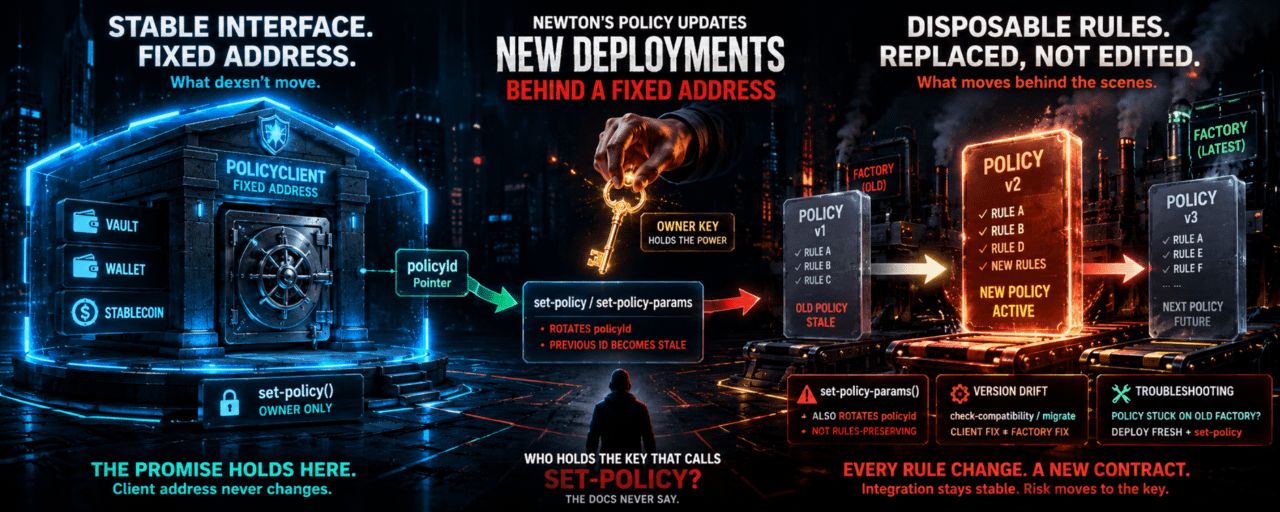
A promise to change something "without redeploying" sounds absolute, right up until you ask what exactly stays fixed. Usually it means one specific thing doesn't move. Everything behind that one thing can still get torn down and rebuilt.
Newton's policy engine is a clean test case for that distinction.
Official materials describe rule changes as something that adapts to new regulations or data providers, no contract redeployment required. I don't think that claim is false. I think it's aimed at a narrower target than it sounds like.
That target is the vault, the wallet, the stablecoin contract sitting on top of Newton. For that layer, the promise holds completely. What it doesn't describe is what happens to the policy itself.
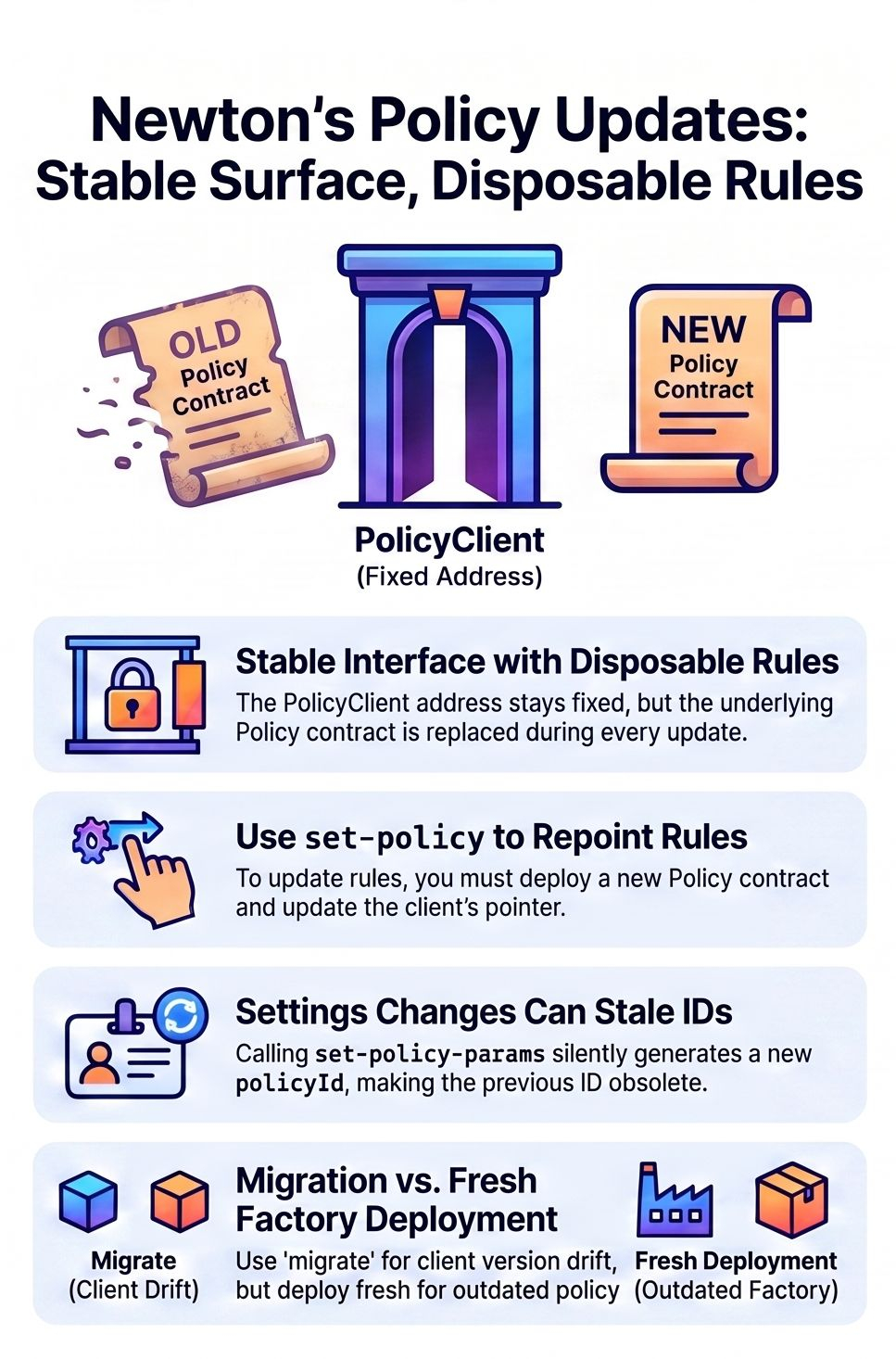
That's where the mechanism actually lives.
A PolicyClient contract doesn't store rules directly. It stores a reference, a policyId, pointing at a separately deployed Policy contract. Changing that reference is an owner-only call, set-policy, and it returns a new policyId once it runs. The PolicyClient's own address never moves. That's the part of "no redeployment" that's actually true.
The policy behind it is a different story.
It isn't edited. It's replaced. Newton's CLI reference documents policy deploy as producing a fresh Policy contract, separate from anything that existed before, through whichever factory is current at the time. Updating the actual rules means running that deployment again, then calling set-policy to repoint the existing client at the new address.
Stable interface, disposable rules. I think that's a fair trade. I don't think it's the trade the marketing implies.
There's a sharper wrinkle one command over. set-policy-params, the command meant for expiration and client-side configuration, carries a documented warning: calling it internally re-registers with the Policy contract and returns its own new policyId, silently making the previous one stale.
That's not a small detail.
Two different commands, one explicitly about swapping rules and one nominally about settings, both end up rotating the pointer. Anyone treating set-policy-params as a safe, rules-preserving call is working from an assumption the CLI reference doesn't support.
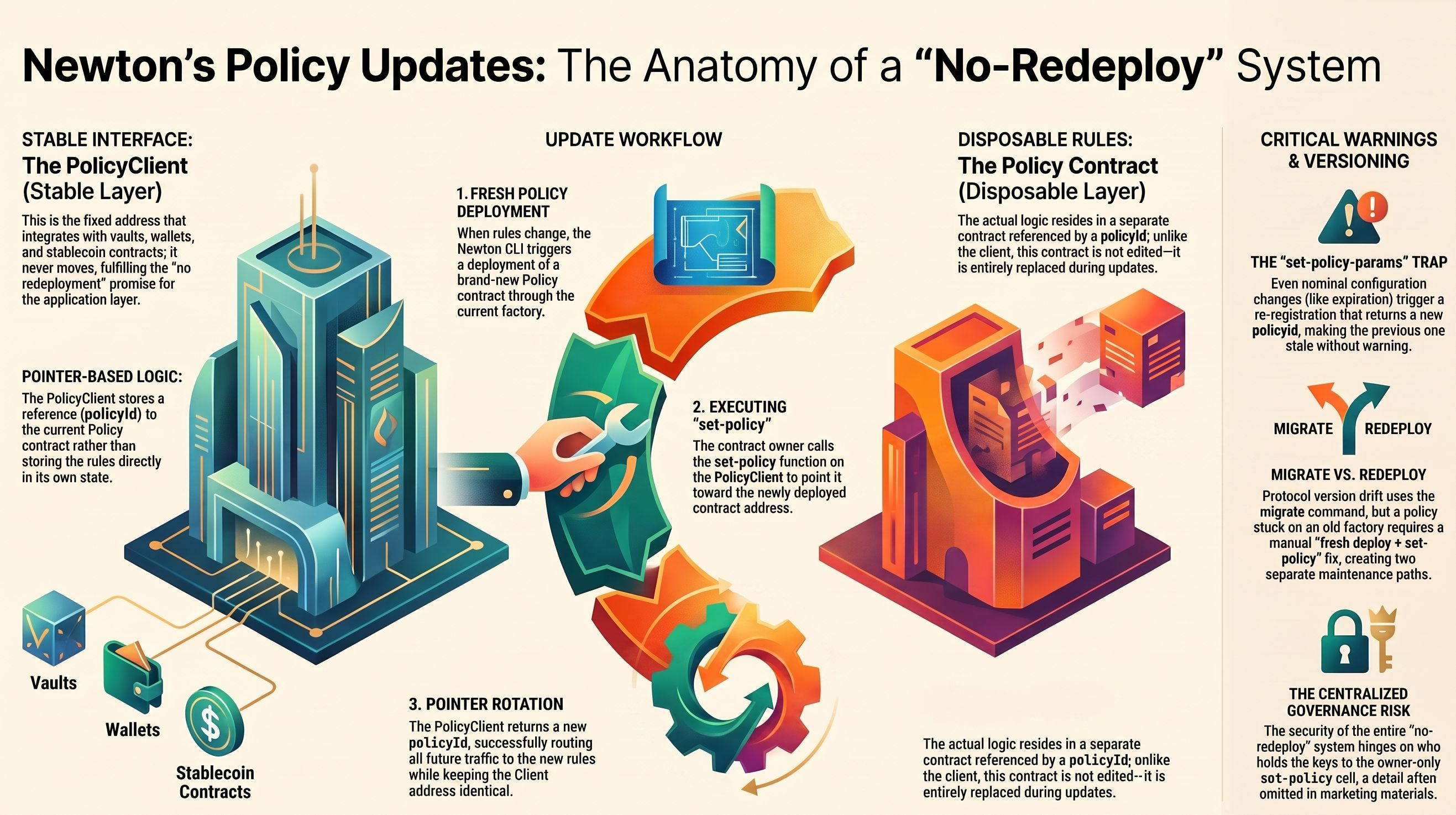
Then there's version drift. Newton ships a separate version command group, check-compatibility and migrate, aimed at PolicyClient contracts that fall behind the current protocol version. The troubleshooting entry for a policy stuck on an old factory describes a different fix entirely: deploy fresh through the latest factory, then call set-policy. Migrate isn't mentioned there.
Two version problems. Two separate fixes.
Whether migrating a PolicyClient also resolves a policy stuck on an old factory, or whether the two repairs are meant to be handled independently, isn't something the CLI reference settles on its own. That's the one part of this I can't verify further from what Newton publishes.
Everything else here, I'd stand behind.
Newton's design keeps the integration surface stable while every rule change routes through a new contract and an owner-gated pointer update. That's a defensible trade. Audit and rollback happen at the contract level, not through mutable state hidden inside one.
Whether that only relocates upgrade risk, from redeploying the app to redeploying the policy behind it, or whether it's a genuinely better place to put that risk, comes down to one thing the docs never discuss: who actually holds the key that calls set-policy.
@NewtonProtocol #Newt $NEWT $LAB $VANRY