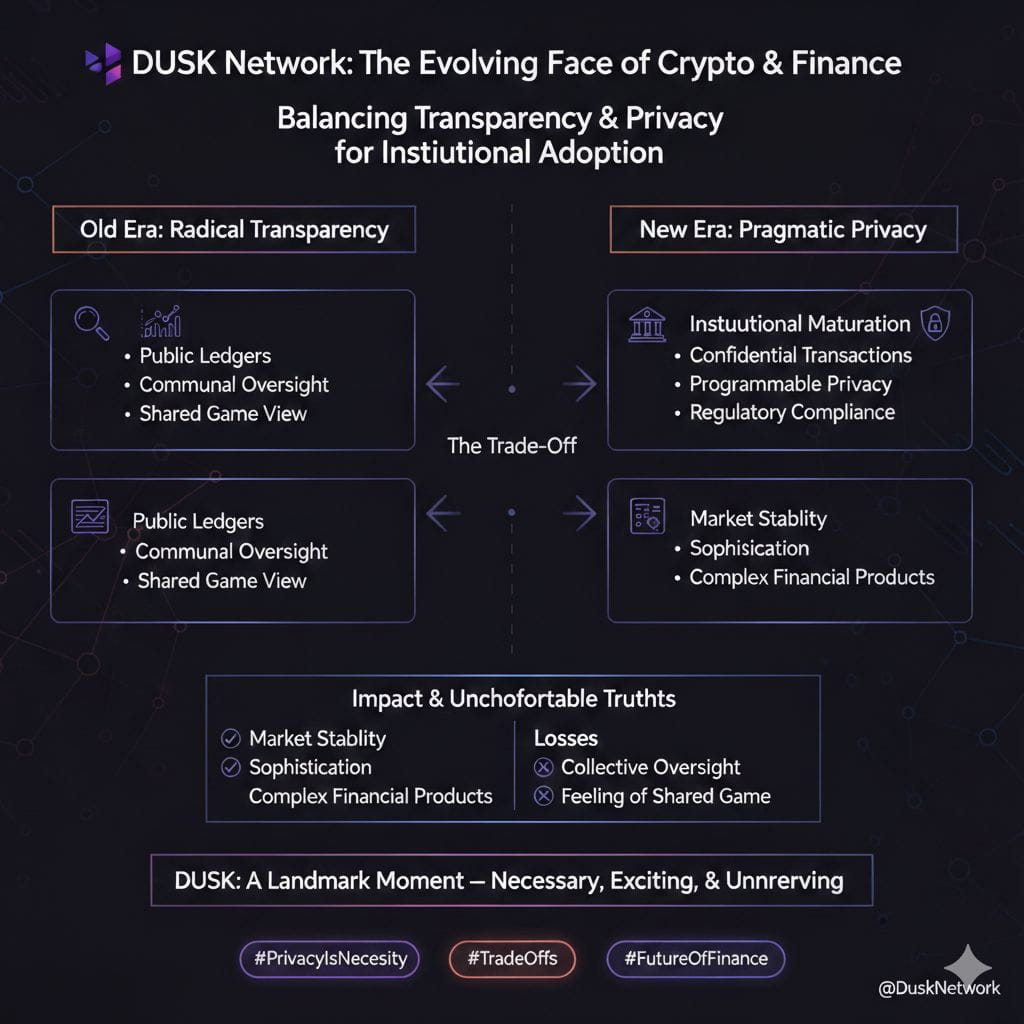
Just a few years ago the crypto world had a sort of religious devotion to transparency.
This wasn’t just a slogan or marketing gimmick it was the core of blockchain’s identity.
Every transaction was visible public and permanent.
Anyone could see who sent what how much and when.
If a whale moved a million dollars worth of Bitcoin you could see it.
If a token was being manipulated someone somewhere would spot it. There was a collective awareness a kind of strange decentralized oversight.
Transparency wasn’t just a feature it was the superpower of blockchain.
No one could cheat without leaving a trace and the market flawed as it was had a kind of honesty built into it.
But now comes DUSK Network and it is challenging this idea at its very foundation.
DUSK essentially says “Hold on maybe not everything needs to be public.”
At first glance this sounds almost heretical to anyone steeped in crypto orthodoxy.
But the story is more nuanced than a simple rebellion against transparency.
What DUSK is really doing is redefining who transparency serves and how.
DUSK isn’t just another meme coin riding the wave of hype. It isn’t a DeFi protocol designed purely for yield farming or speculative frenzy. DUSK is a layer 1 blockchain built from the ground up with regulated finance in mind.
Its architecture is designed for banks funds and institutional players who want to tokenize real assets securities or other financial instruments but do not want the world to see every move they make.
Through zero knowledge proofs DUSK allows transactions to be private yet verifiable when necessary for example by regulators or auditors.
This is the crucial point privacy here is selective.
It’s private by default but auditable when required.
From a technical perspective this is incredibly impressive.
It opens doors for institutions that have historically avoided crypto.
Hedge funds family offices large trading desks they finally have a platform where they can operate without exposing their strategies to the entire world.
Imagine a bank tokenizing bonds or trading tokenized stocks.
On traditional blockchains those moves are public and that visibility can feel like a liability.
On DUSK these institutions gain the freedom to operate efficiently and discreetly. For them this isn’t just privacy it’s essential infrastructure.
And yet while this is thrilling for institutional adoption it introduces a subtle unease when we think about the broader market. There is a side to full transparency that paradoxically protected small investors and created a certain shared understanding of what was happening in markets. When everyone could see everything it produced a collective vision.
Traders analysts and even casual observers could watch the blockchain and draw conclusions about market sentiment large movements or potential manipulations. This was imperfect of course but it created a common framework for understanding.
Now imagine the same world but with DUSK’s privacy model.
A major player executes a massive trade. No one outside the counterparty and perhaps a regulator months later will ever see it.
The rest of the market sees only fragments disconnected pieces impossible to assemble into a coherent whole. That’s the trade off institutional participation versus collective visibility.
The implications of this shift are profound. First fraud becomes more difficult to detect in real time. Services like Chainalysis which have relied on public data to monitor for illicit activity will lose much of their power.
Malfeasance doesn’t disappear it just becomes harder to see.
Second the market itself becomes less predictable.
Previously large transactions left traces signals that smaller participants could follow speculate upon or hedge against.
With DUSK these signals vanish swallowed by privacy.
Market dynamics may not be less fair they may just become less legible.
Third retail investors and smaller traders could feel increasingly disconnected from the real game.
Institutions know more see more and can act with confidence the rest of us are left piecing together a puzzle with missing parts.
Of course DUSK emphasizes that privacy does not mean impunity.
Audit mechanisms exist.
Regulators can verify transactions when necessary.
But human nature and bureaucratic reality complicate the picture. Access depends on will discretion and enforcement. What is possible in theory isn’t always guaranteed in practice. Privacy is a shield but not an unbreakable one. Still the sense of invisibility changes how markets behave and how participants perceive them.
Personally I have mixed feelings about this. On one hand I deeply understand why institutions want privacy. Without it many will never enter crypto. And without large institutional players DeFi remains a niche playground a casino where billions of dollars circulate among a small number of active traders rather than a system capable of supporting serious regulated finance. DUSK’s model is the bridge between the speculative past of crypto and the regulated future. It’s a necessary evolution if we want blockchain to truly intersect with the wider financial system.
On the other hand there’s a loss here that’s hard to quantify. We are losing something strange intangible but real the collective visibility that kept the market in some ways honest. When everyone could see everything it was difficult for even the largest players to operate completely in secret. The market had a communal eye flawed and incomplete but real that imposed a form of accountability. With DUSK’s privacy that communal lens disappears. We are entering a world where participants see only fragments of reality the full picture is reserved for a privileged few.
This is not just an academic concern. Market behavior depends on information. If transparency decreases strategies change. If smaller participants can no longer perceive the movements of larger actors the natural checks and balances embedded in shared visibility are weakened. This could make markets less volatile in some ways because large players can move without tipping their hand but in other ways it could make markets less stable. We are venturing into an era of asymmetrical knowledge where insiders operate with clarity and outsiders act in the dark.
Yet it’s important to recognize that this shift may be inevitable. Crypto is no longer a fringe playground. Regulators institutions and real world assets are coming online. To attract this next phase of adoption privacy isn’t optional it’s mandatory. DUSK is solving a problem that the earlier transparency obsessed blockchains could not how to reconcile the immutable decentralized world of crypto with the confidentiality needs of regulated finance.
In a sense DUSK represents a philosophical pivot as much as a technological one. Transparency was once sacred in crypto because it empowered everyone equally. Privacy in contrast is selective. It privileges some actors over others by design. This feels like a step away from the radical openness that originally defined the space. And that’s uncomfortable. The ideals that made crypto exciting openness shared oversight collective insight are being adjusted to accommodate institutional realism.
But maybe that’s the trade off we must accept. Crypto is growing up. Early adopters thrived in a world where everyone could see everything. They were part of a community that monitored itself discovered patterns and sometimes even restrained bad behavior through collective awareness. Now the system is maturing to support actors with very different needs banks hedge funds and large trading institutions that cannot operate under constant scrutiny. For them privacy is not a bug it’s a feature.
Still I can’t shake the feeling that something essential is being lost. Not transparency in the abstract but a shared sense of reality. When all transactions are public even imperfectly there is a communal narrative. We all see to some degree what’s happening. When privacy dominates that narrative fragments. Markets become layered what insiders know what regulators can verify and what the rest of us perceive. And while that may make large scale finance more feasible it also creates a subtle elitism.
It is worth reflecting on what this means for the average market participant. For years the crypto ecosystem gave everyone a peek behind the curtain. You could analyze the blockchain and draw insights that were once the exclusive domain of insiders. DUSK’s model changes that. The curtain is drawn. The show goes on but the audience sees only glimpses. For retail traders and analysts the playing field is less visible even if it remains technically level. Knowledge becomes fragmented and strategy must adjust accordingly.
Yet we should also consider the counterpoint. Privacy can enable broader adoption stability and even fairness in its own way. It allows financial institutions to enter the market without fear of exposing strategic positions. This could attract more liquidity more sophisticated products and ultimately a healthier ecosystem. The alternative complete transparency might keep crypto open but also limited niche and dominated by speculation. Privacy is a necessary condition for crypto to scale into mainstream finance.
In the end DUSK forces us to confront a paradox at the heart of blockchain’s evolution. Transparency created trust and collective oversight. Privacy enables growth adoption and the entry of serious financial actors. Both are valuable but they are in tension. DUSK has chosen privacy as the lever to bring the next wave of institutional adoption. That choice is bold forward thinking and pragmatic but it is also a quiet farewell to the old radical ethos of blockchain openness.
Perhaps this is the future we have been heading towards all along a crypto landscape that mirrors traditional finance with tiers of knowledge selective visibility and privacy as a shield for large actors. But I cannot help feeling ambivalent about it. There is something strangely poetic about the early days of blockchain where the ledger was visible to all and the market for all its chaos had a shared consciousness. With DUSK that shared view is replaced by selective perception. The market does not disappear it simply becomes different. More closed. More institutional. More complex. And perhaps inevitably a little less human in its transparency.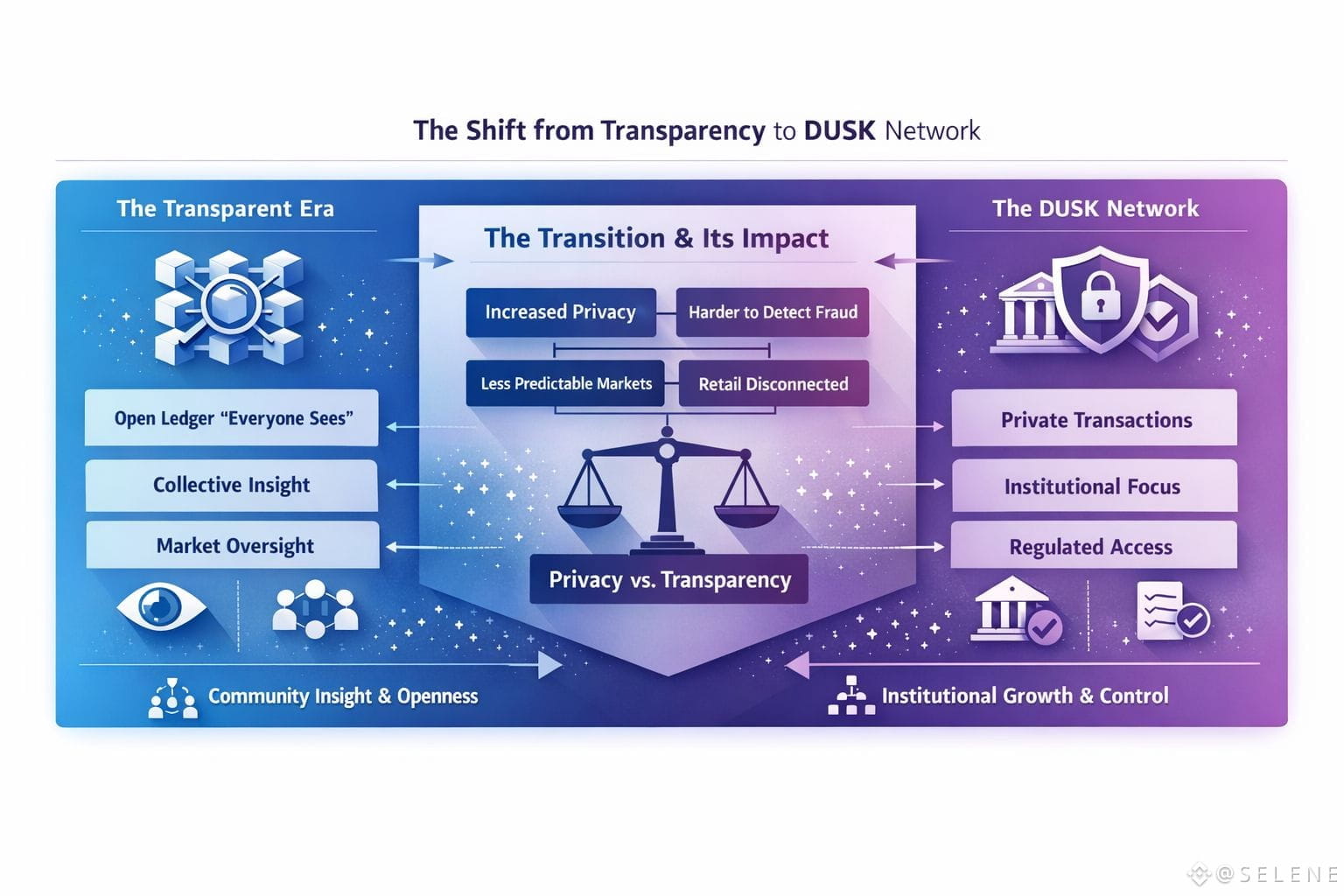
As we watch DUSK unfold we are witnessing a turning point. Crypto is no longer just a speculative playground for retail traders it is maturing into a platform capable of supporting regulated finance complex financial products and large scale institutions. This evolution is necessary for long term viability. But as we gain privacy and sophistication we lose something else the communal clarity the collective oversight the small but meaningful sense that “we are all seeing the same game.”
Maybe this is progress. Maybe it is the price we pay for adoption stability and growth. Or maybe it is a trade off we are only beginning to understand. Whatever the case DUSK reminds us that blockchain is no longer purely about radical transparency it is about balance privacy and the complex reality of bringing decentralized finance into the regulated institutional world. And for better or worse that world will look very different from the one we first fell in love with.
In the final analysis DUSK is not just a blockchain it is a mirror of our evolving priorities. It asks us to reconsider what we value the purity of transparency or the pragmatic benefits of privacy. It forces us to confront uncomfortable truths about power knowledge and trust in markets. And it leaves us perhaps with mixed feelings. For the crypto enthusiast the philosopher and the retail trader alike DUSK represents both opportunity and loss. It is a path forward yet a path that feels a little less open a little more guarded and a little more like the financial world we once sought to disrupt.
DUSK is a landmark moment.
Not just because of what it does but because of what it represents.
Transparency was a religion and privacy is now a necessity.
Institutions will thrive small investors may feel sidelined. The market will gain stability and sophistication but it may lose some of its shared communal clarity. We are entering a new era. And like any new era it is exciting necessary and slightly unnerving all at once.