

Most blockchain conversations still revolve around transactions. How fast they are, how cheap they are, how many can fit into a block. That focus made sense when blockchains were primarily used to move value. It becomes less useful the moment applications start dealing with real data at scale.
Modern applications are data-heavy by default. They generate logs, user content, models, media, records, and historical traces that far exceed what blockchains were designed to store directly. As soon as an application grows beyond simple state changes, developers are forced to look elsewhere for storage. That is where complexity begins to creep in.
@Walrus 🦭/acc exists because this gap has quietly become one of the biggest constraints in Web3.
Data Is the Hidden Bottleneck
Most applications today are not limited by computation. They are limited by data handling. Files are large. Datasets grow continuously. Availability matters more than permanence, and retrieval speed matters more than global consensus on every byte.
Blockchains were never meant to handle this type of load. Storing large blobs on-chain is expensive, slow, and unnecessary. As a result, developers stitch together systems. On-chain logic lives in one place. Data lives somewhere else. Availability guarantees depend on centralized providers or fragile incentive schemes.
This fragmentation increases operational risk. It also increases cognitive overhead for teams trying to build products rather than infrastructure.
Walrus simplifies this by giving data-heavy applications a native place to put large data without pretending it belongs on the base chain.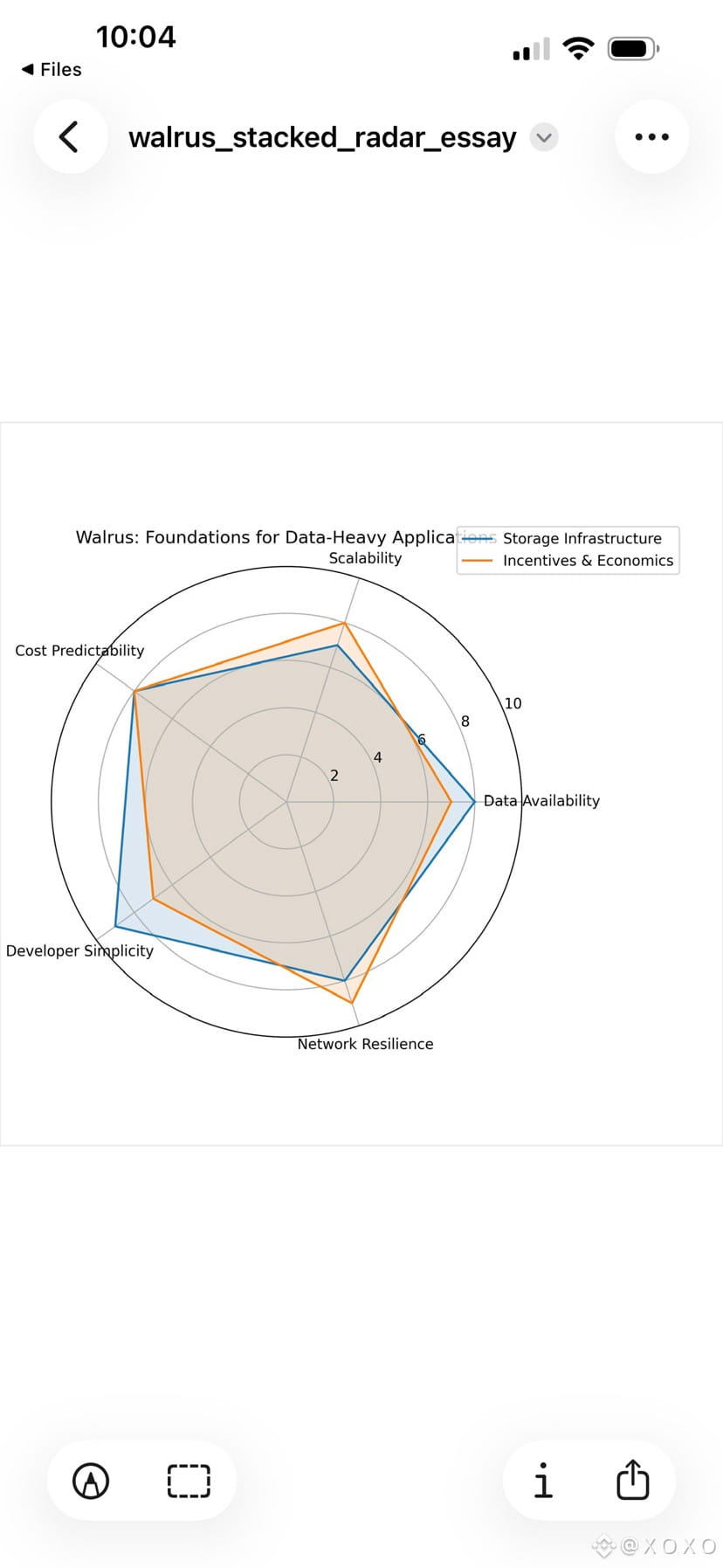
Blob Storage as an Architectural Primitive
Walrus is built around a simple idea that is often misunderstood. Not all data needs consensus. What it needs is availability.
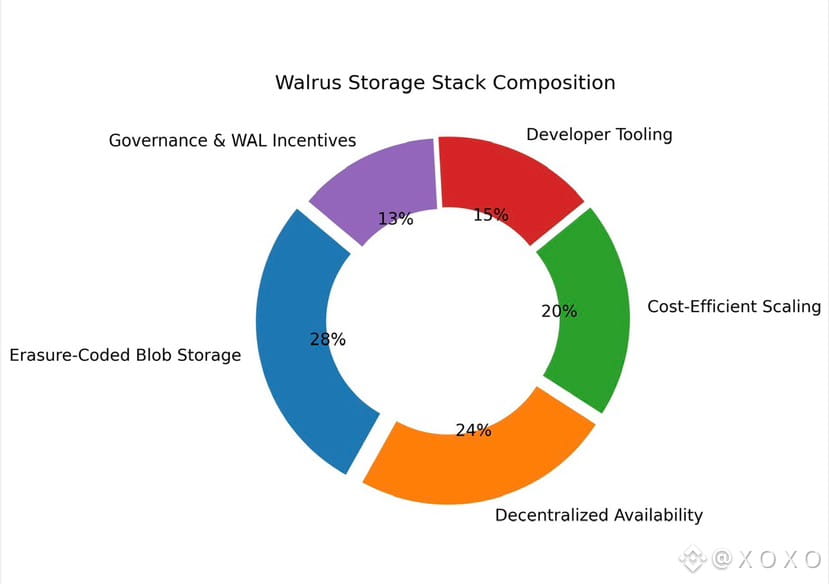
By treating large files as blobs rather than state, Walrus allows applications to offload heavy data while still preserving strong guarantees about retrievability. Erasure coding distributes each blob across many nodes, which means data remains available even when parts of the network go offline.
For developers, this removes a major design decision. Instead of choosing between cost, decentralization, and reliability, they get a system that optimizes for all three within the context that actually matters.
This is not about replacing blockchains. It is about letting blockchains do what they are good at, while data lives where it belongs.
 Why Erasure Coding Matters in Practice
Erasure coding is often described in technical terms, but its real benefit is operational simplicity. Applications do not need to worry about replicating files manually. They do not need to overpay for redundancy. They do not need to trust a single provider to keep data online.
Walrus breaks data into fragments and spreads them across the network in a way that ensures availability as long as a threshold of nodes remains active. This design reduces the risk of data loss while keeping storage costs predictable.
For data-heavy applications, predictability matters. Media platforms, AI systems, analytics pipelines, and gaming backends cannot afford surprises in storage behavior.
Walrus turns data availability into an infrastructure assumption rather than a constant concern.
Simplifying the Developer Experience
One of the quiet strengths of Walrus is that it reduces the number of architectural layers developers must manage. Instead of combining decentralized storage, availability layers, indexing services, and custom incentive logic, teams interact with a system that is purpose-built for large data.
This simplification is not cosmetic. Every additional component increases failure modes. Every dependency introduces coordination risk.
By aligning storage incentives through WAL, Walrus keeps providers honest without forcing developers to design their own economic mechanisms. Rewards and penalties ensure that uptime is not optional. Governance provides a path for evolution without hard-coding assumptions forever.
For teams building data-heavy applications, this means fewer moving parts and clearer responsibilities.
Data Availability Without Exposure
Another reason Walrus resonates with real applications is that it does not assume all data should be public in raw form. While data is distributed, access patterns can remain controlled. This is especially important for enterprise use cases where data sensitivity and compliance requirements exist.
Walrus does not market itself as a privacy layer, but its architecture naturally supports resistance to censorship and undue pressure. Data that is widely distributed is harder to suppress, alter, or disappear quietly.
For applications that depend on durable records, this resilience is more important than maximal transparency.
WAL as the Coordination Layer
Walrus would not work without WAL. The token is not an afterthought. It is the mechanism that aligns incentives across storage providers, users, and governance participants.
WAL rewards nodes that store and serve data reliably. It penalizes behavior that undermines availability. It allows the network to adjust parameters as usage patterns evolve.
This matters because data-heavy applications do not behave like financial protocols. Their load is uneven. Their growth is organic. Their requirements change over time.
WAL gives Walrus a way to adapt without breaking trust.
Why Data-Heavy Applications Care About Economics
Storage economics are often ignored until they become painful. Many Web2 systems rely on subsidized storage until costs explode. In Web3, those costs surface immediately.
Walrus offers a model where costs are tied to actual usage rather than speculation. Developers pay for what they store. Providers are compensated for what they serve. There is no need for artificial demand or inflated metrics.
This alignment makes Walrus attractive to applications that want to scale without reinventing their storage model every year.
A Better Default for Web3 Data
Perhaps the most important contribution Walrus makes is psychological. It changes the default assumption.
Instead of asking how to squeeze more data onto the chain, developers can ask what data belongs on-chain at all. State remains on the blockchain. Heavy data lives in Walrus. Availability is guaranteed. Complexity is reduced.
This separation of concerns makes systems easier to reason about and easier to maintain.
Walrus does not try to be everything. It solves one problem extremely well. Data-heavy applications need storage that is reliable, decentralized, affordable, and simple to integrate. Walrus provides that without forcing developers to compromise on architecture.
As Web3 applications grow more complex and data-driven, this kind of infrastructure stops being optional. It becomes foundational.
Walrus simplifies data-heavy applications not by hiding complexity, but by designing around it from the start.