
WAL is the kind of chart that doesn’t just move, it tests you. It tempts you into chasing candles, then punishes you for believing a bounce means safety. And yet, that’s exactly why it’s worth studying like a professional, because coins like this don’t hand out easy wins, they offer high-quality trades only to the people who respect structure, timing, and risk. Recently, WAL has been trading in the low ten-cent region, with sharp intraday swings that tell a clear story: liquidity is present, emotions are high, and the market is actively deciding what this token is truly worth in the short term.
The bigger picture is heavy. Over the past couple of months, WAL has carried the weight of a sustained decline, the kind that slowly rewires crowd psychology. In a trend like this, every rally becomes suspicious, every green candle feels like a trap, and every holder starts praying for a return to “their price” just to escape. That’s not poetic, that’s order flow. When a market spends weeks sliding, it creates layers of trapped supply above current price. Those layers don’t disappear because the project is strong. They disappear when the chart proves it can climb, then hold, then climb again, forcing sellers to back off and forcing shorts to cover.
What makes WAL different from the average speculative token is that the narrative underneath it has real infrastructure weight. The Walrus protocol is positioned around decentralized, privacy-preserving storage and data availability on the Sui ecosystem, built for distributing large blobs of data across a network in a way that aims to be censorship-resistant and cost-efficient. In a world sprinting toward data-heavy applications, especially AI-adjacent applications that demand massive throughput and availability guarantees, storage and data availability are not side quests, they are core highways. That’s why traders keep WAL on watchlists even during ugly downtrends. The story is substantial enough that if the chart ever flips momentum, the rotation into “real utility” can be fast and surprisingly violent.
But a professional trader never falls in love with the story while ignoring the tape. The tape is what pays you. And right now, the tape is shouting that WAL sits at a critical decision zone where buyers are trying to build a floor while sellers keep leaning on every recovery. In recent sessions, the market has shown a recognizable pattern: dips into the lower support area attract bids that create a bounce, then rebounds into the upper zone get sold hard, as if the market is saying, “You can breathe, but you cannot run.” This is exactly the environment where impatient traders get chopped into pieces, while disciplined traders wait for confirmation and take the cleanest slice of the move.
The first thing to understand is the battlefield of levels. There is a near-term floor that has recently acted like a line in the sand, the zone where price has repeatedly tried to break lower and has been met by defensive buying. When that floor holds, WAL can produce sharp rebounds, the kind that feel like the start of a new trend. The trap is that rebounds in downtrends often exist only to provide better sell prices. So the question is not “did it bounce,” but “did it bounce and stay bid afterward.” If price dips, recovers, and then starts printing higher lows on the intraday structure, that is the first sign of sellers losing their grip. If price dips, rebounds, then immediately collapses back into the same area, that is weakness disguised as hope.
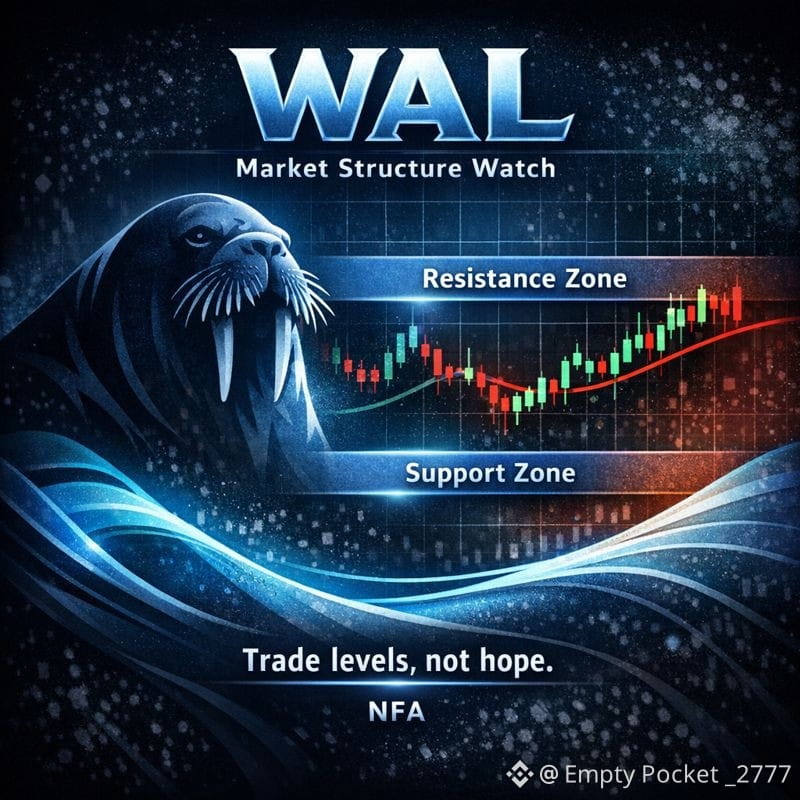
Above the market, there’s a clear ceiling, an area that has recently rejected price when buyers tried to push higher. You can think of it like the roof of the room. If WAL keeps hitting that roof and falling, then the coin is simply oscillating in a range inside a broader downtrend, and the most reliable strategy is not to predict a breakout, it’s to trade with strict rules or wait. If WAL finally breaks through that ceiling and then holds it as support, that’s where the tone changes. That’s where a coin stops being “a falling knife that sometimes bounces” and starts becoming “a structured reversal candidate.”
A proper pro-trader read of this setup focuses on behavior around those boundaries. If WAL is genuinely shifting from distribution to accumulation, you’ll feel it. The pullbacks get bought earlier, the recoveries get less violently sold, and the market starts spending more time above the midpoint of the range instead of below it. Volume tends to show up not only on pumps, but also on dips, and that’s a key detail most people miss. When volume only appears during green candles, it often means late buyers are getting harvested. When volume shows up during red candles and price still stabilizes, it can signal stronger hands building positions.
Now let’s translate this into a trader’s plan without turning it into a sterile checklist. There are two clean ways WAL can pay: either through a true reclaim of the ceiling level that flips market structure, or through a controlled bounce off the floor that stays intact long enough to let you ride the mean reversion. In the first scenario, the trader waits for WAL to push above resistance, then watches for the market to retest that zone and hold it. If the hold is real, that reclaimed level becomes the springboard. That’s where you can aim for a first push into the next liquidity pocket, then a second push into the prior price memory zone from weeks earlier, then potentially a third extension if momentum and sentiment turn risk-on. In the second scenario, the trader treats the floor like a live wire. If it holds and the bounce shows strong follow-through, you can take a tactical long, but you do it knowing you are trading inside a larger downtrend, so profits must be respected and risk must be tight. The money in these trades comes from precision, not from bravery.
The bearish side is just as important, because WAL is absolutely capable of turning a small mistake into a painful lesson. If the floor breaks cleanly, and price cannot reclaim it quickly, the psychology flips sharply. Dip buyers become trapped, then they become sellers on the next bounce. Shorts get bolder. Liquidity thins out at the worst possible moment. This is how a chart goes from “rangebound and tradable” to “sliding and hostile.” In that environment, the best decision often isn’t to short impulsively, it’s to wait for a bounce into resistance and then judge whether sellers are still in control. Good shorts are not about being pessimistic, they’re about timing your entry where the market naturally offers supply.
One detail traders sometimes overlook with coins like WAL is the presence of perpetual futures markets and leverage. The existence of leverage changes the way moves unfold. It can create sudden squeezes when shorts get crowded, and it can create fast liquidations when longs overextend. The result is a chart that can whip both directions even when the broader trend is down. For a disciplined trader, that’s not scary, it’s information. It means you must size properly, avoid emotional entries, and treat every setup as guilty until proven innocent. If you trade WAL like a calm large-cap asset, it will humble you. If you trade it like a volatile alt with real liquidity, it becomes manageable.
Fundamentally, WAL sits in a category that the market tends to revisit whenever narratives around decentralized infrastructure heat up. Storage and data availability are not “nice-to-have” features for modern on-chain applications, they are structural requirements. If the broader market enters a phase where builders, funds, and traders begin rotating into infrastructure bets again, WAL becomes the type of token that can catch a wave. But the timing is everything. Fundamentals can explain why a coin deserves attention. Only price action decides when the coin is ready to run.
So the emotional truth, the one professionals quietly accept, is this: WAL doesn’t need you to believe. It needs you to *observe*. Watch how it behaves at the floor. Watch how it reacts at the ceiling. Notice whether bounces are getting sold faster or slower. Notice whether dips are getting absorbed with confidence or with panic. Then act only when the market gives you something clean. If WAL reclaims resistance and holds, it can evolve from a brutal downtrend into a reversal candidate with room to breathe. If it fails and loses support, it can sink into a deeper phase where patience is the only edge.
WAL is not a coin for people who want certainty. It’s a coin for traders who want opportunity and can handle the pressure of waiting until the chart finally shows its hand. The ones who win here aren’t the loudest, they’re the calmest. They let the market confirm the story, then they step in with discipline and leave with profit before the crowd realizes the mood has changed.