

Vanar, I see a project that is trying to feel like infrastructure first and marketing second, because everything about the way it presents itself keeps pulling the conversation away from simple chain speed talk and toward a broader idea of what an L1 should do if it wants to support real usage at scale, where costs stay predictable, experiences stay smooth, and builders do not have to fight the network every time demand rises.
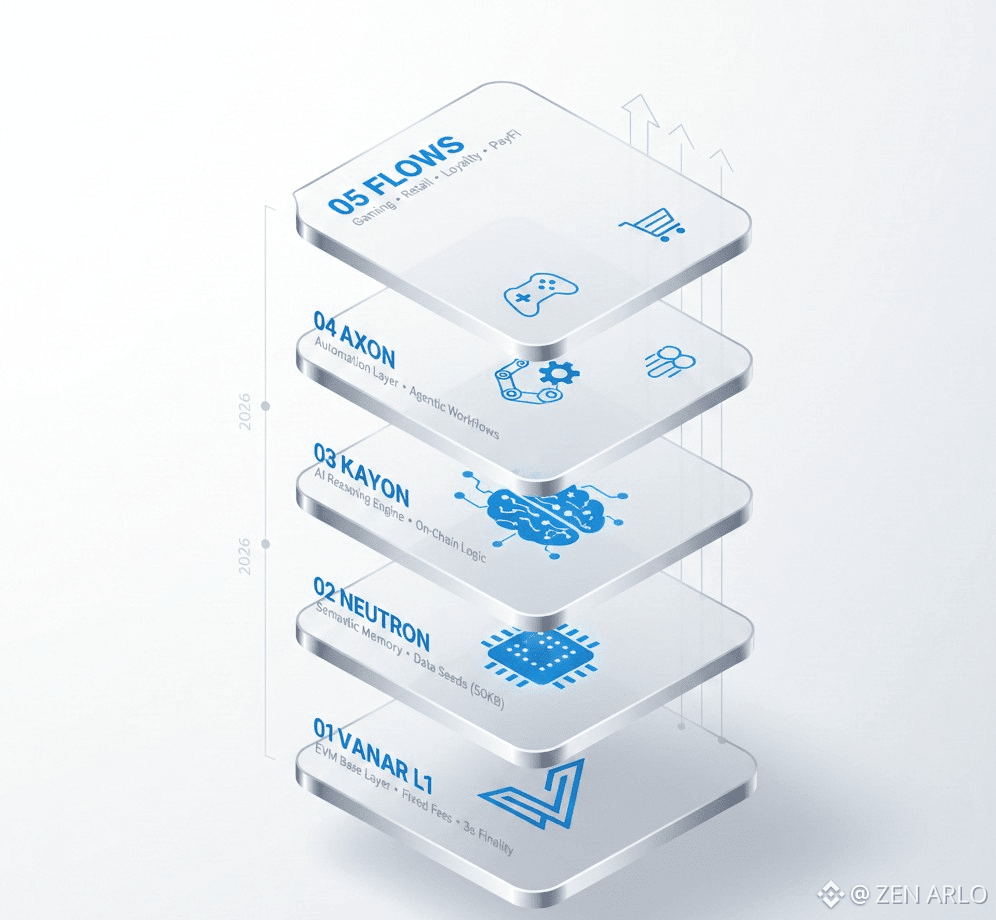
What stands out to me is that Vanar does not act like the chain is the whole product, because it keeps placing the chain at the bottom of a larger stack where memory and reasoning sit above execution, and that framing tells you what they believe the next adoption wave will look like, since modern applications are not only about sending tokens and calling contracts but about keeping context, handling data responsibly, and enabling workflows that can be verified without becoming slow or expensive the moment real users arrive.
The fee philosophy is one of the clearest signals of intent, because Vanar leans into the idea of fixed and predictable costs and transaction handling that is meant to feel fair rather than auction based, and even if someone does not care about the underlying mechanics, the outcome matters a lot for gaming, payments, and consumer apps where users drop off quickly when they see costs change without warning, which is why this part of the design reads like a product decision more than a technical preference.
The technical approach feels deliberately practical, because the project stays close to EVM compatibility so builders can work with familiar tools and patterns, and at the same time it tunes the chain for faster cadence and higher throughput so the experience can feel responsive, which is usually the route taken by teams that want to get developers shipping quickly and want to lower the psychological barrier that comes from learning a completely new environment before building anything meaningful.
I also pay attention to how they describe validation and network stewardship, because the message suggests a controlled early phase that expands outward through a reputation driven process, and that kind of setup is typically chosen when a team wants stability and predictable performance during the first waves of growth, while still leaving room for a broader validator set later, which becomes an important milestone to watch because decentralization is not only a narrative point but a trust profile that changes as participation widens.
Where Vanar really tries to differentiate is above the base chain, because the way it talks about memory through Neutron and reasoning through Kayon suggests they want data and context to become native building blocks rather than external services that cannot be verified, and if you take that seriously then the project is aiming for a world where applications can store compressed, portable units of information and then query them for decisions, compliance style checks, and agent driven workflows, which fits the direction the industry is moving toward as AI becomes part of how people interact with software every day.
The token story, as I see it, is meant to be simple and functional, because VANRY is positioned as the fuel for activity and participation rather than a decorative badge, and that matters because the cleanest utility models are the ones where increased usage naturally creates increased demand for gas, staking, and network level incentives, while the more ambitious part of the story is whether the ecosystem layers and products become sticky enough that usage is sustained and not just a short burst around announcements.
When I think about what is next, I do not get lost in vague promises, because the stack presentation itself makes the near term targets fairly obvious, since the layers described as coming soon are the ones that need to turn the platform narrative into something developers can actually use repeatedly, where automation becomes a real bridge between reasoning and execution, and application flows become repeatable templates that reduce time to deployment for teams that care about shipping rather than experimenting forever.
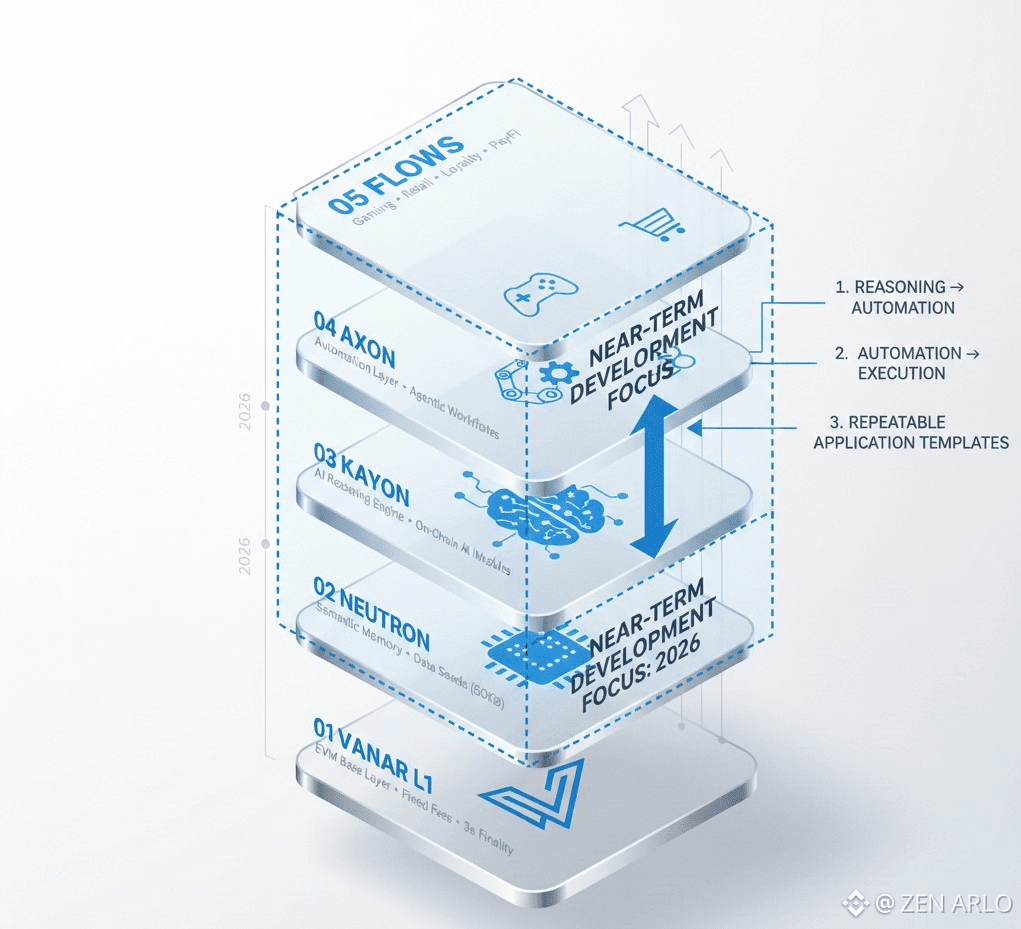
Vanar is trying to win by making blockchain feel normal in the places where blockchain usually breaks, which is when fees become unpredictable, when user experience becomes slow, and when applications cannot keep context across sessions and workflows, and if they execute the higher layers with the same discipline they describe at the base layer then the project can become more than an L1 claim, because it can become a platform that makes builders faster and makes real world style products easier to maintain, while the proof will always show up in the same place, which is whether the stack creates steady usage that does not depend on hype cycles and whether the network keeps expanding in capability without losing the predictability that the entire story is built on.