
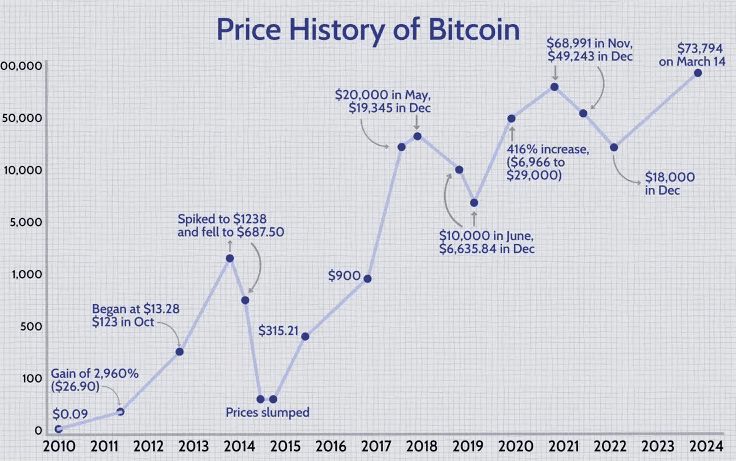
Among asset classes, Bitcoin has had one of the more volatile trading histories. The cryptocurrency's first significant price increase occurred in October 2010 when the value of a single bitcoin started moving past its long flat price of less than $0.10.
The price changes for Bitcoin generally reflect investor enthusiasm, demand, and supply. Satoshi Nakamoto, the anonymous Bitcoin inventor(s), designed it for use in daily transactions—but it has become far more than a payment method.
It attracted traders who began to bet on its price changes. Investors turned to Bitcoin as a way to store value, generate wealth, and hedge against inflation, and institutions worked to create Bitcoin investment instruments.
Bitcoin's price fluctuations primarily stem from investors and traders hoping for an ever-increasing price in anticipation of riches. If you're thinking of investing in Bitcoin, be sure to research the best cryptocurrency exchanges and apps first.
2009 - 2015
2009–2015
Bitcoin had a price of zero when it was introduced in 2009. Its price jumped from its long-held level of $0.10 to $0.20 on Oct. 26, 2010. Before the year had closed out, it had reached $0.30. In 2011, it started growing past $1, reaching a peak of $29.60 on June 8, 2011; however, a sharp recession in cryptocurrency markets followed, and Bitcoin's price dropped, closing out the year at about $5.
2
The year 2012 proved to be a generally uneventful year for Bitcoin, though it did increase by a few dollars; however, 2013 witnessed strong gains in price. Bitcoin began the year trading at $13, crossed $100 by April, then $200 by October.
The remainder of the year witnessed historic gains for Bitcoin. It crossed $1,000 in November and closed out the year at $732.
2016 - 2020
2016–2020
Prices slowly climbed through 2016 to over $900 by the end of the year. In 2017, Bitcoin's price hovered around $1,000 until it broke $2,000 in mid-May and then skyrocketed to close at $19,188 on Dec. 16.
2
Mainstream investors, governments, economists, and scientists took notice, and other entities began developing cryptocurrencies to compete with Bitcoin.
Bitcoin's price moved sideways in 2018 and 2019, with small bursts of activity. For example, there was a resurgence in price and trading volume in June 2019, with the price surpassing $10,000. However, it fell to a closing price of $6,612 by mid-December.
In 2020, the economy shut down due to the COVID-19 pandemic. Bitcoin's price burst into action once again. The cryptocurrency opened the year at $7,161. The pandemic shutdown and subsequent government policies fed investors' fears about the global economy and accelerated Bitcoin's rise.
At the close on Nov. 23, Bitcoin was trading for $18,383. Bitcoin's price closed at $28,993 on Dec. 31, 2020, increasing 416% from the start of that year.
2021 - 2023
2021–2023
Bitcoin took less than a month in 2021 to smash its 2020 price record, surpassing $40,000 by Jan. 7, 2021. By mid-April, Bitcoin prices reached new all-time highs of over $60,000 as Coinbase, a cryptocurrency exchange, went public. Institutional interest propelled its price further upward, and Bitcoin reached a peak of $64,895 on April 14, 2021.
2
By the summer of 2021, prices were down by 50%, closing at $30,829 on July 19. September saw another bull run, with prices scraping $52,956, but a large drawdown took it to a closing price of $40,597 about two weeks later.
On Nov. 10, 2021, Bitcoin again reached an all-time high of $69,000 before closing at $64,921. In mid-December 2021, Bitcoin fell to a close of $46,211. The price started fluctuating more as uncertainty about inflation and the emergence of a new variant of COVID-19, Omicron, continued to spook investors.
2
Between January and May 2022, Bitcoin's price continued to gradually decline, with closing prices only reaching $47,459 by the end of March before falling further to $29,000 on May 11. This was the first time since July 2021 that Bitcoin closed under $30,000. On June 13, crypto prices plunged. Bitcoin dropped below $23,000 for the first time since Dec. 2020. Bitcoin then dropped below $20,000 by the end of 2022.
3
Fortunes changed for Bitcoin in 2023, which saw a stellar rise in the price of the cryptocurrency. Bitcoin opened 2023 at a price of $16,530. It rose consistently throughout 2023, ending the year at $42,258.
2024
2024
In January 2024, the long fight for Bitcoin Spot ETFs came to a close after the SEC was forced by courts to review its denial of certain Bitcoin-related investment products. Some brokerages swarmed the market and increased their holdings, while others, like Grayscale's Bitcoin Trust (GBTC), experienced significant outflows at the onset.
The outflows from certain funds slowed going into March, settling the market somewhat. The marketwide rebalancing was likely because there were suddenly more options for investors to choose from.Bitcoin's price climbed quickly after the fund approvals—in late February and early March, it once again breached $60,000, setting a high of $69,210 on March 6 and another of $70,184 on March 8. On March 14, Bitcoin continued setting records, reaching $75,830 by mid-day on EXMO, a cryptocurrency exchange in Poland.