


Introduction
Dusk Network is not trying to be just another privacy coin. Its goal is much bigger. Dusk wants to build the basic infrastructure that real financial systems can use on a public blockchain. On January 7, 2025, Dusk launched its main network after more than six years of work. The team sees this launch not as the finish line, but as the starting point for a new kind of financial system.
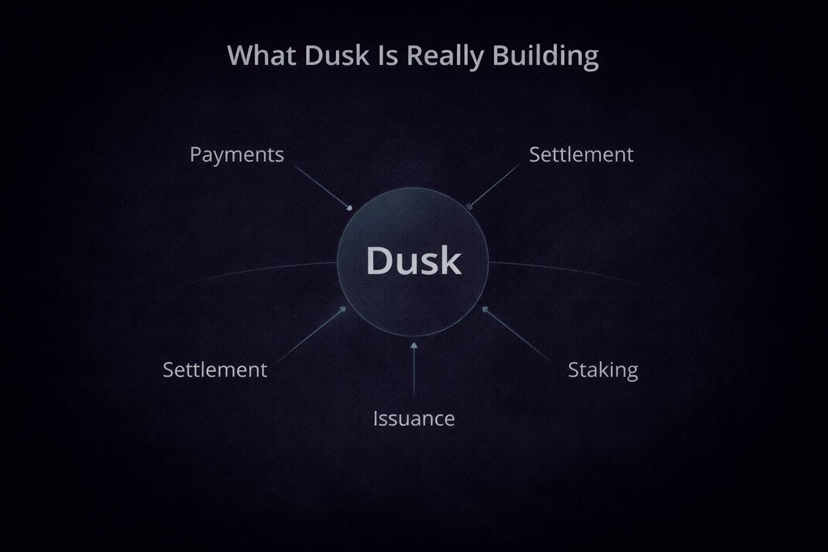
In this system, payments, asset issuance, and settlement can all happen on-chain while keeping sensitive information private and still allowing audits when needed. After the launch, Dusk focused on several major upgrades: regulated payments, an Ethereum-compatible smart contract layer, new staking models, and a system for tokenizing real-world assets. By breaking the blockchain into separate parts and adding cross-chain connections, Dusk aims to serve developers and institutions that need both privacy and legal clarity.
Dusk Pay – regulated payments on blockchain
One of Dusk’s first major upgrades after launch is Dusk Pay. This is a payment system designed to follow financial rules while running on a blockchain. It is built around a digital token that represents real money, similar to a regulated stablecoin.
Dusk Pay is designed so individuals and institutions can make payments that are legally recognized. This makes it suitable for everyday use under European financial laws. By combining blockchain transfers with legal recognition, payments can be faster and cheaper than traditional systems.
At the same time, Dusk Pay uses Dusk’s privacy features. This means normal payment details can stay private, while regulators can still check the system when required. In simple terms, people get privacy, and authorities still get oversight.
Lightspeed – smart contracts that work like Ethereum
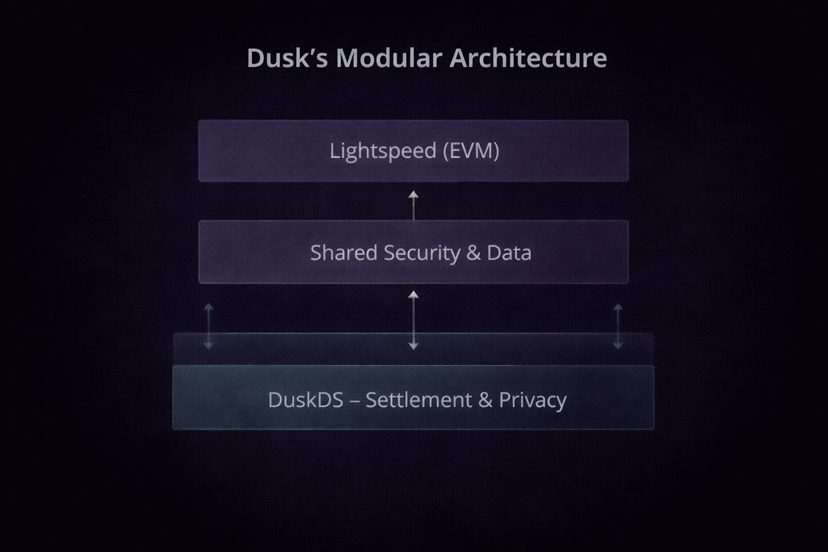
Dusk created Lightspeed to make it easy for developers to build on the network. Lightspeed is compatible with Ethereum’s smart contract system, which means developers can use familiar tools and programming languages.
Instead of creating a completely new system, Dusk chose compatibility to reduce friction. Smart contracts run on a layer that handles execution, while the main Dusk chain handles settlement, security, and privacy. This separation allows the system to evolve without breaking everything.
Lightspeed uses a modern design that allows data to be handled efficiently and upgraded over time. Right now, transactions finalize after a short delay, but future updates aim to make final settlement almost instant.
For developers, this means they can deploy Ethereum-style contracts while gaining privacy features. Contracts can stay private by default and reveal information only when proof is needed, such as for regulators or business partners. With future cross-chain connections, assets on Dusk can also move between Ethereum, Solana, and Dusk’s own smart contract layer.
Hyperstaking – easier and smarter staking
Most blockchains require users to manually stake tokens or delegate them to validators. Dusk simplifies this with a system called hyperstaking. In hyperstaking, smart contracts can handle staking automatically.
This allows new services like staking pools, where users deposit tokens and let a contract manage everything. Users can still earn staking rewards while keeping access to their funds through derivative tokens. This improves liquidity and makes staking easier for everyone.
Hyperstaking also allows new models, such as reward-sharing systems where users earn extra benefits by bringing new participants. These features turn staking into a flexible financial tool rather than a technical chore.
Dusk still keeps traditional staking rules. Users need a minimum amount of tokens to stake, but there is no maximum limit. Staked tokens become active after a short period, and users can unstake without penalties. New tokens are released slowly over decades, with rewards reducing every few years. Validators who misbehave are temporarily suspended instead of permanently punished. This design encourages long-term participation and network stability.
Zedger – tokenizing real-world assets
Dusk is not only about payments and staking. It also focuses on tokenizing real-world assets like stocks, bonds, and property. This is where Zedger comes in.
Zedger is designed for assets that must follow strict laws. Unlike simple tokens, Zedger tokens know who is allowed to own them and who is not. Transfers are restricted, investor identities are checked, and rules are enforced directly by smart contracts.
Real-world assets often need special actions like dividends, voting, or court-ordered changes. Zedger includes these features by design. If someone loses access to their wallet or a legal authority orders a change, authorized parties can move tokens safely. Only approved investors can hold or trade these assets. This turns tokenized assets into fully usable financial instruments, not just digital representations.
Two transaction types – public and private on the same chain
 At the same time, Dusk Pay uses Dusk’s privacy features. This means normal payment details can stay private, while regulators can still check the system when required. In simple terms, people get privacy, and authorities still get oversight.
Lightspeed – smart contracts that work like Ethereum
Dusk created Lightspeed to make it easy for developers to build on the network. Lightspeed is compatible with Ethereum’s smart contract system, which means developers can use familiar tools and programming languages.
Instead of creating a completely new system, Dusk chose compatibility to reduce friction. Smart contracts run on a layer that handles execution, while the main Dusk chain handles settlement, security, and privacy. This separation allows the system to evolve without breaking everything.
Lightspeed uses a modern design that allows data to be handled efficiently and upgraded over time. Right now, transactions finalize after a short delay, but future updates aim to make final settlement almost instant.
For developers, this means they can deploy Ethereum-style contracts while gaining privacy features. Contracts can stay private by default and reveal information only when proof is needed, such as for regulators or business partners. With future cross-chain connections, assets on Dusk can also move between Ethereum, Solana, and Dusk’s own smart contract layer.
Hyperstaking – easier and smarter staking
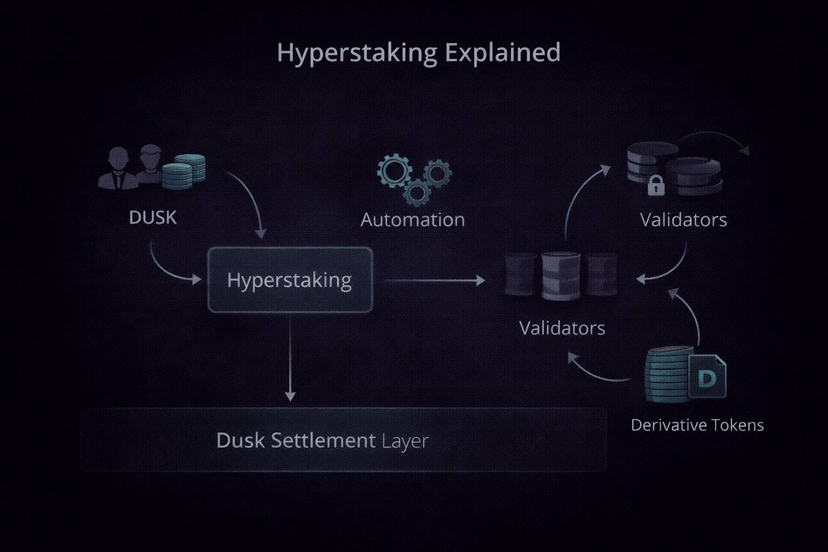 Most blockchains require users to manually stake tokens or delegate them to validators. Dusk simplifies this with a system called hyperstaking. In hyperstaking, smart contracts can handle staking automatically.
This allows new services like staking pools, where users deposit tokens and let a contract manage everything. Users can still earn staking rewards while keeping access to their funds through derivative tokens. This improves liquidity and makes staking easier for everyone.
Hyperstaking also allows new models, such as reward-sharing systems where users earn extra benefits by bringing new participants. These features turn staking into a flexible financial tool rather than a technical chore.
Dusk still keeps traditional staking rules. Users need a minimum amount of tokens to stake, but there is no maximum limit. Staked tokens become active after a short period, and users can unstake without penalties. New tokens are released slowly over decades, with rewards reducing every few years. Validators who misbehave are temporarily suspended instead of permanently punished. This design encourages long-term participation and network stability.
Zedger – tokenizing real-world assets
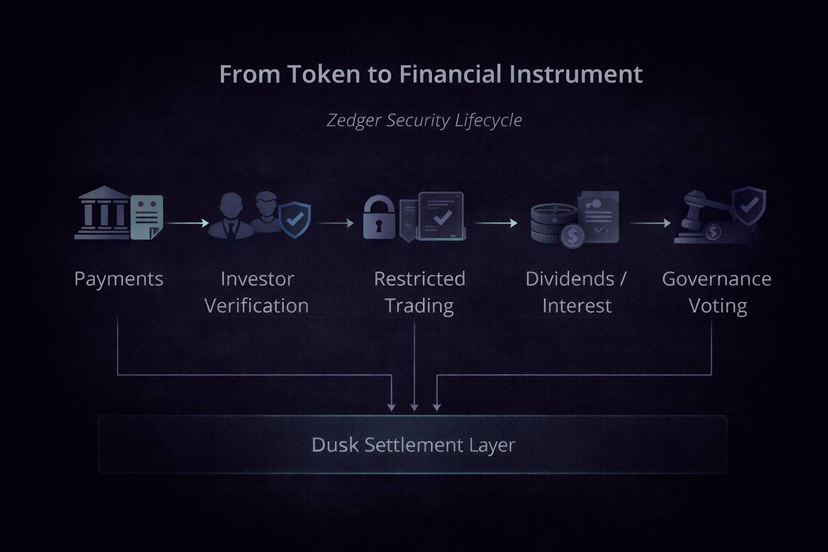 Dusk is not only about payments and staking. It also focuses on tokenizing real-world assets like stocks, bonds, and property. This is where Zedger comes in.
Zedger is designed for assets that must follow strict laws. Unlike simple tokens, Zedger tokens know who is allowed to own them and who is not. Transfers are restricted, investor identities are checked, and rules are enforced directly by smart contracts.
Real-world assets often need special actions like dividends, voting, or court-ordered changes. Zedger includes these features by design. If someone loses access to their wallet or a legal authority orders a change, authorized parties can move tokens safely. Only approved investors can hold or trade these assets. This turns tokenized assets into fully usable financial instruments, not just digital representations.
Two transaction types – public and private on the same chain
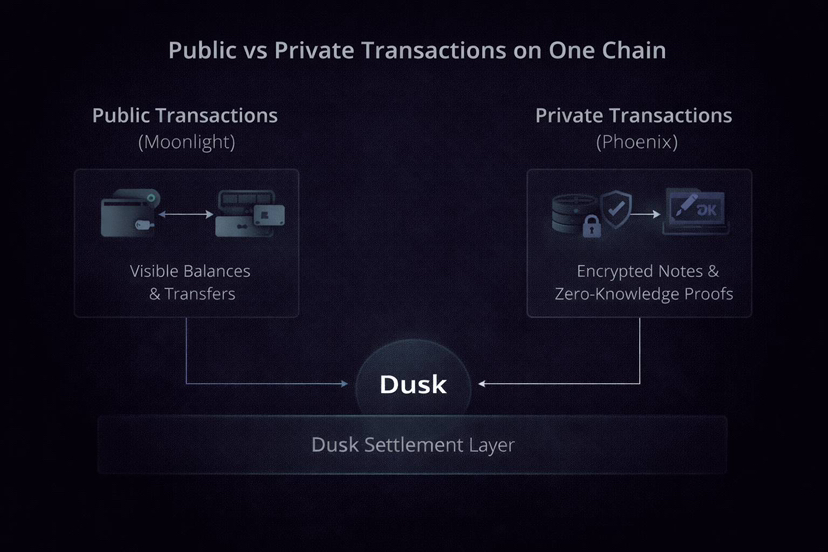
Dusk supports two ways to move assets. One is fully transparent, where balances and transfers are visible. The other is fully private, where transaction details are hidden using cryptography.
In private mode, the sender, receiver, and amount are hidden, but the system still proves that everything is valid. Users can share specific details later if needed, such as during an audit.
Both transaction types exist on the same blockchain. Assets can move between public and private modes without leaving the network. This allows Dusk to support open systems that need transparency and regulated products that need confidentiality, all in one place.
Bridges and cross-chain connections
As Dusk moves toward a modular design, bridges become important. Users can move tokens between Dusk’s settlement layer and its smart contract layer. Tokens used for private transactions must first be made public before moving across layers.
Once bridged, DUSK tokens are used to pay transaction fees and run smart contracts. Future upgrades allow assets to move across different blockchains using secure cross-chain technology. This lets Dusk assets interact with Ethereum and Solana ecosystems.
When Dusk launched its main network, older tokens from other chains were burned and replaced with native tokens. This ensured a clean supply and allowed all tokens to participate in the new system. With Ethereum compatibility, Dusk aims to attract developers who want privacy without giving up existing tools.
Why all this matters
Finance needs privacy to protect users and markets, but it also needs rules and proof. Dusk is built around this balance. Users can choose privacy or transparency depending on the situation. Payments and smart contracts follow regulations. Staking becomes flexible and liquid. Tokenized assets follow real laws. Cryptography ensures everything works securely.
By separating settlement from execution, Dusk can upgrade parts of the system without disrupting everything else. This mirrors how traditional finance separates roles like exchanges and clearing systems. With cross-chain connections, assets created on Dusk can eventually work with the wider blockchain world.
Conclusion
Dusk Network is not just another blockchain. It is building a private, compliant, and flexible financial infrastructure. Through regulated payments, Ethereum-compatible smart contracts, advanced staking, real-world asset tokenization, and privacy-preserving transactions, Dusk creates tools that both institutions and developers can use.
Privacy is built in, but proof is always possible. As cross-chain connections improve and adoption grows, Dusk could become a meeting point between traditional finance and decentralized finance. Whether this vision succeeds depends on real usage and regulatory progress, but the foundation built in 2025 and 2026 shows a serious effort to create the future rails of on-chain finance.