
Most crypto projects focus on letting you do things on a blockchain. Plasma quietly offers something different: the confidence that the chain will behave predictably and consistently, even when stress hits. That may sound boring until you look at Plasma’s real goal. Stablecoins aren’t game tokens — they are real money for people and businesses. And with money, the biggest risk isn’t speed, it’s uncertainty. If a payment rail behaves differently under load, breaks in edge cases, or can’t be audited cleanly, it simply won’t be trusted for serious use.
This is where Plasma’s mindset stands out: it thinks like a payments company running a stablecoin chain. Operational reliability is the core narrative. Design choices start to make sense once you ask one question: How do we make this behave like real infrastructure?
Determinism over hype in stablecoin rails
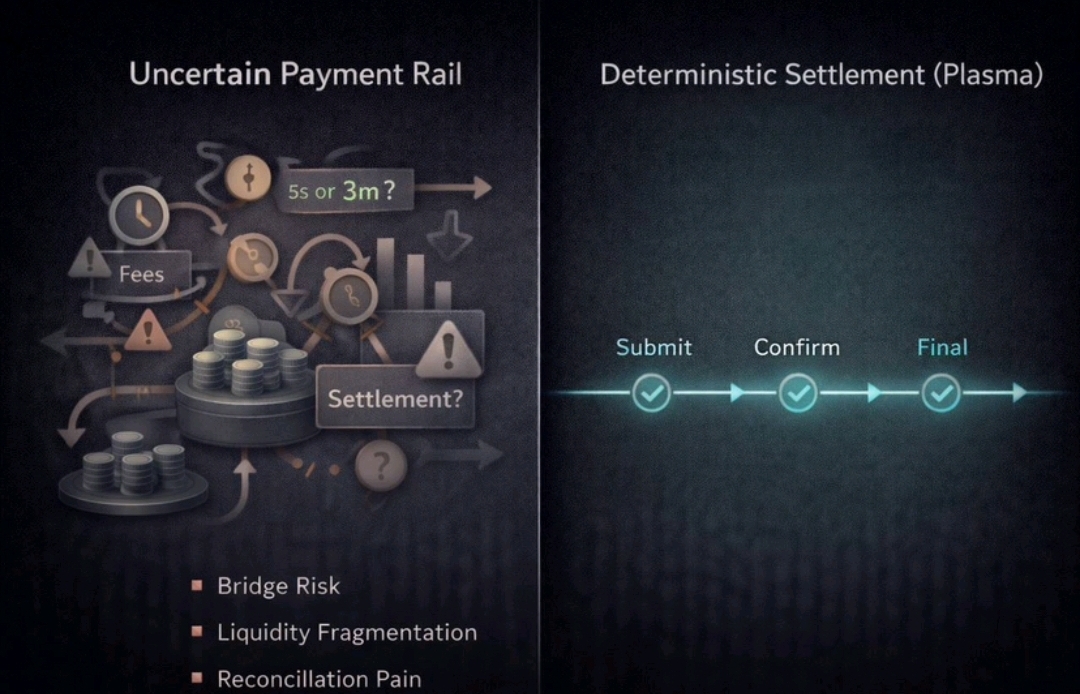
In crypto, “fast” is often marketed as flexibility. In payments, determinism wins. Determinism means predictable behavior: fees don’t spike randomly, confirmations aren’t guesswork, finality isn’t ambiguous. Once a transaction is confirmed, it stays confirmed. Node failures don’t turn the network into a mystery. That’s the difference between a chain that’s fun to experiment with and one a business can rely on without fear.
If Plasma becomes a backbone for stablecoin activity, it must act like settlement infrastructure — not a social experiment.
Rust as a signal of seriousness
Most users don’t care what language a chain is written in. Builders and enterprises absolutely do. Plasma’s heavy use of Rust isn’t about raw performance — it’s about safety and correctness. Payments infrastructure needs code that’s harder to fail silently, easier to reason about, and suited for rigorous testing. Rust doesn’t magically solve security, but choosing a modern, safety-oriented stack signals a team optimizing for a world where outages and bugs are far more costly than benchmark speed.
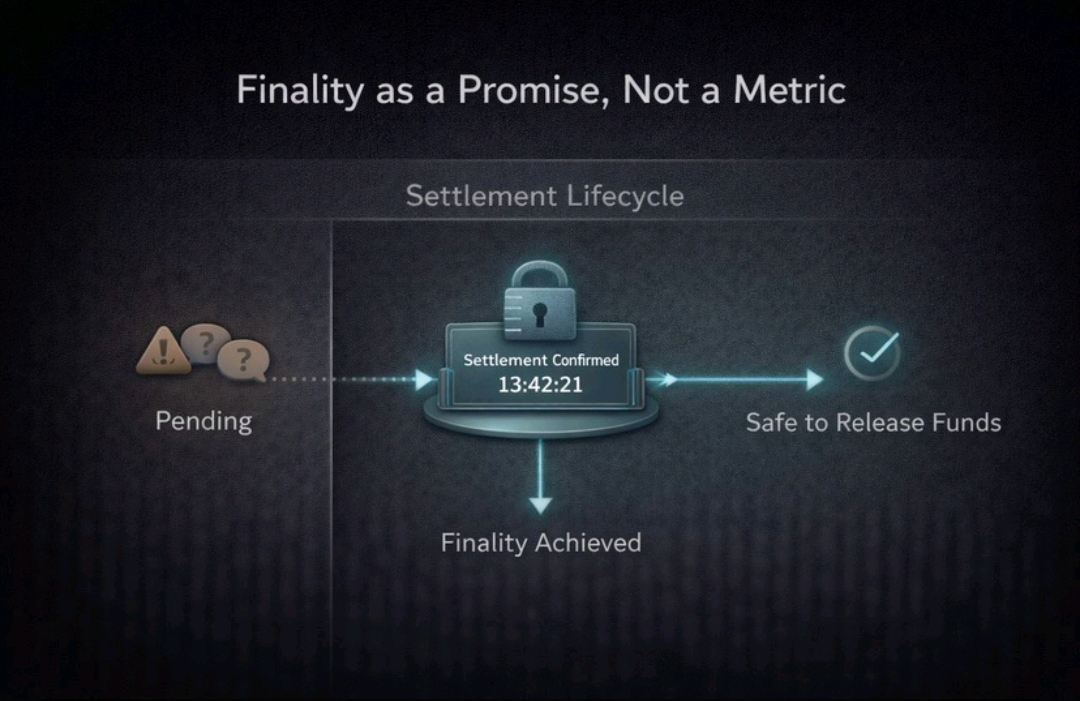
Finality as a promise, not a stat
Finality isn’t a leaderboard number — it’s a commitment. When companies pay suppliers or run batch payouts, they need to know exactly when money is settled. Slow or inconsistent finality introduces buffers, manual checks, and mistrust. Plasma prioritizes strong guarantees over marketing speed, aiming to make settlement feel definitive. That reduces hidden operational costs like waiting, reconciliation, and human verification.
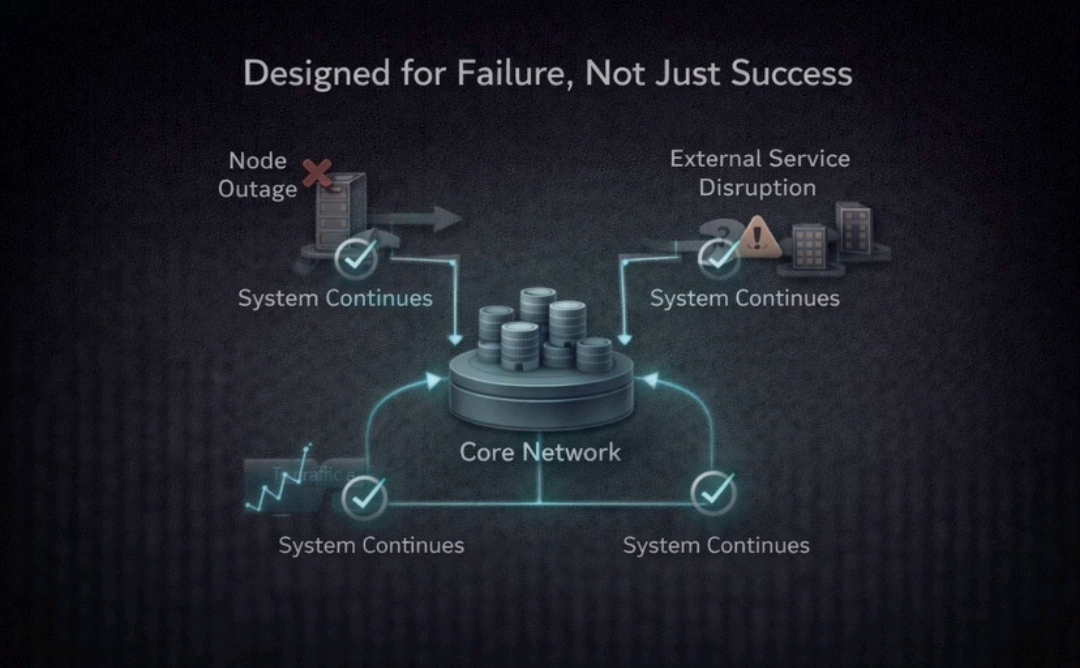
Planning for failure, not just success
Financial infrastructure isn’t defined by good days — it’s tested on bad ones. Node failures, traffic spikes, network partitions, spam edge cases. Plasma assumes these will happen and designs for them. Its node architecture allows lightweight observers alongside full execution, enabling broad participation without forcing everyone to validate. More independent operators mean more redundancy, more verification paths, and higher resilience. In essence, Plasma thinks like an SRE team: monitoring, redundancy, and recovery are part of the product.
Modular data availability matters more than people think
Not every application needs the same data guarantees. Some require maximum security, others prioritize cost efficiency. Plasma’s configurable data availability lets applications choose the right balance instead of forcing everyone into the most expensive model. For stablecoins — spanning simple transfers, merchant payments, treasury operations, and programmable finance — this flexibility isn’t fancy, it’s essential.
Security economics that scale with maturity
Stablecoin rails live or die by sustainable security. Plasma avoids the common trap of either overpaying for security early or underpaying later. Emissions are tied to real participation and network growth, keeping security costs proportional to maturity. Penalties focus on slashing rewards rather than principal, discouraging bad behavior without terrifying honest operators. The goal isn’t casino economics — it’s long-term, believable security.
Predictable fees build real trust
Stablecoin users don’t want surprise discounts or chaotic fee markets. They want predictability. Plasma’s economics aim to balance issuance and usage while preventing runaway supply growth. This kind of boring, well-tested economic plumbing is exactly what businesses can model, budget, and depend on.
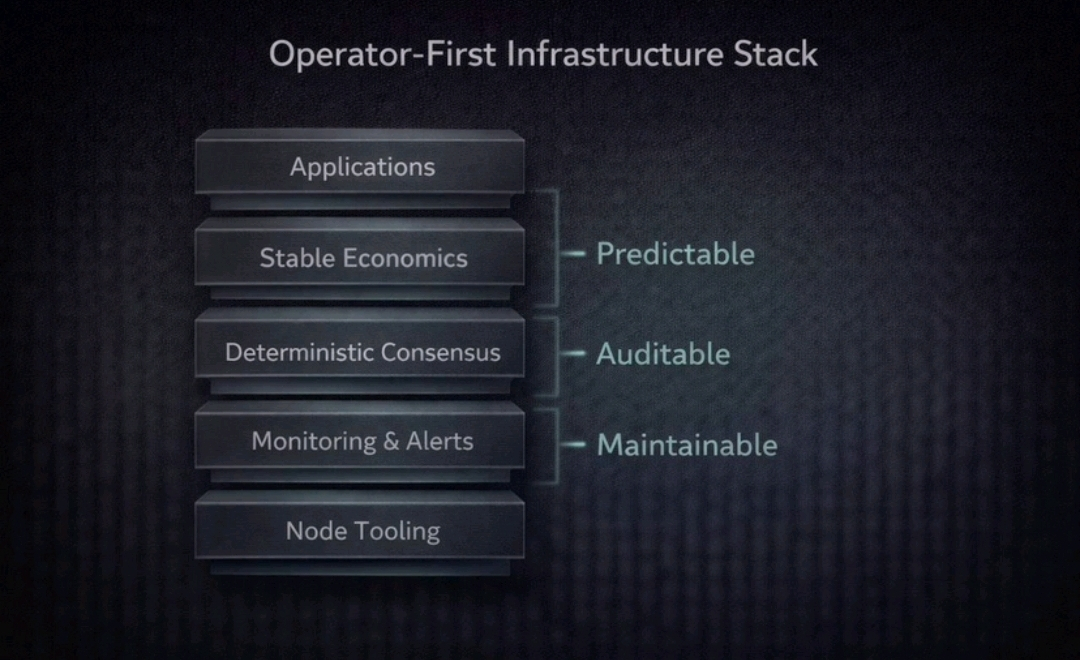
Operator-first thinking changes everything
Many chains prioritize end users first. Plasma prioritizes operators — wallets, payment apps, custodians, compliance teams, treasury systems. When operator experience breaks, user experience follows. By optimizing for predictable finality, consistent behavior under load, clean node tooling, and stable economic rules, Plasma builds a network businesses can actually run.
In the end, Plasma isn’t just a stablecoin chain. It’s infrastructure meant to be operated by real organizations.
Success, from this reliability-first lens, looks quiet. Plasma wins when people stop talking about it and simply use it — because it works, because it audits cleanly, because settlement is boring and dependable. That’s the mature version of crypto. And if Plasma stays focused on reliability, its biggest advantage won’t be a feature — it will be earned trust over time, the same kind that powers real payment rails.