
Most blockchains were designed to record transactions. Vanar is trying to record context. Instead of treating the chain as a ledger that only confirms payments, the network is positioning itself as a memory layer where AI agents, users, and applications continuously exchange small actions, payments, and data. That shift matters because the next phase of digital infrastructure may not be driven by human-initiated transactions alone, but by autonomous systems acting on stored knowledge.
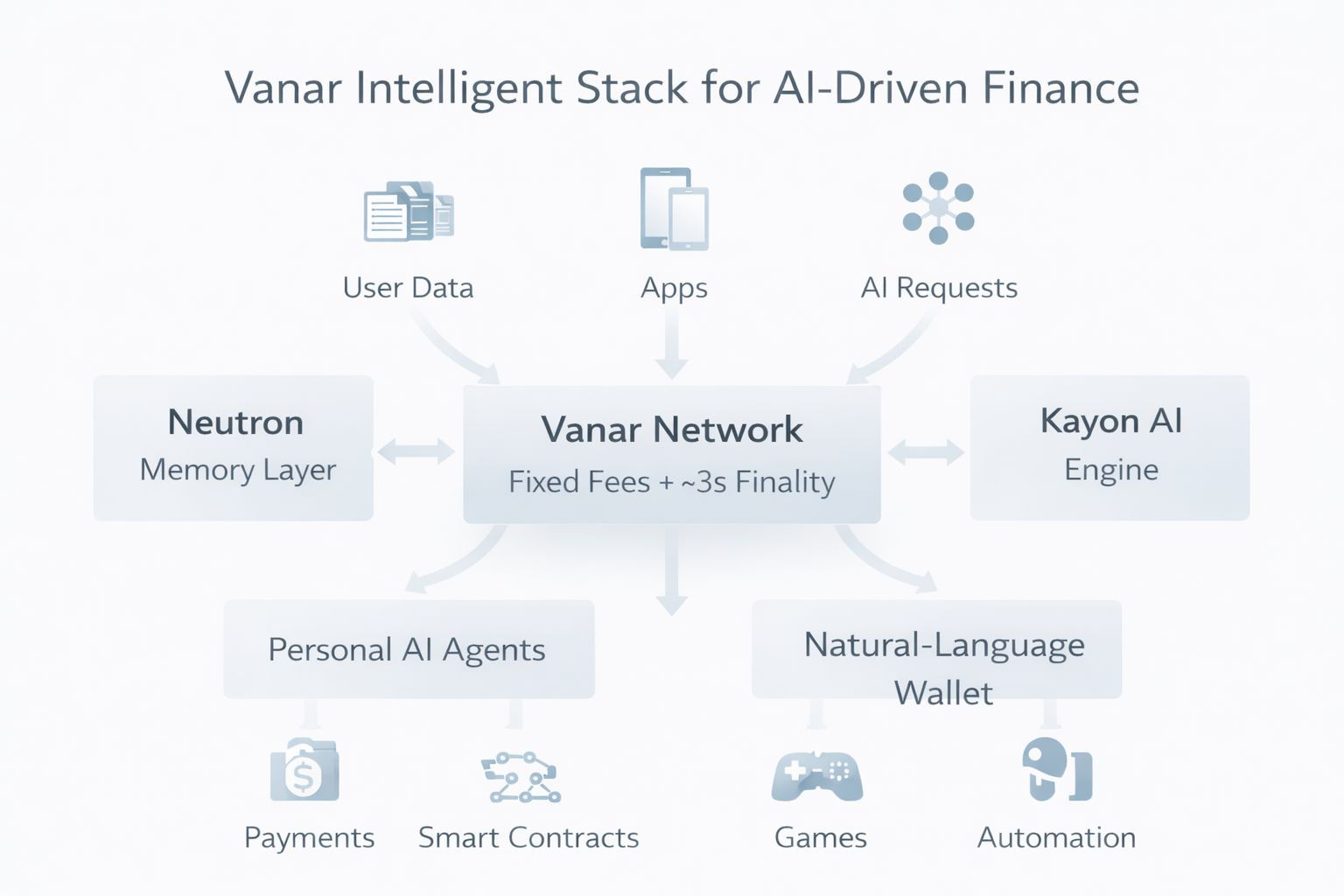
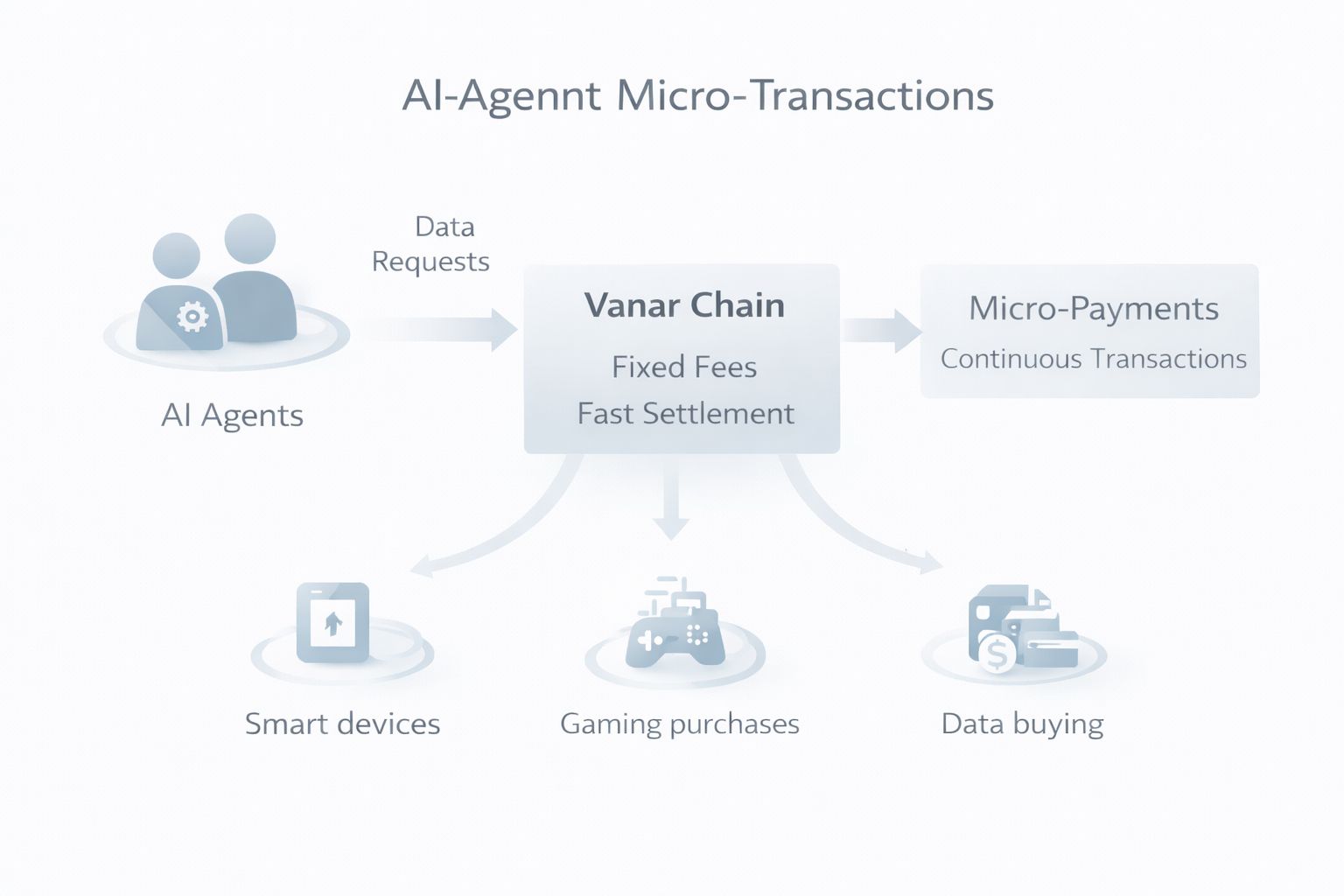
At its core, Vanar is building for environments where activity is constant and granular. The network’s settlement times and predictable sub-cent fees are meant to make micro-transactions practical rather than theoretical. When fees remain stable even during demand spikes, use cases like machine-to-machine payments or AI-driven services become easier to design. A device that pays for electricity by the second, a digital assistant that purchases data access in real time, or a game economy where rewards and purchases happen continuously all depend on predictable transaction costs. In that sense, Vanar is less focused on high-value transfers and more focused on high-frequency interaction.
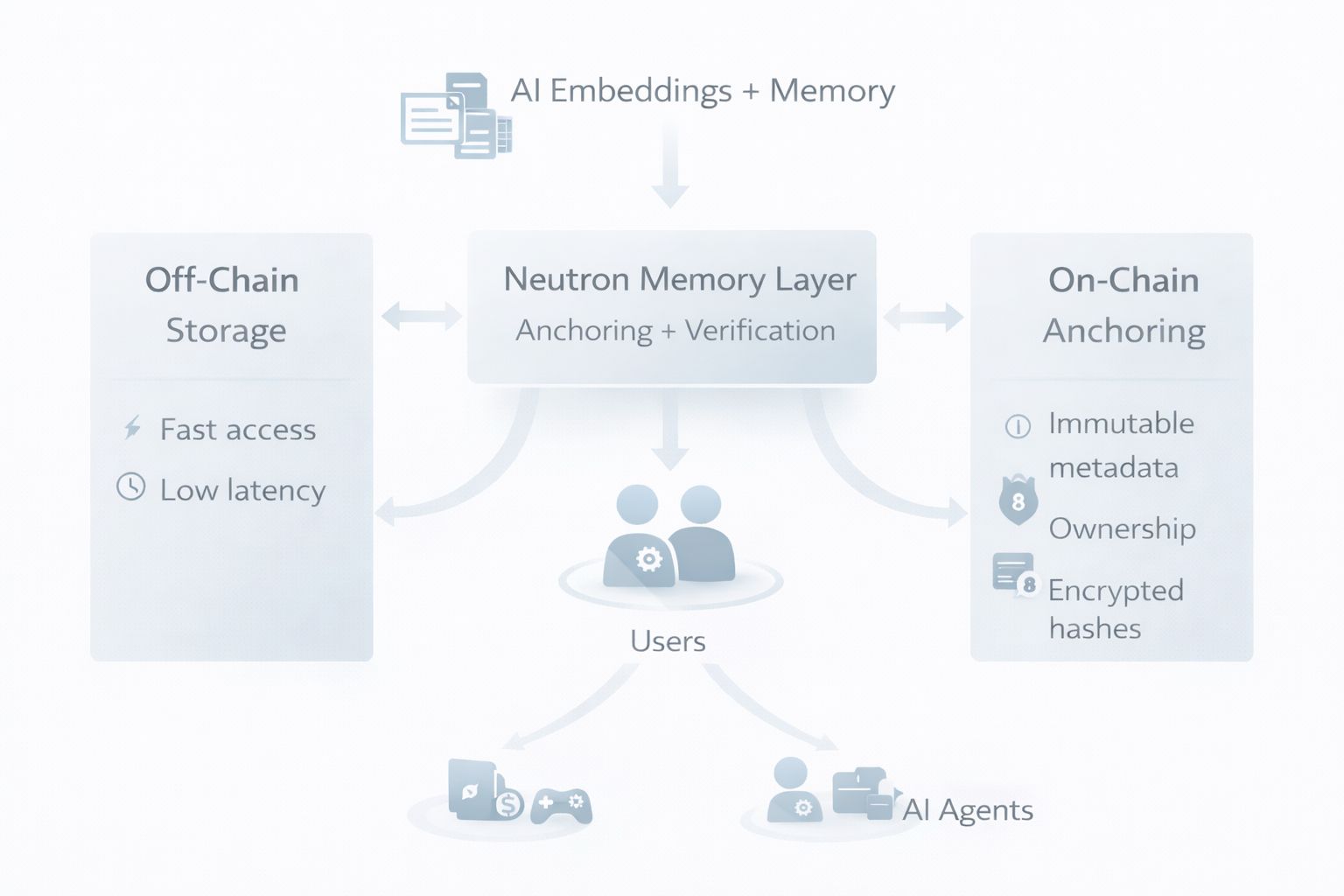
The architecture behind this approach relies on a hybrid storage model. Instead of forcing all data on-chain, Vanar’s Neutron layer separates content from verification. Sensitive or heavy data can stay off-chain for speed, while encrypted hashes and metadata are anchored on-chain to preserve ownership and auditability. This allows the network to act as a verification layer for information without becoming overloaded with raw data. It also enables a new concept: treating AI embeddings and structured knowledge as “seeds” that can be referenced, searched, and reused by agents. In practical terms, this turns the blockchain into a memory index rather than just a payment rail.
On top of that memory layer sits Kayon AI, which functions as a coordination engine. Instead of existing as a standalone chatbot, Kayon connects to existing tools and converts scattered files, messages, and documents into structured knowledge that can be queried. The idea is to create a unified knowledge base where AI can retrieve information across systems while still maintaining encryption and user control. By giving developers APIs to Structured data, Vanar is trying to position Kayon as an infrastructure component for productivity software and enterprise applications, not just a feature for end users.
The personal-level extension of this system appears in MyNeutron and Pilot. MyNeutron allows individuals to create agents that remember past interactions and preferences across tools and environments. These agents don’t start from zero each time; they accumulate context and can act on it. Pilot, meanwhile, experiments with natural-language wallets that let users interact with blockchain functions through simple instructions. Together, these components aim to reduce the friction between human intent and on-chain execution. Instead of navigating complex interfaces, users could rely on memory-aware agents that understand goals and perform actions.
Gaming environments provide a testing ground for this model. In large virtual worlds running on Vanar infrastructure, AI-driven characters and player economies interact in real time, generating large volumes of small transactions and data exchanges. These environments highlight why predictable fees and fast settlement matter: without them, real-time in-game economies would be difficult to sustain. Developer tools for engines like Unreal and Unity further suggest that the network is targeting interactive applications where digital assets, payments, and AI behavior converge.
Partnerships with cloud providers, payment processors, and enterprise platforms reinforce the idea that Vanar is aiming for integration rather than isolation. By aligning with infrastructure providers and payment networks, the project signals that it wants to sit within existing economic systems rather than operate purely as a speculative crypto network. Renewable-energy-powered validators and offset strategies also reflect an attempt to address environmental concerns that often shape enterprise adoption decisions.
Token utility in this ecosystem is tied to usage rather than only trading activity. If advanced AI features, storage functions, and subscriptions require the network token, then demand becomes linked to how often developers and users rely on the stack. Staking and potential token burns add another layer, connecting network security and activity to supply dynamics. Whether this model succeeds depends less on short-term market cycles and more on whether applications built on the network actually generate sustained usage.
Looking ahead, Vanar’s exploration of quantum-resistant cryptography and long-term security research suggests that the team is planning for infrastructure longevity rather than rapid experimentation alone. Still, technological ambition does not guarantee adoption. The real test will be whether enterprises, developers, and consumers find enough value in a memory-centric blockchain to integrate it into everyday workflows.
What Vanar ultimately proposes is a shift in how blockchains are perceived. Instead of acting solely as financial settlement layers, they could become systems that store, organize, and act on knowledge while enabling continuous micro-transactions between humans and machines. If AI agents become active economic participants, a network that combines memory, payments, and computation could form the backbone of autonomous digital economies. Whether Vanar becomes that backbone will depend on how effectively its stack moves from experimentation to widespread use.