
Dusk Network is one of those projects I find myself thinking about whenever the conversation shifts from speculative crypto activity to what real on-chain finance might actually require. It sits in a quieter part of the industry, far from the noise around throughput races and short-term hype cycles, and focuses on a structural issue that becomes obvious the moment serious financial activity tries to move on-chain. Finance cannot operate on a fully transparent settlement layer without giving up confidentiality, competitive protection, and basic client privacy. That tension is exactly where Dusk begins to feel relevant. The project isn’t trying to hide everything, and it isn’t trying to ignore regulation. It’s trying to create an environment where sensitive financial activity can remain private by default while still producing outcomes that can be verified and audited when required.
What draws me in isn’t hype or momentum but the way the system is framed. Dusk doesn’t treat privacy as a feature you bolt on later. It treats it as infrastructure. The idea is simple: if blockchain is going to support real financial markets, confidentiality has to exist alongside accountability. Markets have always operated on that balance. Sensitive information stays protected, while correctness and compliance remain enforceable. Dusk seems to be trying to recreate that balance on-chain rather than forcing finance to adapt to a fully transparent environment that doesn’t fit how institutions actually work.
I keep returning to the phrase “confidentiality with accountability.” In traditional markets, trades, positions, and internal logic aren’t broadcast to the world, but regulators and auditors can still verify what needs to be verified. That dual requirement is difficult to achieve on public blockchains, where transparency is often absolute. Dusk’s design suggests a model where transactions and financial logic can remain confidential while still producing verifiable outcomes. If that works in practice, it opens the door to a different category of applications—ones that feel closer to real financial systems than experimental DeFi tools.
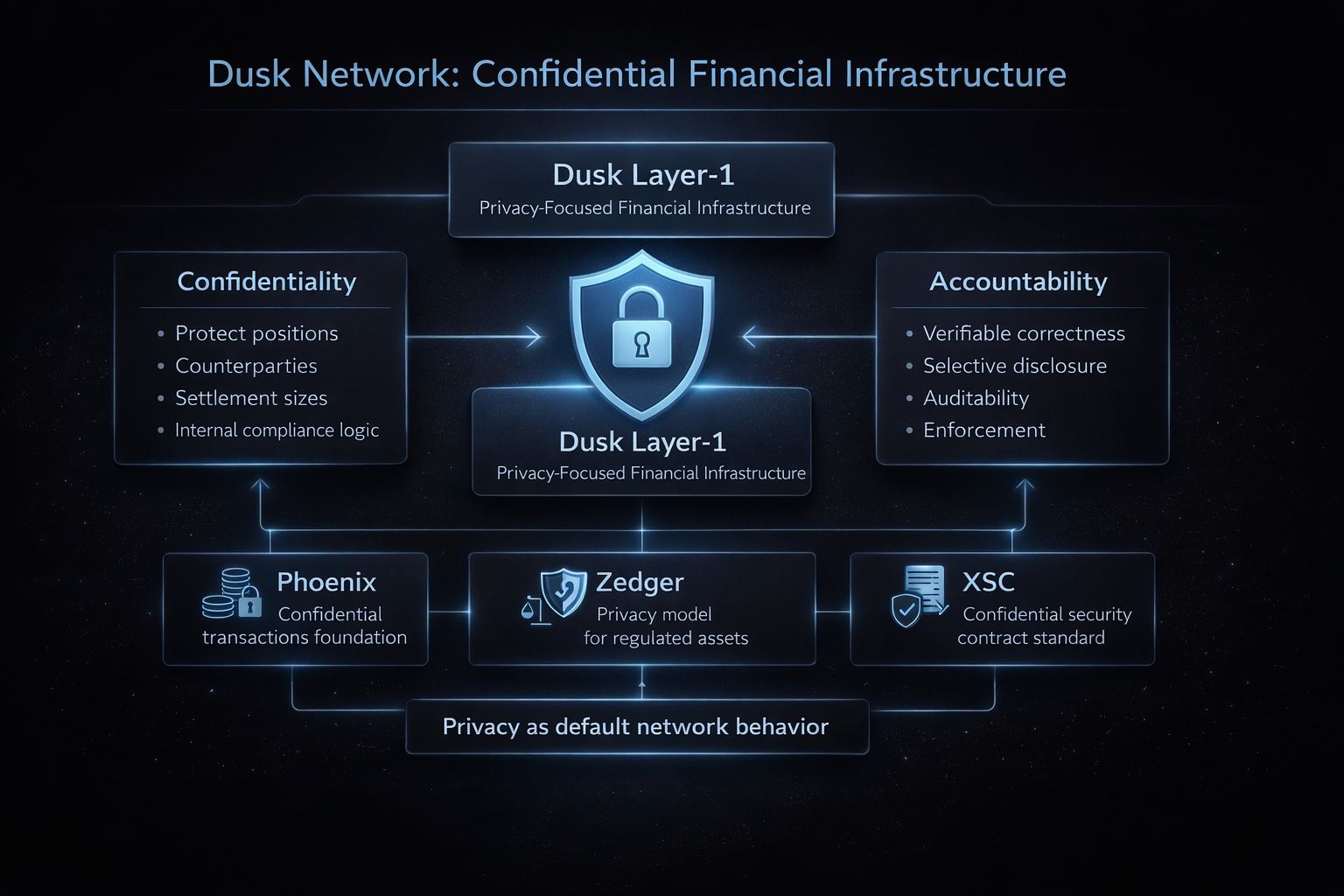
Looking at the architecture described around the ecosystem, the intent becomes clearer. Phoenix acts as the transactional foundation for confidential value movement. Instead of asking users to opt into privacy, the model implies that confidentiality is simply how transactions behave. That shift changes the user experience. Privacy becomes normal rather than exceptional. For institutions and regulated participants, that predictability matters. They need to know that sensitive information won’t leak by default, and that the system they’re using behaves consistently.
Zedger, positioned as a privacy-preserving framework for security tokens, reveals another layer of the strategy. Security tokens bring more than simple transfers. They require lifecycle management, compliance logic, and governance rules that can withstand audits. Handling them responsibly requires structure and standardization. If a network can support regulated instruments without exposing every detail publicly, it begins to solve a problem that has quietly slowed tokenization efforts. The promise of tokenized assets only becomes meaningful when the infrastructure beneath them can support them responsibly.
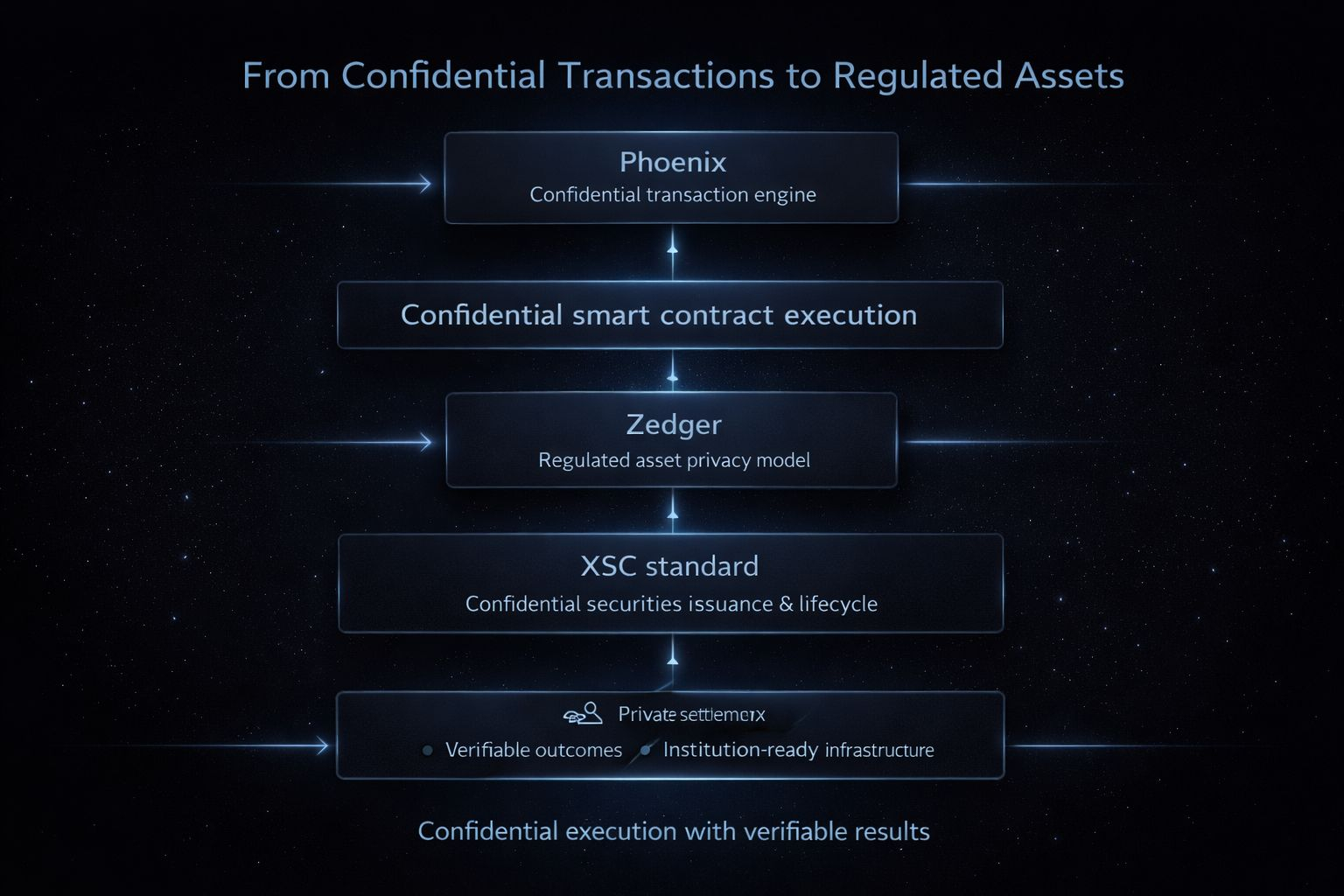
The Confidential Security Contract standard, often called XSC, feels like the connective tissue that could allow this ecosystem to scale. Standards are what make financial systems repeatable. They allow issuers and developers to rely on predictable behavior instead of building custom logic every time. When I imagine what Dusk might become if it succeeds, I see a network where issuing and managing confidential financial instruments feels structured rather than experimental. That’s a long-term vision, but it’s one that aligns with how real financial infrastructure evolves.
What makes all of this resonate with me is the broader direction the industry appears to be moving in. Tokenization is no longer theoretical. Institutions are slowly exploring ways to bring regulated assets on-chain. But for that shift to accelerate, the underlying networks have to meet institutional standards. They have to provide privacy where privacy is necessary and transparency where verification is required. They have to operate in a way that regulators and operators can trust. Dusk seems to be positioning itself for that environment rather than for the short-term attention cycle.
I also find meaning in how the project builds. Infrastructure is rarely flashy. It develops through steady iteration, tooling improvements, and gradual hardening of the system. Seeing ongoing work around developer experience, node operations, and documentation suggests a focus on usability and reliability. Those are the qualities that matter when a network is meant to support serious financial activity. It signals a willingness to build patiently, even if that approach doesn’t always generate immediate excitement.
The token’s role fits into this infrastructure-first mindset. DUSK began as an ERC-20 asset, which gives it a transparent on-chain history, but within the ecosystem it functions as part of the operational layer. Staking, participation, and incentives tie it to the network’s security and operation. That doesn’t make it immune to market volatility, but it anchors its purpose to the system it supports. If the network grows into a meaningful settlement environment, the token’s role becomes clearer as part of that foundation.
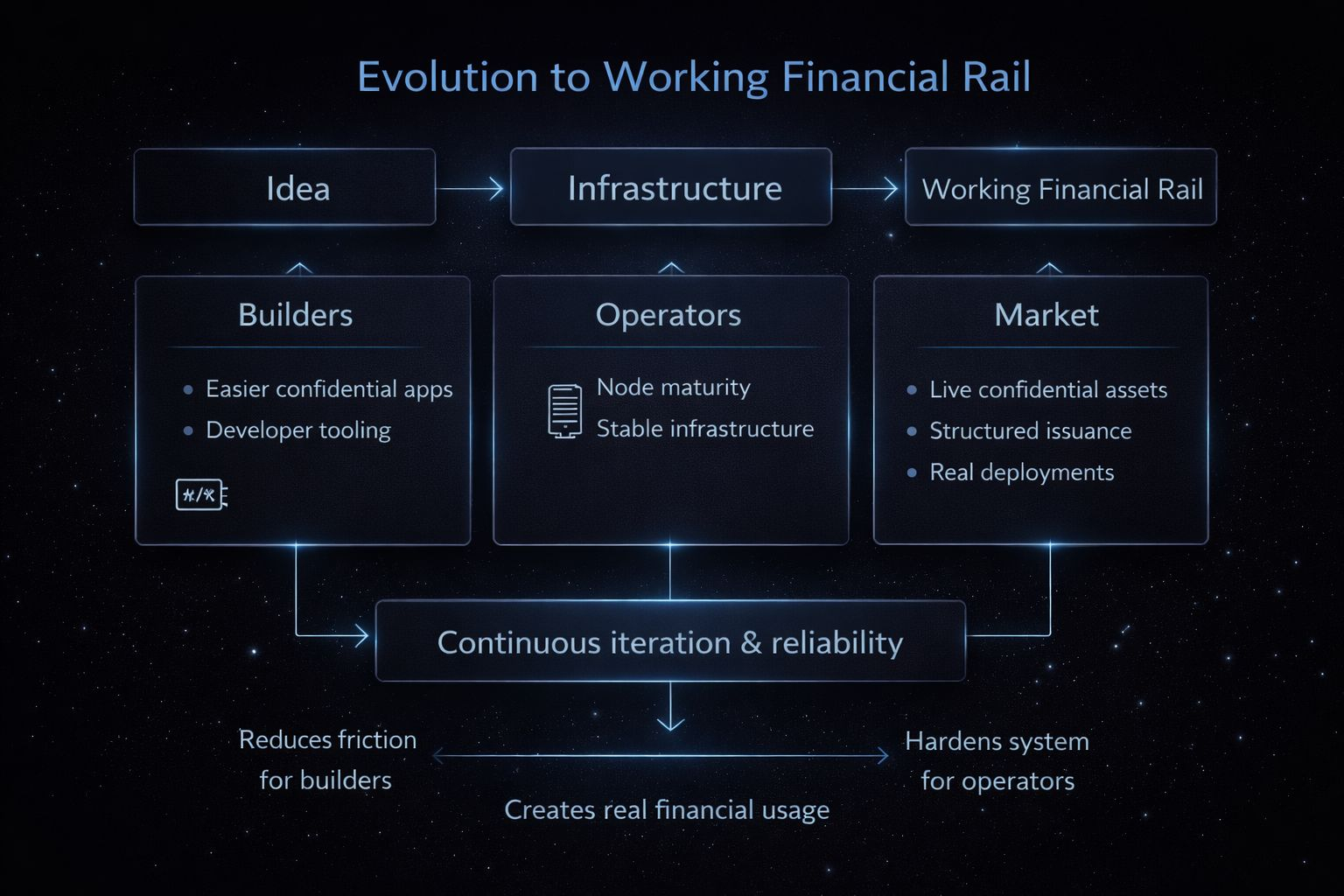
Emotionally, what keeps me interested is the sense that this type of project is building for a future that hasn’t fully arrived yet but feels increasingly likely. I don’t see Dusk as something designed to dominate headlines. I see it as something that could quietly become essential when the industry reaches a point where privacy and compliance are no longer optional. If regulated assets continue moving on-chain and institutions look for environments that can handle them responsibly, networks like this could find themselves in demand.
There’s something human in watching a project pursue a long-term thesis. It requires patience from builders and from observers. It requires believing that infrastructure work matters even when it isn’t immediately rewarded with attention. I find that perspective grounding in an industry that often moves at the speed of narrative. It reminds me that some of the most important systems are built slowly, layer by layer, until they become so integrated into the background that people forget they were ever new.
If Dusk succeeds, it probably won’t look like a sudden breakthrough. It will look like a gradual shift where confidential financial applications start appearing, where issuance flows feel structured, and where privacy becomes a normal part of interacting with on-chain markets. At that point, the narrative won’t need to be forced. The network will simply be used. And in that moment, what once looked like a niche privacy project may start to feel like the kind of infrastructure the industry was quietly waiting for.