


AI is everywhere in crypto right now. Most of it feels bolted on. A model here, a chatbot there, wrapped around infrastructure that was never designed for intelligence in the first place.
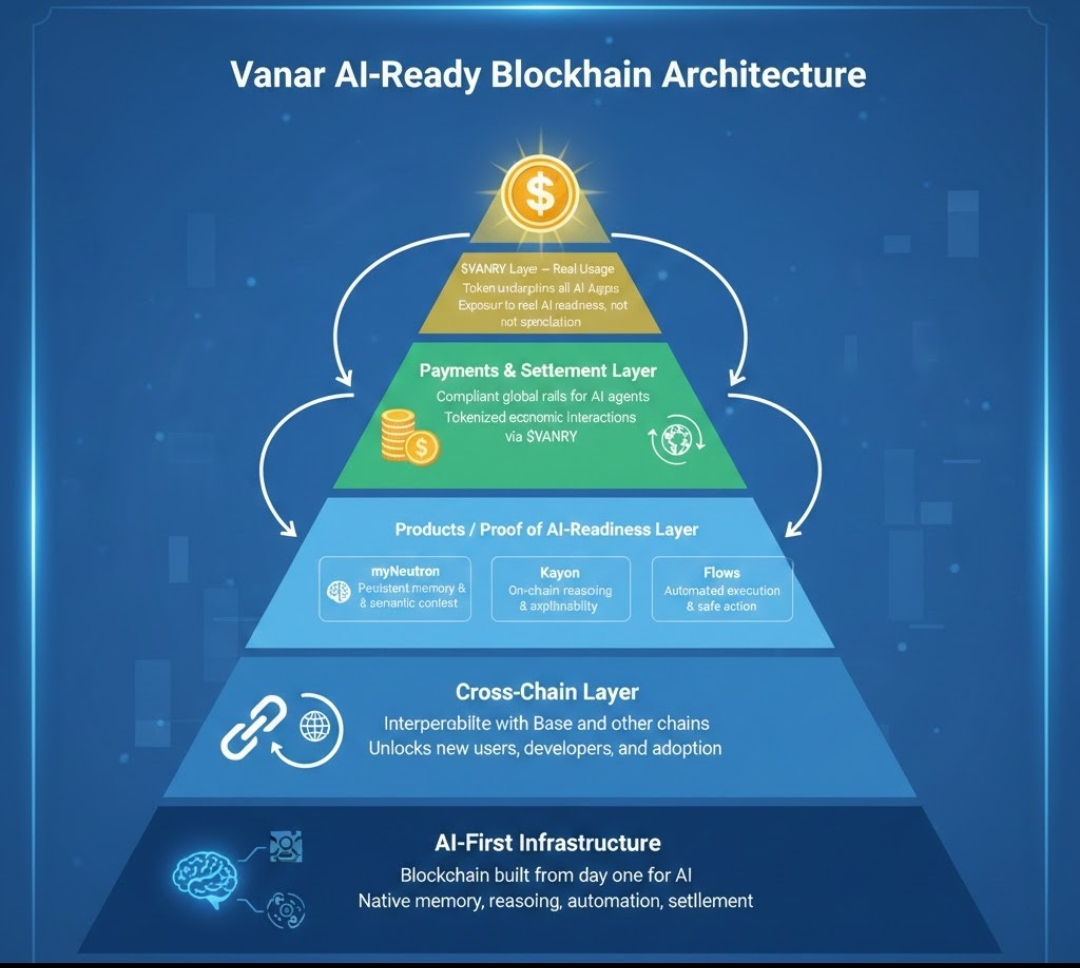
Vanar Chain takes a very different stance: if AI agents are going to operate on-chain, the chain itself needs to support how AI actually works. Memory. Reasoning. Automation. Settlement. Not as features, but as primitives.
That difference is subtle on the surface — and massive underneath.
AI-First vs AI-Added: Why the Distinction Matters
Most chains are still optimized for human users clicking buttons. AI systems don’t behave that way. They don’t open wallets, approve popups, or tolerate friction. Retrofitting AI onto that stack creates demos, not infrastructure.
Vanar was designed AI-first. That means intelligence isn’t layered on top of the chain — it’s embedded into it. This is why raw TPS numbers feel outdated here. Speed without context, memory, or execution logic doesn’t help autonomous systems.
What matters is whether AI can persist, reason, and act safely.
What “AI-Ready” Actually Looks Like in Practice
Vanar’s stack answers that question with live, production-facing components.
myNeutron introduces persistent semantic memory at the infrastructure layer. AI agents and characters can retain context across interactions instead of resetting every transaction. This is foundational for games, virtual worlds, and long-lived AI agents that evolve over time.
Kayon handles native reasoning and explainability. Decisions made on-chain aren’t opaque black boxes — they’re verifiable. For enterprises, brands, and regulated environments, this is critical. Automated decisions must be auditable, not just fast.
Flows translate intelligence into action. Multi-step workflows can execute autonomously and securely without manual intervention. This is where AI stops being experimental and starts doing real work.
Together, these aren’t concepts. They’re proof that AI-native infrastructure can exist below the application layer.
Cross-Chain on Base: Why Isolation Isn’t an Option
AI infrastructure can’t live on a single chain. Intelligence scales through reach, not silos.
Vanar’s move to make its technology available cross-chain, starting with Base, is a growth unlock. Applications don’t need to migrate. Games, brands, and platforms on other networks can integrate Vanar’s AI primitives directly.
This expands usage beyond one ecosystem and turns Vanar into an intelligence layer rather than just another L1. The result is broader demand, more surface area, and real-world relevance.

Why Payments Complete the AI Stack
AI agents don’t care about wallet UX. They care about settlement.
For intelligence to operate economically, it needs compliant, global payment rails that work programmatically. Without this, AI remains a showcase, not a participant in the economy.
This is where $VANRY comes into focus. It underpins memory usage, reasoning execution, automated flows, and settlement across the intelligent stack. As AI-driven activity increases, demand is tied to usage — not narratives.
Instead of being fueled by speculation alone, $VANRY is positioned around real economic throughput generated by agents, applications, and enterprises.
Why This Matters Long Term
Web3 doesn’t need more base infrastructure. It needs infrastructure that reflects how the next users — machines — will actually behave.
Vanar isn’t loud about this. It’s shipping. While many projects are still pitching AI roadmaps, Vanar is deploying systems that assume AI is already here and building accordingly.
That’s what makes it interesting. Not promises. Not trends. Readiness.