

Most payment talk in crypto still sounds like a feature pitch. Faster blocks. Lower fees. A new wallet flow. A “gasless” badge. But the moment you actually try to move money, the real friction shows up somewhere else: the system asks you to care about things you didn’t come for. You’re holding stablecoins because you think in dollars, and the chain still makes you buy a volatile token just to pay the toll. That isn’t a performance problem. It’s a design choice, and it quietly decides who gets to use the network without feeling punished on the first click.
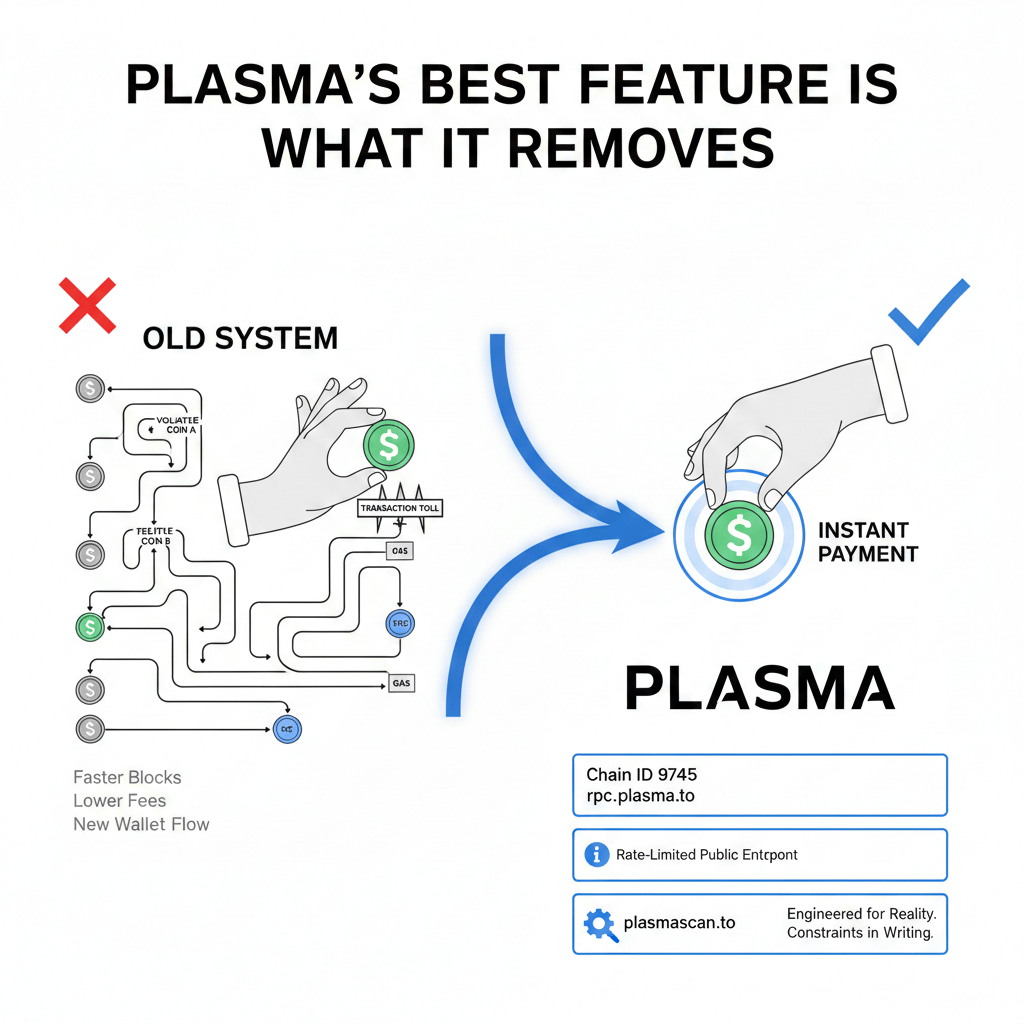
Plasma reads like a chain built by someone who’s watched that exact moment happen too many times and decided it should be engineered out. It’s already live as a public Mainnet Beta, and the “this is real, not a concept” details are openly published: Chain ID 9745, a public RPC at rpc.plasma.to, and the public explorer at plasmascan.to. What makes it feel more infrastructure-minded than marketing-minded is the part teams usually hide: the docs explicitly note the public RPC is rate-limited, and they frame it as a public endpoint—not something you should rely on for production-grade load. That tiny admission matters. Real rails always have constraints, and serious teams don’t pretend those constraints don’t exist; they put them in writing and design the system like it’s going to meet reality.
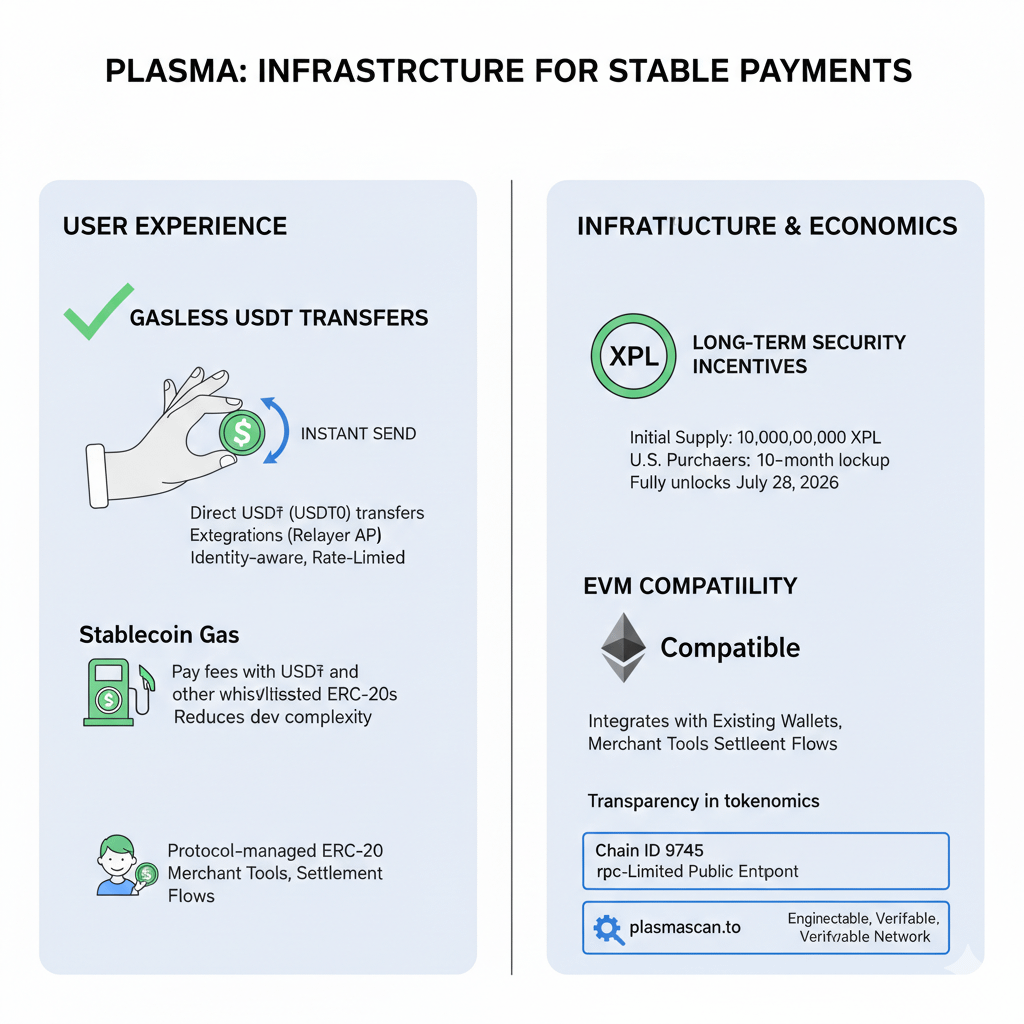
This is why the “gasless USDT transfers” idea lands differently here than it does in most hype cycles. “Gasless” has become one of those words that often means “we’ll subsidize it until the budget runs out.” Plasma’s version is oddly restrained. The documentation frames it as a tightly scoped lane: it sponsors only direct USD₮ (USDT0) transfers, and it’s designed for external integrations through the Plasma Relayer API. Even more telling, it describes identity-aware controls and rate limits to reduce abuse, which is exactly the kind of unsexy detail you only add when you’re thinking like infrastructure.
If you picture the actual user, the benefit isn’t abstract. The usual stablecoin flow forces a mental detour: before you can send dollars, you must adopt a separate asset, learn it, acquire it, and hope you never run out of it at the worst moment. Plasma is trying to remove that detour for the most common payment action. It’s not promising a free world. It’s trying to make the most basic, most frequent movement—sending stable value—feel like it belongs on the chain by default. When you remove that first-click friction, you don’t just make UX nicer; you change eligibility. A stablecoin-only user can participate without being forced into a volatile-token relationship just to get started.
Transfers, though, are only the beginning of real payment behavior. The moment you move beyond a simple send—approvals, merchant contracts, settlement logic, payroll-like flows—you’re back in the world of gas and execution. Plasma’s “stablecoin-native” posture shows up again here in a way that’s more structural than cosmetic: the docs describe custom gas tokens that let users pay transaction fees using whitelisted ERC-20 assets like USD₮ rather than forcing everyone to hold XPL for gas. The important part is how they frame the mechanism: it’s powered by a protocol-managed ERC-20 paymaster maintained by Plasma, explicitly reducing the need for developers to run their own gas abstraction stack. That’s the difference between adding a UX trick and embedding a payment-friendly assumption into the chain.
At this point people often misunderstand the role of XPL. If you hear “stablecoin gas” and “zero-fee transfers,” it’s easy to assume the chain is trying to pretend a native token doesn’t matter. Plasma’s own materials point in the opposite direction. The token is not being erased—it’s being placed. The network can support stablecoin-first user flows while still keeping a native asset that underwrites long-term security and incentives. The tokenomics docs spell out the backbone clearly: an initial supply of 10,000,000,000 XPL, and explicit unlock rules, including a note that XPL purchased by U.S. purchasers is subject to a 12-month lockup and fully unlocks on July 28, 2026. Whether you like token mechanics or not, the transparency is the point: Plasma isn’t hiding the machinery, it’s just trying not to make the machinery the user interface.
This is also where EVM compatibility stops being a generic buzzword and starts acting like a practical adoption lever. Payments rails don’t win because they have the best narrative. They win because they get integrated—into wallets, merchant tooling, settlement flows, and everything that already exists. Plasma’s documented environment keeps the developer surface familiar, which means builders aren’t being asked to learn a new programming universe just to offer stablecoin-native UX. Familiar developer surfaces plus stablecoin-native primitives is a simple combination, but it’s rare to see it treated as the chain’s identity instead of an add-on.
A payments rail becomes real when it can be inspected, not when it can be narrated. That’s why the explorer matters. The footprint is visible—stablecoin contracts, transfers, transaction flow—signals that don’t need interpretation. They just sit there, quietly, as proof that this is a network you can verify instead of a story you have to trust.
There’s also a small naming trap worth clearing up. “Plasma” is a term people sometimes recycle in unrelated contexts, including older Ethereum “Plasma” scaling references. This piece is about the Plasma network running as a payments-focused Layer 1, documented as Mainnet Beta with Chain ID 9745 and its own RPC and explorer. In payments infrastructure, that kind of clarity isn’t optional. A rail either exists in a verifiable form, or it’s just branding.
So the bet Plasma is making isn’t simply “stablecoin payments matter.” Plenty of projects can say that. The sharper bet is that stablecoins are already a global behavior, and the chain should stop treating that behavior like a niche. Make the most common stablecoin action feel native through a deliberately scoped, abuse-aware gasless lane. Let people pay execution costs in the assets they already hold through protocol-managed stablecoin gas support. Keep the deeper crypto machinery—token incentives, validator economics, long-horizon security—working in the background, fully acknowledged and clearly documented, but not shoved into the user’s first experience.
In that sense, Plasma doesn’t feel like it’s trying to impress you with novelty. It feels like it’s trying to remove the moment where you’d normally get annoyed, close the tab, and never come back—because the chain didn’t ask you to become a different kind of person just to send a digital dollar.