There is a quiet shift happening beneath the surface of the internet. You do not hear it in headlines. You do not see it in loud price charts. You feel it in the way digital worlds are slowly becoming more human, more usable, more real. In the middle of this shift stands Vanar Chain, not as noise, but as a signal. A signal that Web3 is no longer a playground for a small group of insiders. It is becoming a city with open doors.
Vanar Chain was not built as a theory. It was built as a response. A response to confusion, to complexity, to the gap between promise and reality. For years, blockchain projects spoke about mass adoption, about billions of users, about a future that felt close yet always far. Vanar looked at that gap and asked a simple question. What if Web3 actually made sense to normal people?
That question became a foundation.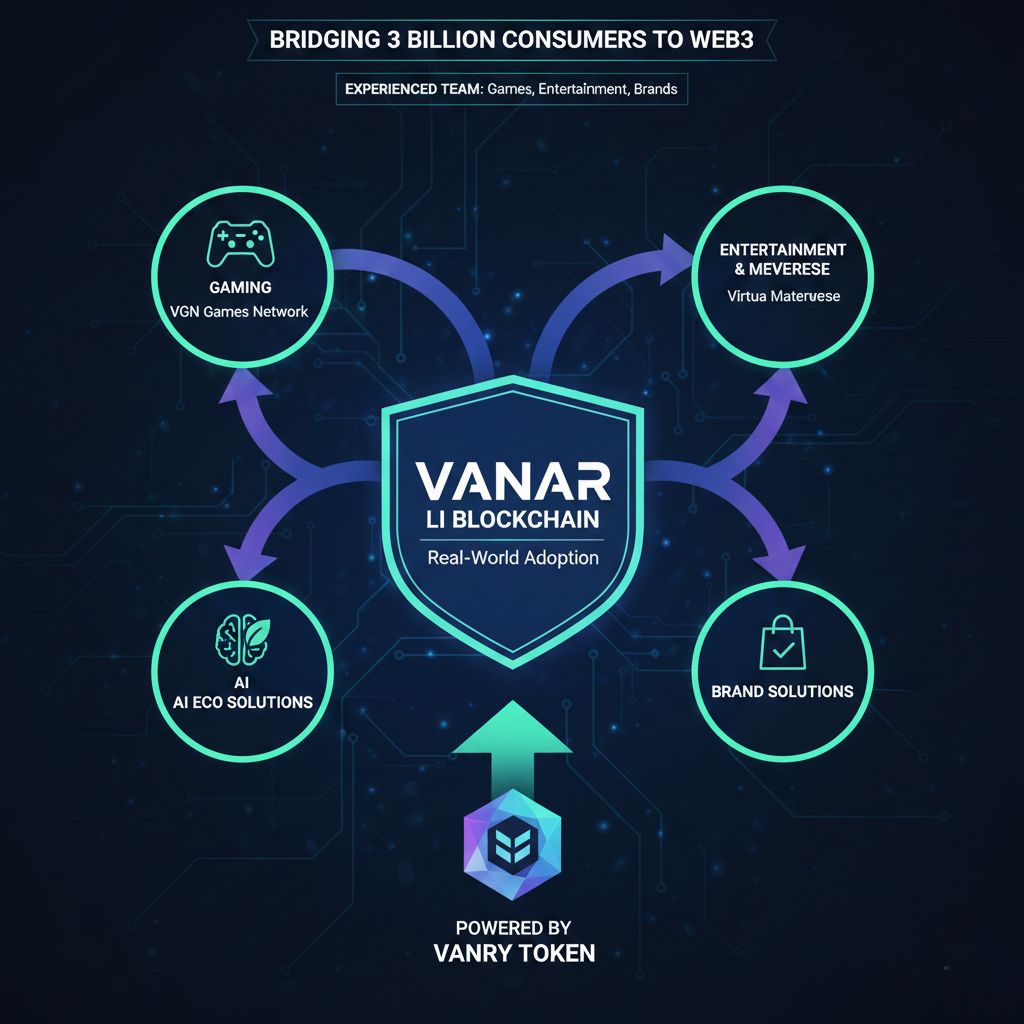
Vanar Chain is a Layer 1 blockchain, but those words alone do not tell the story. Many Layer 1 networks exist. Many claim speed. Many claim scalability. Vanar feels different because it was shaped by people who understand games, entertainment, brands, and culture. Not only code. Not only finance. Culture.
The team behind Vanar worked in spaces where experience matters. Where users do not care about complex wallets or technical terms. They care about fun. They care about identity. They care about feeling part of something alive. So Vanar was designed from the ground up with this in mind. Not just to function, but to be used.
At first, it feels like a simple idea. Build a blockchain that normal people can enter without fear. But when you look closer, you see a living system forming.
Imagine Vanar Chain as a digital organism. The smart contracts are like veins. They carry value, agreements, rules. Quietly, efficiently. Liquidity flows like blood. It moves through gaming economies, brand ecosystems, metaverse experiences. It keeps everything alive. Governance becomes a form of consciousness. A shared mind that guides growth and direction.
This is not cold machinery. It feels organic.
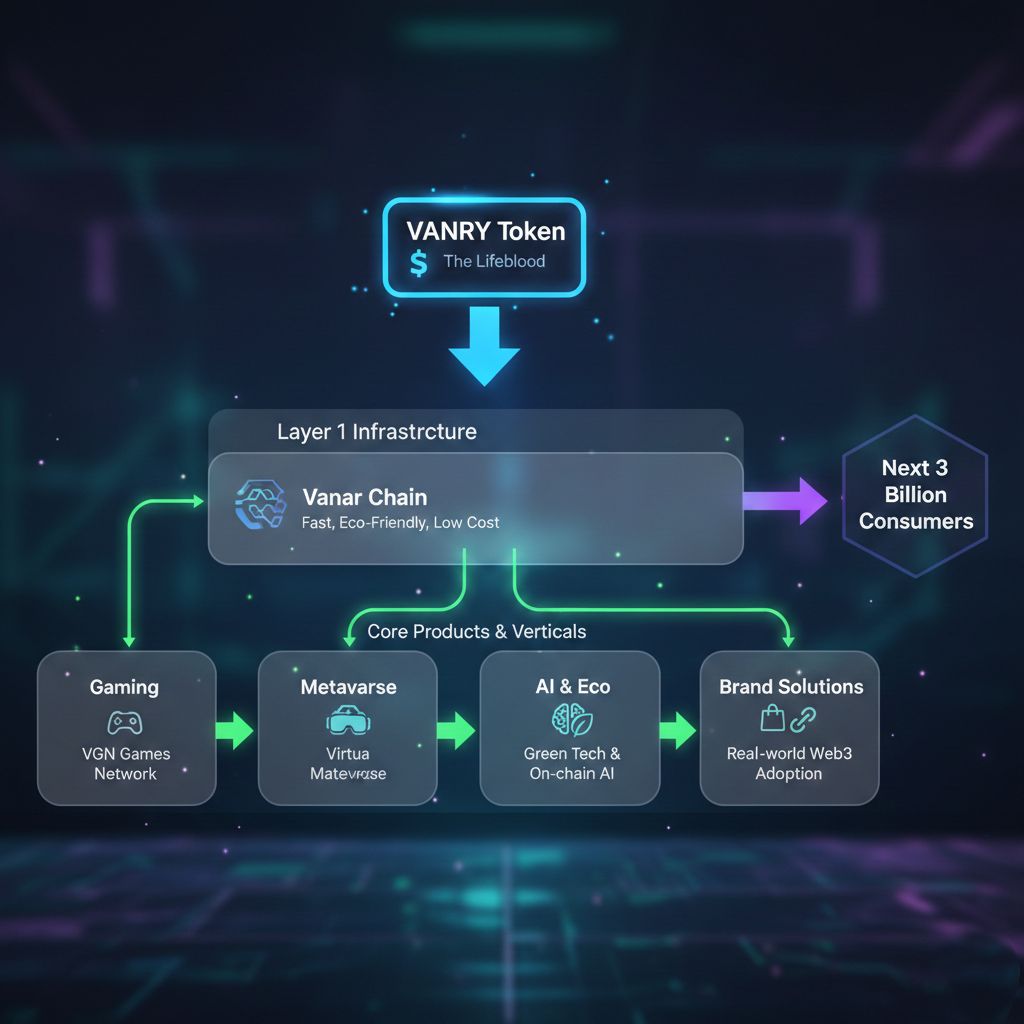
At the heart of this system lies the VANRY token. VANRY is not just a trading symbol. It acts like energy. It powers transactions. It supports participation. It connects different parts of the Vanar ecosystem. Without it, the organism slows. With it, everything moves.
But Vanar is not only a chain. It is a network of worlds.
One of its strongest expressions is Virtua Metaverse. Virtua is not just a digital map. It is a place where brands, creators, and users build identities. Digital land becomes more than pixels. It becomes presence. Users walk through virtual cities. They attend events. They collect digital items. They shape how they appear to others. It feels less like a website and more like a parallel layer of reality.
Then there is the VGN, the games network built within the Vanar ecosystem. Gaming is not treated as a side experiment. It is central. Because games are the first language of the next three billion users. Through VGN, players enter Web3 without even thinking about it. They compete. They earn. They explore. Blockchain works silently in the background, like gravity. Always present. Rarely noticed.
This is where Vanar becomes powerful.
Instead of asking users to learn complex systems, it hides complexity behind smooth experiences. A player does not need to understand nodes or consensus. A brand does not need to master cryptography. They simply build and interact. The chain supports them invisibly.
And this changes the emotional experience.
For builders, Vanar feels like fertile land. Developers are not fighting against heavy systems. They are planting ideas in soil that is ready. Tools are aligned with real world needs. Integration with brands feels natural. Projects do not feel isolated. They feel connected to a larger digital story.
For traders and token holders, the experience becomes more than speculation. When you hold VANRY, you are not only holding a coin. You are holding a piece of a growing digital culture. The growth of gaming networks, metaverse spaces, AI integrations, eco solutions, brand partnerships. All of this feeds into the ecosystem. Value is not created from hype alone. It is created from usage.
For creators, the transformation is personal. Artists can build virtual galleries. Musicians can create immersive experiences. Brands can launch digital campaigns that feel interactive, not static. Web3 becomes a canvas. And Vanar becomes the frame that holds it steady.
There is also something strategic about Vanar’s focus. Many blockchains aim to dominate finance. Others focus on pure decentralization. Vanar looks at mainstream verticals. Gaming. Metaverse. AI. Eco systems. Brand solutions. These are spaces where culture moves fast. Where attention flows. Where the next generation already lives.
Instead of pulling users into crypto, Vanar places crypto inside their existing worlds.
This approach feels subtle, almost quiet. But quiet systems can grow deep roots.
As adoption increases, something interesting happens. The line between Web2 and Web3 begins to fade. A gamer might start by playing on VGN. Then they realize they own their digital assets. A brand might launch a campaign in Virtua. Then they discover token based rewards. Slowly, awareness grows. Not through lectures. Through experience.
Vanar becomes a bridge.
And bridges are powerful. They do not replace one side with another. They connect.
In many ways, Vanar represents a shift from ideology to practicality. Early blockchain movements were filled with strong ideas about decentralization and freedom. These ideas are important. But for the next billions, simplicity matters more. Ease matters more. Familiar design matters more.
Vanar seems to understand this.
It is building an ecosystem where blockchain is not an obstacle but a background layer. Like electricity. You do not think about it. You use it.
There is also a deeper layer to this story. Human machine collaboration.
As AI grows stronger, as digital identities expand, as virtual spaces become more detailed, the need for secure and flexible infrastructure increases. Vanar positions itself within this future. A future where humans create alongside intelligent systems. Where digital ownership defines economic identity. Where brands operate in both physical and virtual spaces.
In this vision, Vanar is not only a network. It is a foundation for digital civilization.
Picture a young creator in a developing country. They design a game asset. They sell it through a Vanar powered platform. They receive VANRY. They reinvest. They grow. The blockchain becomes a ladder.
Picture a global brand entering the metaverse. Instead of building from zero, they plug into Virtua. They create immersive campaigns. Users interact, earn, share. The brand becomes part of a living digital economy.
Picture developers experimenting with AI integrations on Vanar. Smart contracts connect with intelligent agents. Decisions become semi automated. Governance evolves. The system learns.
All of this flows back into the same ecosystem.
What makes this exciting is not speed alone. Not marketing alone. It is coherence. Vanar does not feel scattered. Gaming, metaverse, AI, eco and brand solutions are not random ideas. They are layers of one larger design.
A design focused on real world adoption.
The phrase next three billion users is often repeated in crypto. But it is easy to say and hard to achieve. Those users will not arrive because of technical whitepapers. They will arrive because of stories. Because of experiences. Because of digital worlds that feel welcoming.
Vanar builds those worlds.
And in doing so, it slowly reshapes the digital order. Not by force. Not by noise. But by integration.
When you zoom out, you begin to see Vanar as part of a larger evolution. The internet started as information. Then it became social. Then it became financial. Now it is becoming experiential. Immersive. Owned.
In this stage, infrastructure must support identity, creativity, and value exchange at the same time. Vanar stands at this intersection.
It is both technical and cultural. Both financial and playful. Both serious and imaginative.
That balance is rare.
The future of Web3 will not belong only to coders. It will belong to gamers, artists, brands, students, entrepreneurs. It will belong to people who do not call themselves crypto users at all. They will simply call themselves participants.
Vanar Chain seems ready for that moment.
Not as a loud revolution. But as a quiet awakening.
A living network where smart contracts move like veins. Where liquidity pulses like blood. Where governance thinks like a shared mind. Where VANRY fuels motion. Where Virtua Metaverse builds cities in the cloud. Where VGN turns games into gateways.
And where the next chapter of human machine collaboration begins to write itself.
In the end, Vanar is not just about blockchain. It is about belonging in a digital world that finally feels human.
And that might be the most powerful shift of all.