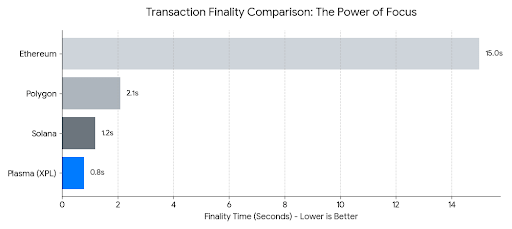
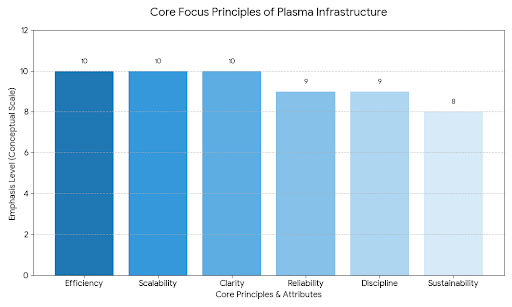
 Plasma is built around a simple idea: strong infrastructure creates lasting ecosystems. Instead of trying to reinvent everything at once, it focuses on building a system that moves value efficiently, scales smoothly, and remains reliable under pressure. At its core, Plasma is designed to optimize how digital assets flow, settle, and interact within a network environment that prioritizes performance and stability.
To understand how Plasma works, it helps to think of it as a specialized execution layer. Rather than handling every possible type of transaction or application, Plasma narrows its focus to doing specific tasks exceptionally well. This targeted design reduces complexity. By limiting unnecessary processes and streamlining validation mechanisms, the network can operate faster and more predictably. Efficiency is not treated as a feature it is treated as a foundation.
One of Plasma’s core mechanisms revolves around batching and structured transaction processing. Instead of treating every interaction as a separate heavy operation, transactions are grouped and processed in a way that minimizes congestion and overhead. This approach improves throughput while keeping costs controlled. In practical terms, it allows the system to handle high activity without slowing down or becoming unstable.
Security is another essential component of how Plasma operates. The architecture is designed so that even as transactions move quickly, verification remains strong. Clear validation rules, transparent state transitions, and deterministic execution help ensure that every operation follows predefined logic. That predictability builds trust. Users and developers can rely on outcomes being consistent rather than uncertain.
Plasma’s main focus rule can be summarized in three principles: efficiency, scalability, and clarity.
Efficiency means reducing friction at every level. From transaction submission to settlement, the process is designed to eliminate unnecessary steps. The goal is to make value movement feel seamless, almost invisible. When systems work smoothly, adoption becomes natural because users don’t have to think about the mechanics behind the scenes.
Scalability means preparing for growth from the beginning. Instead of optimizing only for current usage, Plasma is structured to handle increasing demand without sacrificing performance. Its modular architecture allows expansion without forcing a complete redesign. This forward-thinking approach prevents bottlenecks and supports long-term sustainability.
Clarity refers to both technical design and communication. On the technical side, rules are explicit and execution paths are defined. On the ecosystem side, messaging remains straightforward. Plasma avoids overcomplication because complexity often introduces risk. By keeping systems understandable and transparent, it reduces uncertainty for developers and participants.
Another defining aspect of Plasma is its discipline. Many networks attempt to support every possible feature, which can dilute performance. Plasma intentionally limits its scope to protect its strengths. This focused rule ensures that the network remains optimized for its primary function rather than becoming overloaded with competing priorities.
Developers benefit from this structure because it provides a predictable environment. When performance metrics remain stable and transaction costs stay manageable, building applications becomes less risky. Reliability attracts builders, and builders create ecosystems. Plasma understands that infrastructure must serve as a stable base before innovation can flourish on top of it.
From a user perspective, the impact is subtle but powerful. Transactions confirm faster. Interactions feel smoother. Costs remain consistent. There is less uncertainty during periods of high activity. These improvements may not generate headlines, but they directly influence how people experience a network. Over time, experience determines loyalty.
Plasma’s rule set also encourages sustainability. By avoiding unnecessary computational overhead and focusing on streamlined processes, it reduces wasted resources. That efficiency translates into long-term resilience. Systems that are lean and purpose-driven tend to endure market cycles better than those built around temporary excitement.
Another important element is adaptability within boundaries. While Plasma maintains strict focus rules, it is not rigid. Its modular design allows updates and optimizations without disrupting the entire system. This balance between structure and flexibility ensures that the network can evolve while preserving its core strengths.
What ultimately makes Plasma compelling is its commitment to doing fewer things better. In an industry often driven by expansion and feature accumulation, this restraint feels strategic. Plasma does not aim to dominate every narrative. It aims to perfect its function. That mindset reflects maturity and long-term vision.
In essence, Plasma works by simplifying complexity. It organizes transactions efficiently, validates them securely, and scales through thoughtful design. Its main focus rule efficiency, scalability, and clarity shapes every decision within the ecosystem. Rather than chasing trends, it refines infrastructure.
As the digital asset landscape continues to mature, systems that prioritize reliability over noise will likely become more valuable. Plasma positions itself within that future. It builds quietly, executes precisely, and remains anchored to its core principles. In a space defined by rapid change, that kind of disciplined focus can be one of the strongest foundations of all.