

Plasma feels like it was designed by people who’ve actually had to keep a payments system alive at 3 a.m.
Most chains talk about “rails” the way a demo talks about rails: look, it moves, it’s fast, it’s cheap. Plasma’s angle is more grown-up. It treats stablecoin settlement like something that has to survive real traffic, real users, real mistakes—and still work cleanly. That mindset changes everything, because in payments the problem isn’t sending money once. The problem is sending money a million times without mystery failures, fee surprises, or a black box you can’t explain to your team (or your partners).
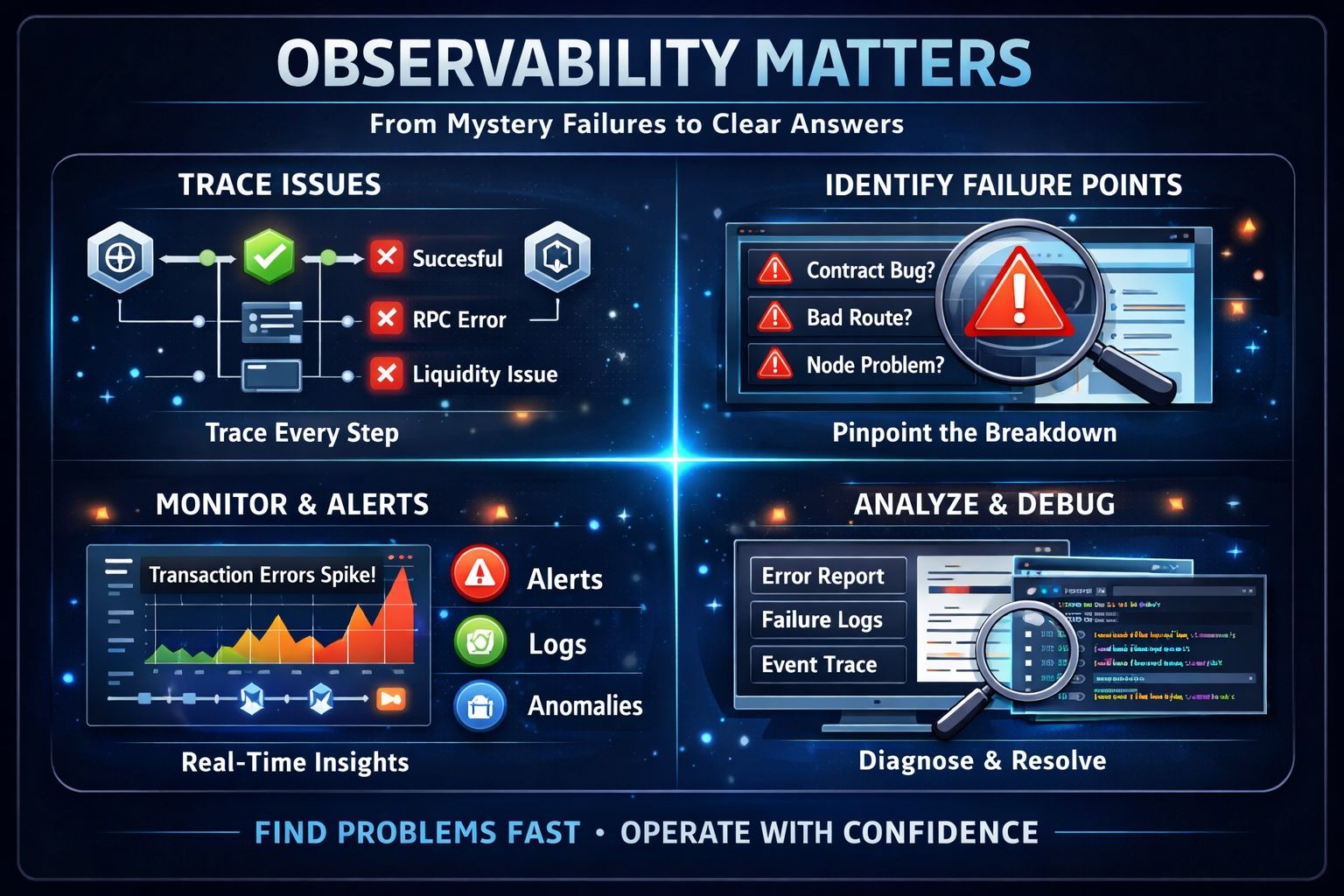
The part that clicks for me is the obsession with observability. That’s not the sexy thing crypto usually leads with, but it’s the thing that separates “cool tech” from “reliable infrastructure.” When a payout doesn’t land, nobody cares about your throughput chart—they care about answers. Where did it fail? Which step broke? Was it configuration, liquidity, a contract edge case, a bad route, an RPC hiccup? Plasma is basically saying: stablecoins become real infrastructure when the chain is not just fast, but inspectable. When you can trace flows, reproduce failures, and spot anomalies before they turn into incidents, you stop operating like an experiment and start operating like a system.
That’s why the “Tenderly-style” direction matters. It’s not just tooling. It’s a signal of maturity: build a network where teams can debug and monitor like professionals, not like hobbyists. Payments teams live on dashboards, alerts, traces, and post-mortems. If Plasma becomes the stablecoin settlement layer people actually depend on, those tools aren’t optional—they’re the product.
Under the surface, the architecture is pretty intentional about where it innovates and where it doesn’t. Plasma doesn’t try to reinvent the developer experience. It leans into EVM compatibility via Reth so builders can move with existing habits, codebases, and tooling. That’s practical. The “new” part is the settlement behavior: PlasmaBFT and sub-second finality are about one thing—making settlement feel immediate and deterministic. In a payments flow, “probably final” is not the vibe you want. You want “done.”
Then you get to the stablecoin-native UX choices, and this is where Plasma stops sounding like a normal L1. Gasless USDT transfers are a small line on paper, but in the real world they’re huge: they remove the “why do I need another token just to move dollars?” moment that confuses normal users and slows adoption. Stablecoin-first gas pushes the same philosophy further: let the user live in the unit they actually care about. If you’re building for people who already think in dollars, forcing them to buy a separate asset just to press “send” is friction you never recover from.
But Plasma also seems aware that “free” can’t be a blanket promise unless you want to get spammed or subsidize forever. So the way I read it is: make the simplest thing (moving USDT) feel effortless, then let more complex activity—smart contracts, richer flows, deeper programmability—carry fees that support the network. That’s a more sustainable shape than pretending everything can be free all the time.
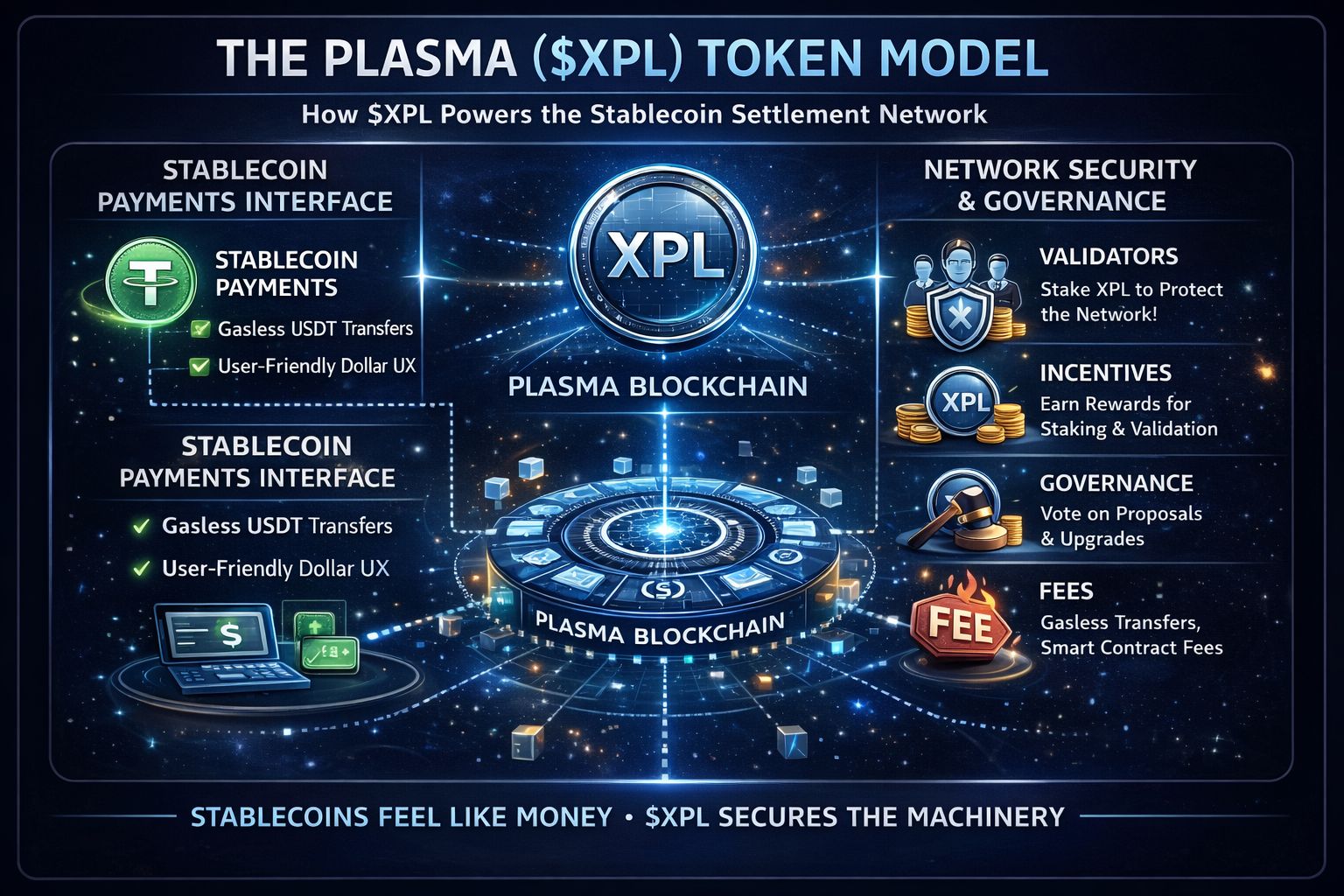
This is where $XPL is not decoration—it’s the spine. Plasma’s model separates what the user touches from what secures the network. Stablecoins can be the interface layer, but XPL is the coordination and security layer: staking, validator incentives, governance, and the fee economy behind anything beyond basic transfers. In other words, Plasma is trying to make stablecoins feel like “money,” while XPL functions like the asset that keeps the settlement machine honest and alive. If Plasma wins, XPL’s relevance grows with the seriousness of the network—because the more value that settles, the more important the security budget and incentive design become.
And Plasma’s security story isn’t casual either. The Bitcoin anchoring narrative is basically Plasma saying: if stablecoin settlement becomes important infrastructure, neutrality stops being a slogan and becomes a requirement. Stablecoins sit in a weird place—globally useful, institutionally sensitive, politically visible. If Plasma ends up handling meaningful settlement volume, it will attract pressure. Anchoring to Bitcoin is a way to reach for a deeper base of credibility while still giving builders an EVM environment they can ship on today. It’s a pragmatic attempt to combine “easy to build” with “hard to capture.”
Ecosystem-wise, Plasma’s success won’t come from being a fast ledger. It’ll come from becoming a place where stablecoin balances don’t just pass through—they stick, because there’s useful financial activity on the same network. That’s why liquidity integrations matter. A settlement chain that can’t keep capital nearby becomes a highway to somewhere else. A settlement chain that turns balances into productive assets becomes the destination.
Of course, the hard parts are still the hard parts. Bridges are always a risk surface, and if Bitcoin anchoring becomes central, the bridge can’t be “good enough”—it has to be exceptional. Progressive decentralization is another tension: moving fast early often means a tighter core set of operators, but long-term credibility in settlement infrastructure requires a validator set and governance posture that outsiders trust. And the “gasless” funnel has to be defended against abuse without turning into a friction tax.
Still, Plasma’s bet is one I think crypto needs: stop treating stablecoin payments as a side quest and start building a chain that behaves like production infrastructure. If Plasma executes, the outcome isn’t just cheaper transfers. It’s a world where sending stablecoins feels normal—fast, predictable, traceable—and where $XPL earns its place as the asset that secures and coordinates a network people actually rely on. That’s the difference between “stablecoins are popular” and “stablecoins are infrastructure”: not hype, but operational trust.
