
Every crypto cycle has a moment where people quietly admit something uncomfortable: most infrastructure is built for insiders. Traders understand it. Developers tolerate it. Normal users bounce off it. You can feel that fatigue now. Wallet friction, gas confusion, broken apps under load — these aren’t edge cases anymore. They’re the reason millions tried crypto once and never came back. Vanar steps into that emotional gap. Its thesis is simple but heavy: blockchain adoption doesn’t fail because people hate technology. It fails because the experience feels foreign. Vanar is trying to design an L1 where interaction feels closer to everyday software than to a technical experiment.
The core problem Vanar targets in this cycle is psychological as much as technical. Most chains optimize for speed or throughput numbers, but the average person doesn’t measure TPS. They measure trust. They want to know a game won’t freeze when traffic spikes. They want to know a digital item won’t disappear. They want transactions to feel predictable. Vanar frames itself around consumer stability rather than raw bragging rights. Its background in gaming, entertainment, and brand ecosystems isn’t cosmetic — it shapes the architecture. Consumer environments punish instability instantly. A single bad experience is enough to lose a user forever. That pressure forces a chain to prioritize smoothness over spectacle.
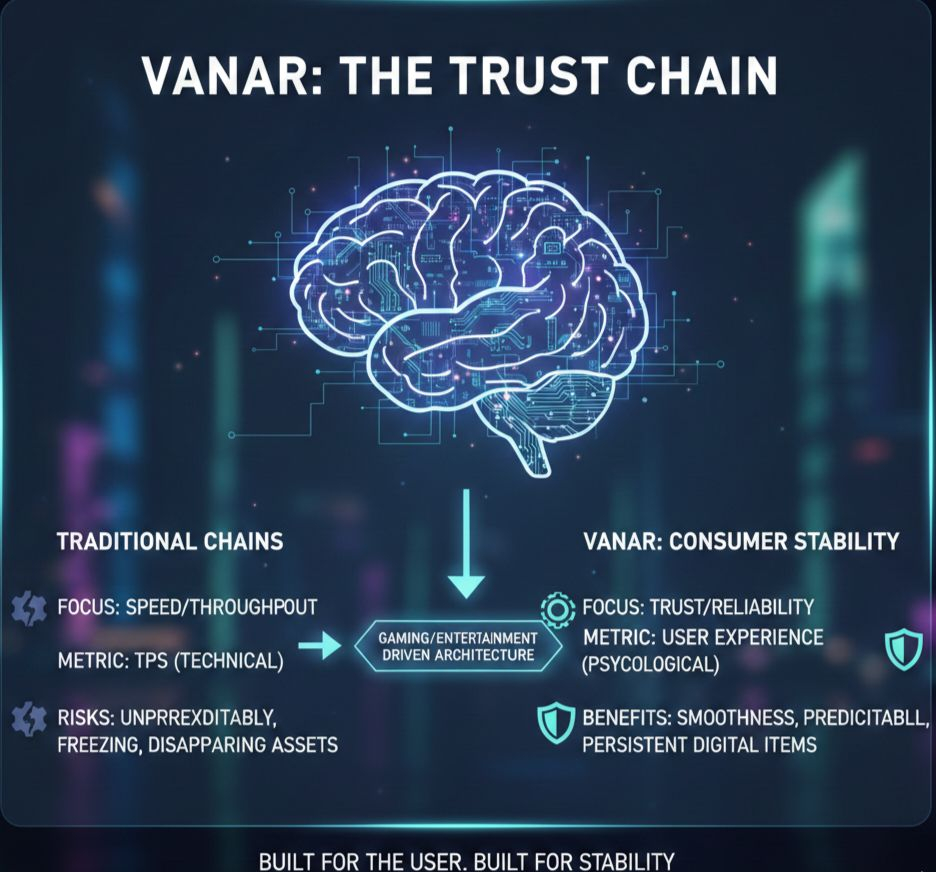
Underneath the marketing language, Vanar is building a stack meant to handle real data and real activity, not just token transfers. The idea behind components like its data compression and AI-aware layers is to make large digital objects — files, assets, media — usable on-chain without breaking the system. For a normal user, the emotional trigger isn’t “AI integration.” It’s the feeling that their digital world behaves consistently. If a metaverse item loads instantly or a game asset is always accessible, trust builds quietly. Trust is what consumer chains live on. It’s invisible when it works and obvious when it fails.
The ecosystem angle is where Vanar feels less theoretical and more grounded. Products like Virtua and the VGN games network aren’t abstract promises. They represent environments where people already spend time. This matters because adoption rarely starts with infrastructure; it starts with entertainment and habit. People don’t wake up wanting a blockchain. They wake up wanting to play, collect, socialize, or express identity. Vanar is trying to embed itself underneath those behaviors instead of forcing new ones. That’s a subtle but powerful narrative difference compared to chains that expect users to adapt to crypto culture first.
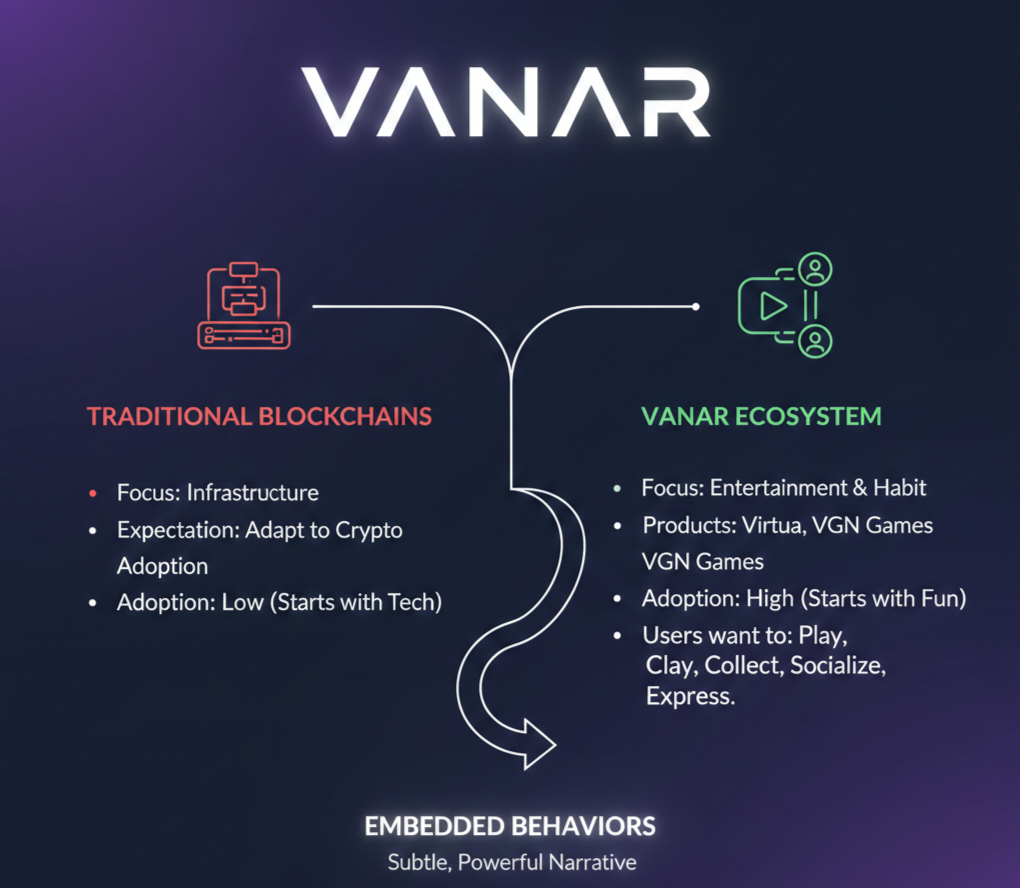
From a market perspective, Vanar sits in a crowded category: consumer-friendly L1s. Competitors exist in gaming chains, scalable general-purpose networks, and app-focused ecosystems. The difference is focus. Some chains chase every vertical. Vanar narrows its lens toward entertainment, brands, and digital environments where emotional attachment forms quickly. That focus can be a strength because consumer loyalty compounds when experiences feel familiar. It can also be a risk. If gaming and metaverse interest cools, the narrative narrows. Market cycles are emotional machines, and sectors rotate faster than infrastructure can rebuild itself.
Liquidity behavior tells its own story. Assets like VANRY don’t trade purely on fundamentals; they trade on attention waves. When the market is risk-on and searching for narratives, mid-cap infrastructure tokens can move violently upward. When attention shifts back to majors, smaller ecosystems feel invisible overnight. That volatility isn’t a flaw — it’s the natural rhythm of speculative markets. The emotional challenge for traders is patience. The chain might be improving during quiet periods, but price doesn’t reward invisible progress immediately. Understanding that gap between development time and market time is where most people lose discipline.
The risks around Vanar are not hidden. Execution complexity is real. Building consumer infrastructure, AI layers, and entertainment ecosystems at the same time stretches any team. Consumer expectations are unforgiving. A delayed update or unstable launch damages confidence more than it would in a developer-only environment. There’s also narrative risk. AI is an overcrowded theme. If messaging outruns real user experience, trust erodes fast. The harsh truth is that consumers forgive boring technology that works. They do not forgive impressive technology that fails at the moment of use.
Here’s the contrarian thought: Vanar’s success might depend on becoming emotionally invisible. The best consumer infrastructure disappears into the background. Users shouldn’t feel like they’re using a blockchain at all. They should feel like they’re using a game, a marketplace, or a digital world that simply behaves. In crypto, teams often chase recognition. In consumer systems, the win is anonymity. If Vanar becomes a silent backbone instead of a loud headline, adoption becomes more durable. That’s a different kind of victory than most crypto narratives promise.
From a trader’s lens, the asset behaves like a catalyst-driven instrument. Accumulation only makes sense when macro conditions allow risk and when ecosystem milestones are close enough to convert attention into sustained volume. Watching how price reacts after announcements matters more than the announcements themselves. Does activity stay elevated, or does it collapse immediately? Markets reveal conviction through follow-through. Emotional discipline comes from accepting that not every development cycle aligns with a profitable entry window.
Looking forward, Vanar’s path isn’t about proving it’s the fastest or the smartest chain. It’s about proving it can host environments people emotionally attach to. Entertainment ecosystems build loyalty differently than finance apps. They become part of identity. If Vanar can support spaces where users feel ownership, creativity, and reliability at the same time, the infrastructure earns relevance organically. If those spaces feel temporary or unstable, users drift the moment the next novelty appears.
Final reflection from a trader’s perspective: I’m less interested in slogans and more interested in whether users stay when hype fades. The projects that survive cycles are the ones people return to quietly. If Vanar becomes a place users revisit out of habit rather than speculation, that’s where long-term value starts forming. Until then, it’s a story in progress — one that deserves attention, but also patience.
