

I used to think EVM compatibility was just a marketing checklist. A "nice-to-have" for chains that couldn't come up with their own architecture. Then I tried to port a high-frequency automation suite from Ethereum to a non-EVM "innovative" Layer 1. Two weeks later, I was still stuck in a documentation rabbit hole, wrestling with a custom SDK that didn't support basic WebSocket listeners.
I moved the project to Vanar last month. It took me exactly eleven minutes.
Here is the truth: For a developer, the most expensive resource isn't gas or compute. It’s cognitive overhead. Vanar’s approach to EVM compatibility isn't about being an "Ethereum clone"—it’s about eliminating the friction between an idea and a production-ready product.
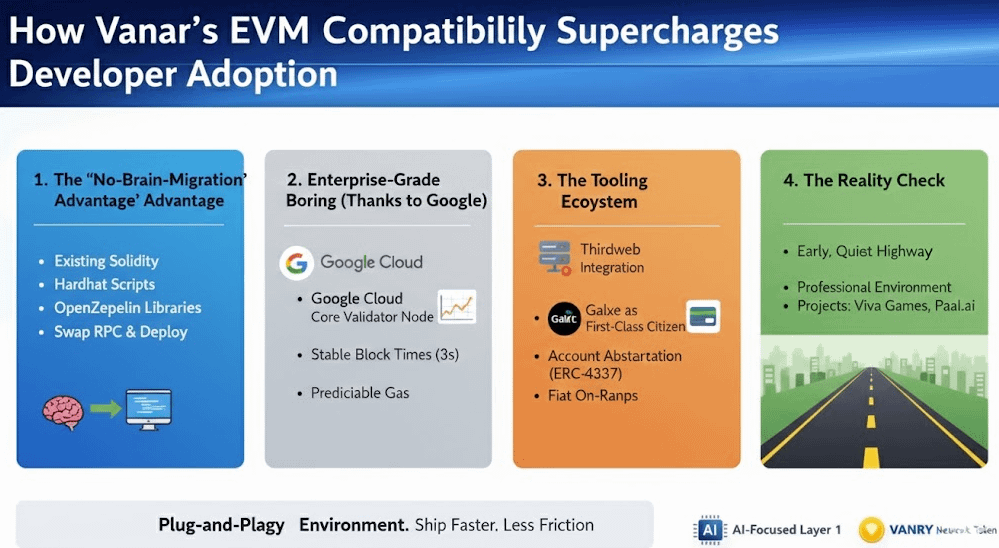
1. The "No-Brain-Migration" Advantage
Most chains ask you to migrate your brain before you migrate your code. They want you to learn a new language, a new security model, and a new way to handle state. Vanar does the opposite. Because it’s fully EVM-compatible, your existing Solidity patterns, Hardhat scripts, and OpenZeppelin libraries work out of the box.
When I deployed my first contract on Vanar, I didn’t have to rethink my logic. I just swapped the RPC endpoint in my config file and hit deploy. For a team with six months of audited code on Ethereum or Polygon, this isn't just a convenience—it’s a massive reduction in security risk and time-to-market.
2. Enterprise-Grade Boring (Thanks to Google)
The real "supercharger" isn't just the code compatibility; it’s the infrastructure underneath. Vanar’s partnership with Google Cloud means they’ve essentially plugged the EVM into industrial-grade hardware.
While other EVM chains struggle with "slot lag" or RPC timeouts during high traffic, Vanar uses Google Cloud as a core validator. This results in a network that feels remarkably stable. I ran a script pushing 50 requests per second for three days on the testnet—the kind of load that makes most explorers crawl. Vanar didn't blink. The block times stayed flat at 3 seconds, and the gas costs remained predictable. For developers building AI agents or high-velocity dApps, that kind of "boring" reliability is the ultimate luxury.
3. The Tooling Ecosystem (Thirdweb & Beyond)
A chain is only as good as the tools that support it. Vanar didn't try to build everything from scratch; they integrated into the platforms developers already use. Seeing Vanar as a first-class citizen on Thirdweb and Galxe is a huge signal. It means you get professional-grade dashboards, easy wallet onboarding via Account Abstraction (ERC-4337), and fiat on-ramps without having to stitch together five different third-party APIs.
4. The Reality Check
It’s not all sunshine. The ecosystem is still in its "early-access" phase. If you look at the block explorer, you aren't going to see the chaotic traffic of a mature chain like Polygon. It’s a clean, quiet highway. But for a developer looking to build a brand-compliant application—like the gaming projects from Viva Games or the AI tools from Paal.ai currently in the ecosystem—that cleanliness is a feature. You’re building in a professional environment, not a digital flea market.
Vanar isn't trying to reinvent the wheel; it’s trying to put the wheel on a better road. By combining the familiarity of the EVM with the brute-force reliability of Google Cloud infrastructure, they’ve created a "plug-and-play" environment for developers who are tired of fighting their infrastructure.
If you’re a dev who values shipping over "theoretical decentralization" debates, Vanar is the pragmatic choice. You don't have to learn a new language. You just have to change an RPC and start building.
#Vanar
$VANRY
@Vanarchain