

When most people talk about blockchain performance, they talk about "TPS" like it’s a car’s top speed - a vanity metric that rarely matters in traffic.
But for a trader, speed isn't about how many transactions a network could handle in a vacuum. It’s about friction: the gap between seeing a price and owning it.
After looking at Fogo, it’s clear they aren't trying to build a faster "world computer." They are building a high-frequency trading floor that just happens to be on-chain.
Here is how Fogo is attempting to eliminate the delays that have historically made professional trading impossible on a decentralized ledger.
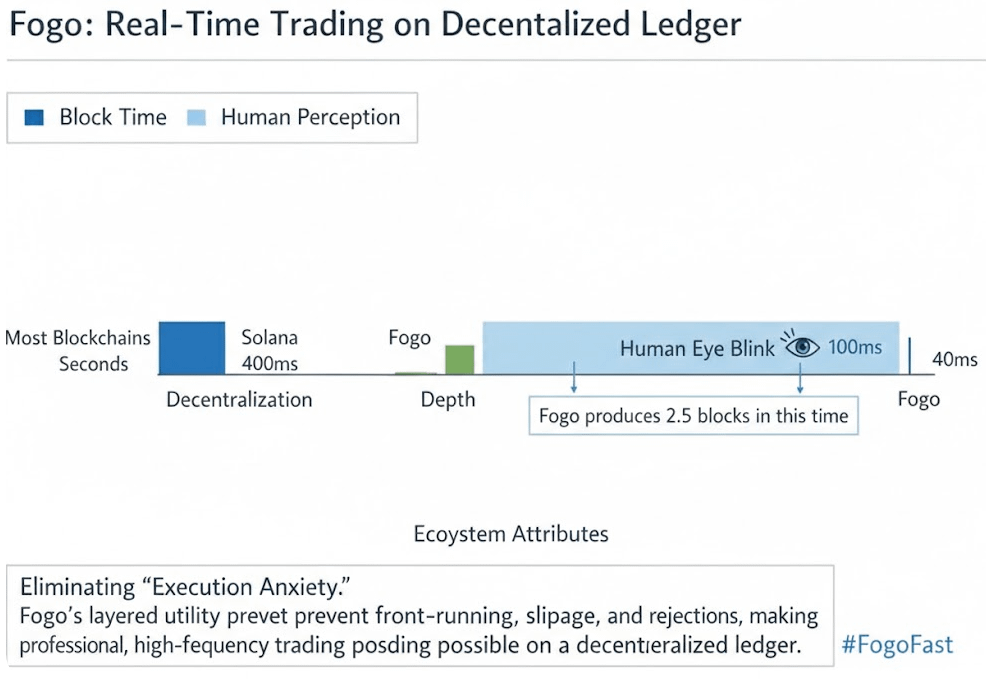
Most blockchains measure block times in seconds. Solana brought that down to roughly 400 milliseconds. Fogo has pushed the boundary further, targeting 40-millisecond block times.
To put that in perspective: the human eye takes about 100ms to blink. Fogo produces two and a half blocks in that time. This isn't just a technical flex; it’s a mission to eliminate "execution anxiety"—that agonizing wait where a trader wonders if their order will be front-run, slipped, or rejected because the market moved while the chain was "thinking."
Most blockchains treat geography as a nuisance to be ignored. Fogo treats it as a physical law that must be obeyed.
Light can only travel so fast through fiber. If your validators are scattered from Tokyo to New York, the speed of your chain is capped by the time it takes a signal to cross the ocean. Fogo’s Multi-Local Consensus model intentionally groups validators into optimized "zones."
By co-locating active validators in specific geographic hubs, the network reduces the "jitter" and propagation delay that normally plagues distributed systems. It’s a "follow-the-sun" model: as global markets wake up, the network's coordination footprint stays tight, ensuring that the physical distance between nodes never becomes a bottleneck for your trade.
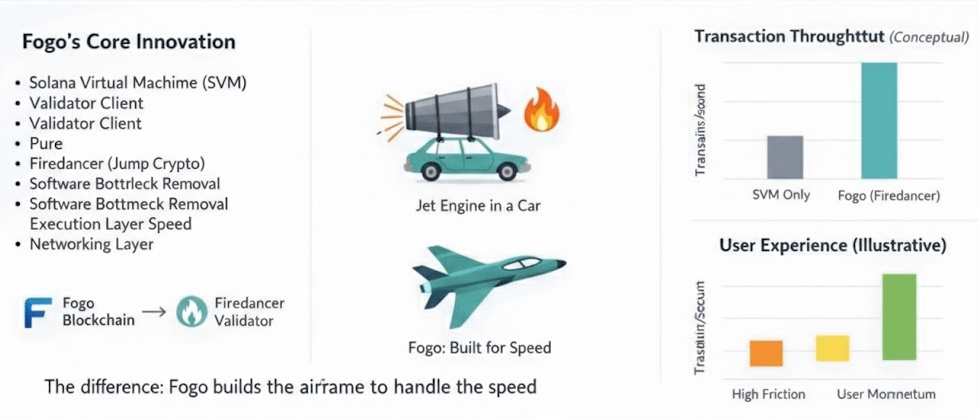
Fogo doesn’t just use the Solana Virtual Machine (SVM) for its ecosystem; it utilizes a validator client based on Firedancer.
Built by Jump Crypto, Firedancer is a total rewrite of the validator software aimed at removing software-level bottlenecks. By running a "pure" Firedancer-based client, Fogo ensures that its execution layer can keep up with its networking layer. It’s the difference between putting a jet engine in a car vs. a plane—Fogo has built the airframe to actually handle the speed.
Beyond the math of blocks and bits, Fogo addresses the user friction that kills momentum.
Through Fogo Sessions, the chain introduces a primitive that allows for gasless, session-based interactions. In a typical DeFi experience, you have to approve every single swap, which adds seconds of human-induced latency. On Fogo, you can open a session, trade with the fluid speed of a centralized exchange (CEX), and maintain self-custody throughout. No repeated pop-ups. No gas math. Just execution.
Critics will point out that Fogo’s curated validator set and geographic concentration trade away some of the "radical decentralization" found in slower chains.
But Fogo’s thesis is simple: Latency is a tax on capital. A perfectly decentralized chain that is too slow for a Central Limit Order Book (CLOB) forces traders back into the arms of centralized exchanges like Binance or Coinbase. By optimizing for the physical constraints of the real world, Fogo is trying to give traders a reason to stay on-chain.
Fogo isn't trying to host your NFTs or your social media apps. It is a vertically integrated environment for high-stakes finance.
If you believe the future of DeFi is a mirror of traditional markets - where milliseconds equal millions - then Fogo’s mission to eliminate delay isn't just an improvement. It’s the only way forward.
#fogo
@Fogo Official
$FOGO