

There is a big difference between a blockchain that looks fast on paper and one that feels stable when real money is moving. Most traders learn that lesson the hard way. Everything works smoothly during quiet hours. Then volatility hits, volume surges, liquidations trigger, and suddenly confirmation times stretch just enough to matter. That gap between theory and experience is where infrastructure either earns respect or loses it.
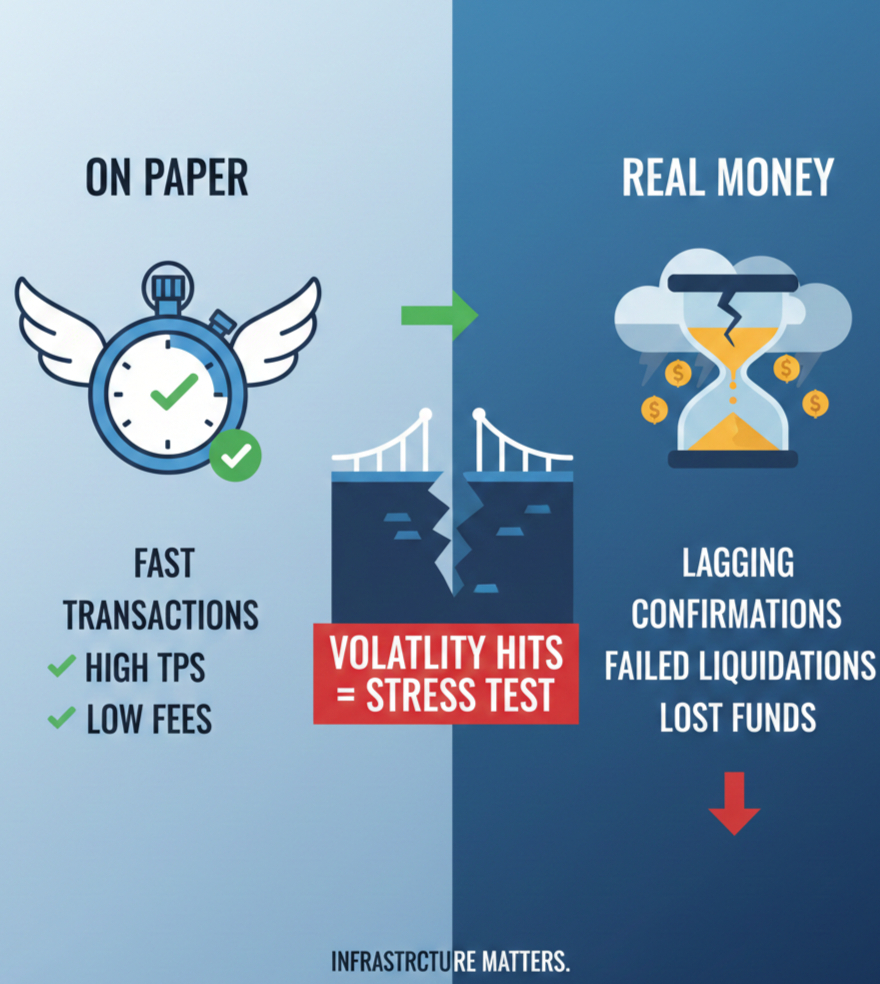
Fogo enters the conversation from that angle. It is a high-performance Layer 1 built around the Solana Virtual Machine, but its identity is not “we’re fast.” Its identity is closer to “we want execution to feel consistent.” That distinction sounds small, but in markets, consistency is everything.
This cycle is different from earlier ones. We are past the stage where users are impressed by abstract TPS numbers. Traders care about fills. Builders care about uptime. Liquidity providers care about latency. Institutions care about predictability. A chain can be technically impressive, but if it behaves unpredictably during stress, capital quietly rotates away. Fogo’s design feels shaped by that reality.
By using the Solana Virtual Machine, Fogo avoids reinventing the execution layer. That is a practical decision. Developers who understand SVM architecture already know how accounts interact, how parallel execution works, how programs behave under load. Instead of building a new ecosystem from zero, Fogo builds on a proven runtime and focuses on refining performance boundaries.
Where it becomes interesting is how it approaches consensus and validator structure. Rather than assuming that more geographic dispersion always equals better outcomes, Fogo organizes validators into zones and rotates which group actively participates in consensus. The logic is simple: physical distance affects communication speed. If you reduce the latency across the active quorum, you reduce unpredictability in finality.
That design choice is honest. It acknowledges that blockchains run on real networks, across real cables, subject to physics. Instead of pretending decentralization has no performance cost, Fogo tries to engineer around the cost in a controlled way.
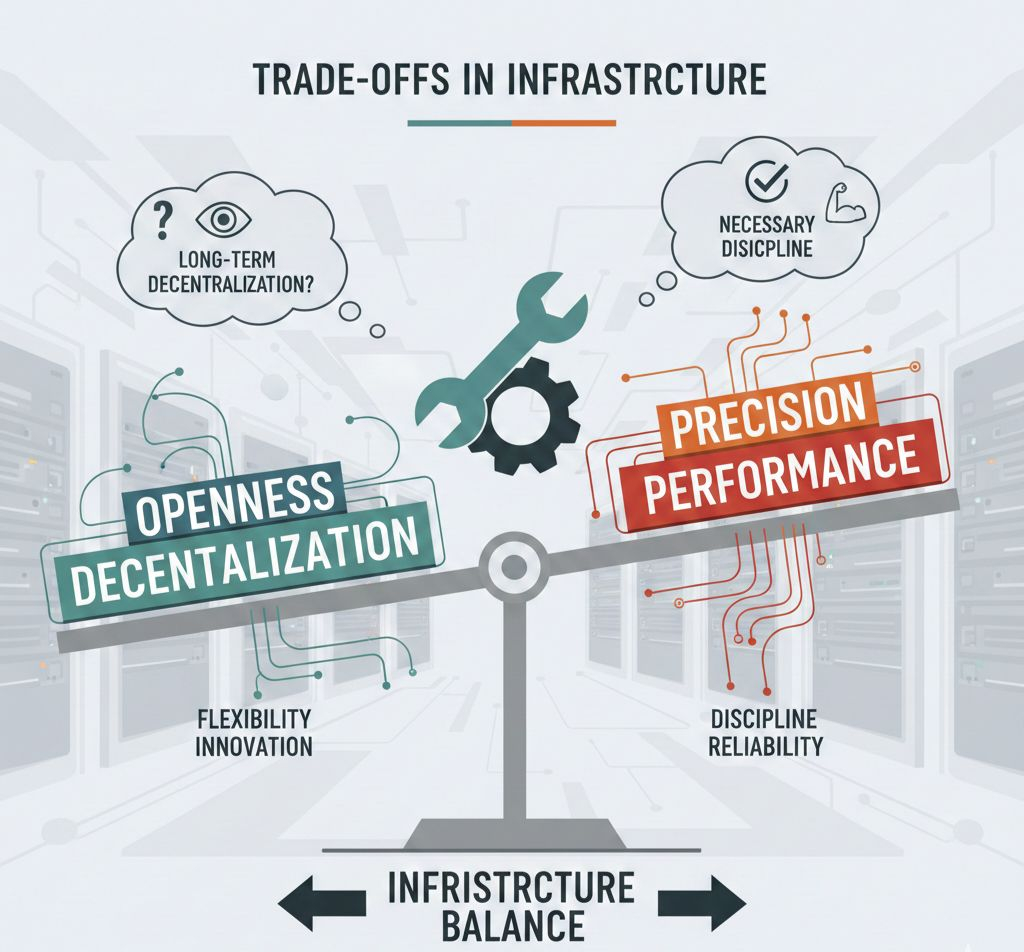
Of course, that comes with tradeoffs. Any time you tighten performance requirements, you naturally raise the bar for operators. Hardware expectations increase. Coordination becomes more structured. Some observers will see that as necessary discipline. Others will question how it impacts long-term decentralization. Both perspectives are valid. Infrastructure is always a balance between openness and precision.
The FOGO token plays a supporting role rather than a flashy one. It secures the network through staking, handles transaction fees, and aligns validator incentives with uptime and performance reliability. In a performance-focused chain, tokenomics should reward stability. If a validator underperforms, that is not just a technical issue; it directly affects user experience. Incentives need to reflect that connection.
When thinking about ecosystem growth, the question is not “how many apps?” It is “what kind of apps?” Fogo naturally aligns with latency-sensitive use cases. Orderbook-based exchanges. Perpetual futures platforms. Settlement layers for fast-moving DeFi strategies. These applications do not forgive inconsistency. They measure performance in milliseconds and reputation in uptime percentages.
Real utility in this context means something simple: when markets are chaotic, the chain behaves calmly. That is the test. If Fogo can demonstrate that confirmation times remain tight during volume spikes, it earns credibility with serious participants.
In terms of market positioning, competition is intense. Solana already commands mindshare in high-performance narratives. Ethereum Layer 2 networks dominate liquidity depth and institutional familiarity. New Layer 1s do not get attention for existing; they must justify their existence with clear differentiation.
Fogo’s differentiation is narrower and more technical: reduce latency variability and optimize the consensus path. It is not trying to be a general-purpose social chain or a meme economy hub. It reads more like infrastructure designed for markets first.
There are real risks. Validator zoning adds operational complexity. Rotating active groups must be executed flawlessly. Any coordination misstep can become a visible weakness. There is also perception risk: performance requirements may concentrate participation among well-resourced operators. Over time, governance transparency and onboarding pathways will matter.
Another subtle risk is market behavior itself. Ultra-fast deterministic environments can favor highly optimized participants. When latency is extremely low and predictable, advanced strategies may dominate. That is not necessarily negative, but it can shape ecosystem culture. Speed alone does not guarantee fairness.
From a trader’s perspective, Fogo is not a short-term hype narrative. It is an infrastructure bet. Infrastructure bets usually move slower in quiet phases and gain relevance when activity expands. In strong bull conditions, performance constraints become visible across ecosystems, and alternative rails gain attention. In slower markets, infrastructure tokens often drift unless backed by measurable growth.
Accumulation decisions, if someone chooses to engage, should be aligned with milestones rather than headlines. Network stability metrics. Developer adoption. Liquidity depth. Consistent uptime history. These are stronger signals than marketing cycles. Patience tends to reward infrastructure plays more than impulse reactions.
Macro alignment also matters. If capital markets continue exploring tokenized settlement and on-chain execution for serious financial flows, deterministic high-performance rails gain structural relevance. If crypto remains largely speculative, then narrative rotations may overshadow fundamentals for longer periods.
The most important question for Fogo is not how fast it can go in ideal conditions. It is how steady it remains in imperfect ones. Markets test infrastructure when nobody expects it. They test it at 3 a.m. during cascading liquidations. They test it when volatility doubles in minutes.
Final reflection, trader to trader: I pay attention to systems that design around constraints instead of denying them. Latency is real. Network distance is real. Coordination cost is real. A project that starts from those truths feels more grounded than one chasing numbers for headlines.
If Fogo can show that its architecture translates into visible consistency—same behavior in calm sessions and chaotic ones—it earns quiet respect. And in this cycle, quiet respect is more valuable than loud promises.
