There's a mistake that almost every Layer 1 project makes, and I've watched it happen over and over again for years. They start with a specific vision, raise money on that vision, and then quietly expand the scope because they're scared of being too niche. Too focused. Too small. The result is a chain that does ten things adequately and nothing exceptionally. Graveyard of blockchain history is full of them.
So when I started digging into Fogo seriously, the first thing that struck me wasn't the technology. It was the discipline.
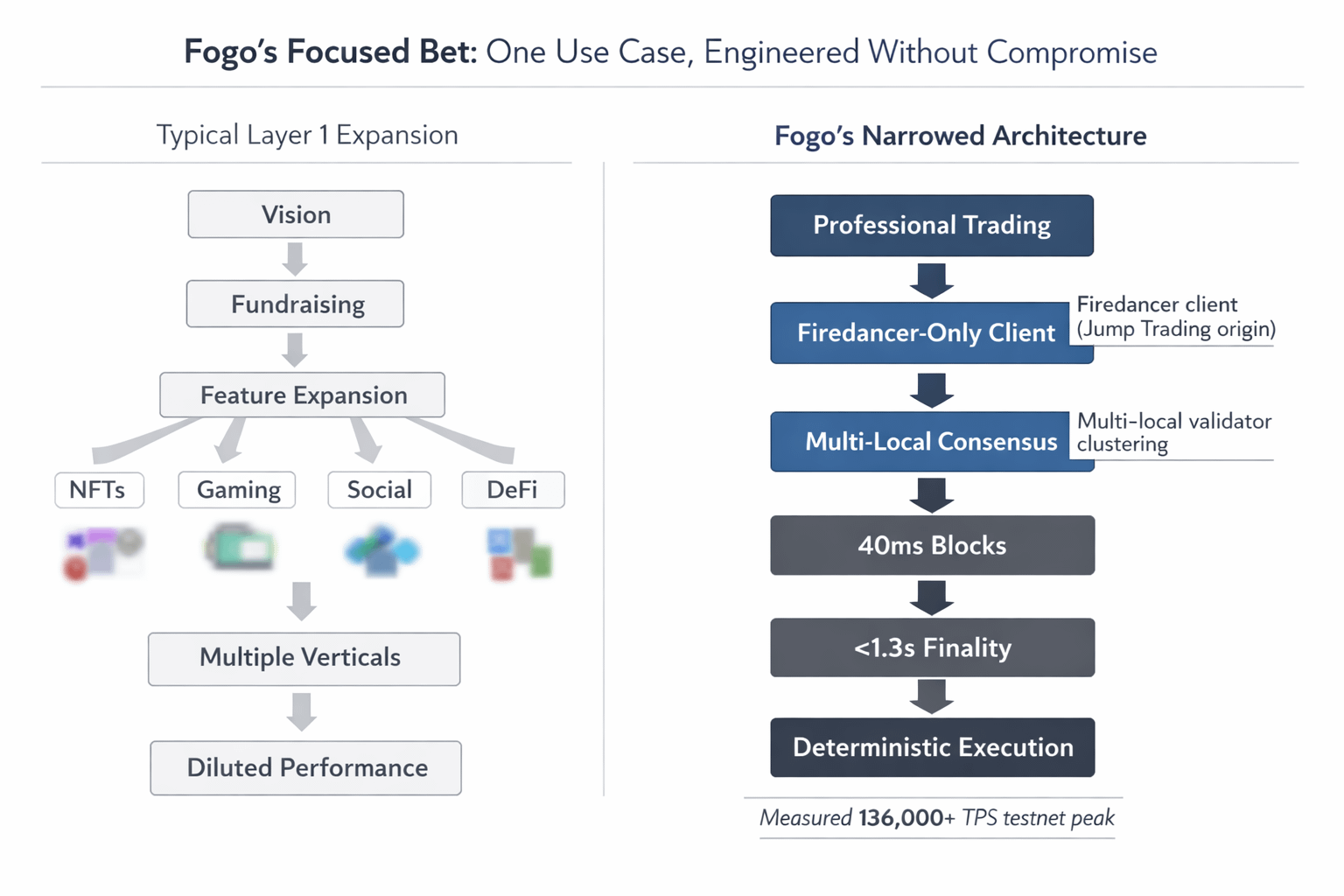
Fogo made a decision that most founders won't. It narrowed everything — the validator set, the client, the consensus mechanism, the entire ecosystem — around one singular use case: professional on-chain trading. Not NFTs. Not gaming. Not social applications. Trading. Order books, perpetuals, real-time liquidations, precision market making. The infrastructure that has lived exclusively on centralized exchanges for a decade because no decentralized chain was ever fast enough or reliable enough to host it. Fogo looked at that gap and decided to fill it completely rather than partially.
That decision shapes everything about how Fogo is built.
The Firedancer client is the foundation. Originally engineered by Jump Trading for extreme throughput, Firedancer runs as one option among several on Solana. On Fogo it runs as the only option — every validator, identical software, identical performance ceiling. No client diversity drag. No inconsistency between nodes. Then Fogo layers multi-local consensus on top — validators co-located geographically so the physical distance data travels during block production is minimized to a degree that globally distributed networks simply cannot achieve. The output is 40ms block times, finality under 1.3 seconds, and testnet peaks above 136,000 transactions per second recorded on Chainspect under real conditions. These aren't projections. They're measurements.
Now here's where I want to push back on something — because I think the Fogo bull case gets overstated in certain corners of crypto Twitter, and that doesn't help anyone.
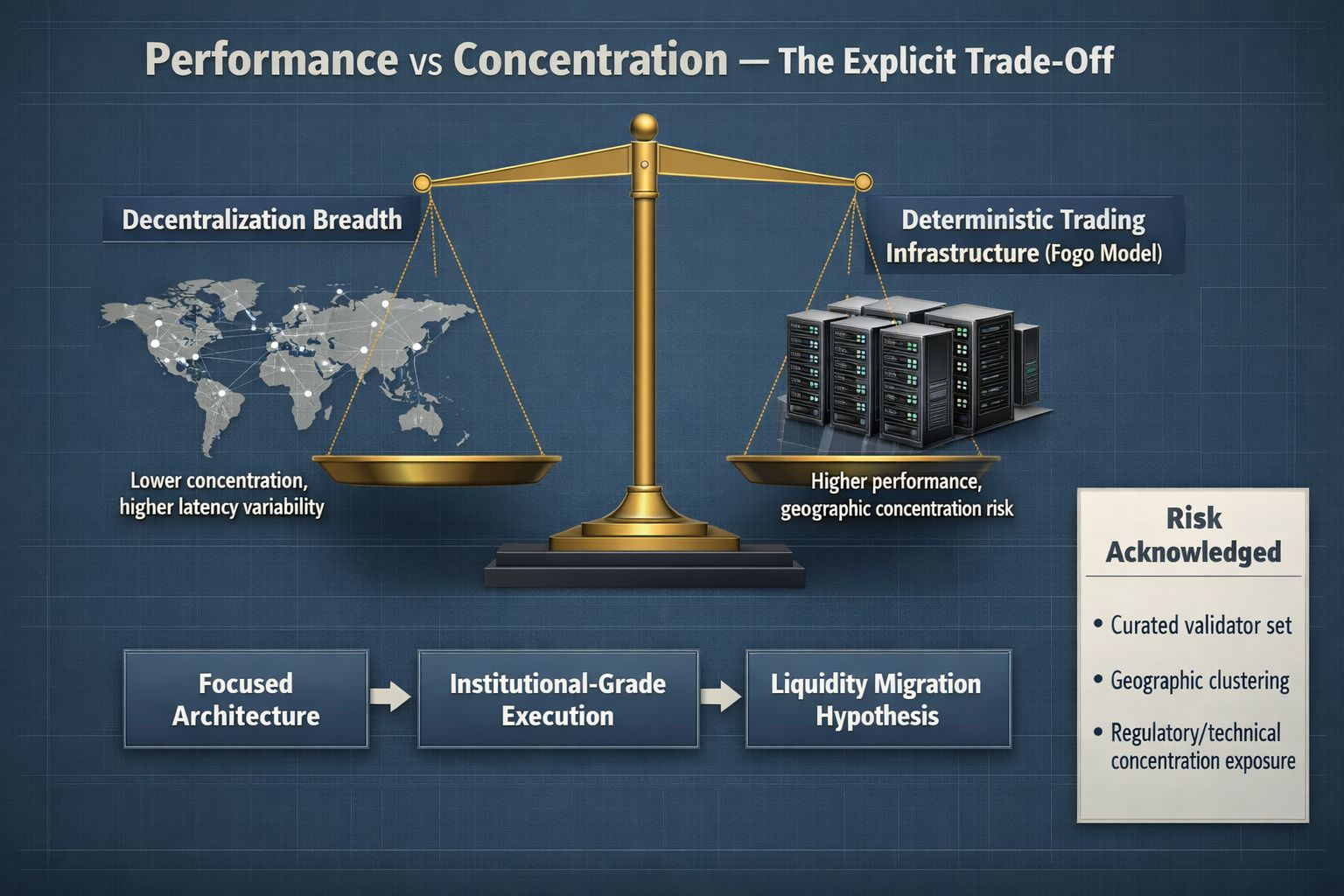
The curated validator set that makes Fogo's performance possible also creates genuine concentration risk. Fewer validators, geographically clustered, means a single point of technical or regulatory failure could halt the network. Fogo's team acknowledges this openly, which I respect. Their answer is that traders will consciously accept this tradeoff for performance gains unavailable anywhere else on-chain — the same logic that drives institutional trading firms to co-locate servers inside exchange data centers. It's a coherent argument. But it's still a tradeoff, not a solved problem. Anyone building on Fogo or holding $FOGO should understand that clearly.
What makes me take the long-term thesis seriously despite that risk is the ecosystem timing. Fogo didn't launch and then ask developers to come build. Valiant launched as the enshrined DEX. Brasa launched for liquid staking. Fogolend and Pyron went live for lending markets. Moonit for token launches. Fogo Sessions — the account abstraction layer that removes gas friction and wallet popups from the trading experience entirely — was built into the base protocol from day one, not retrofitted afterward. The SVM compatibility means Solana developers can deploy on Fogo without rewriting their codebase. That's not an accident of timing. That's a team that understood ecosystem bootstrapping is as important as the chain itself.
The people behind Fogo matter here too. Douglas Colkitt spent years as a quantitative researcher at Citadel before founding Ambient Finance. Robert Sagurton ran digital asset sales at Jump Crypto. Michael Cahill leads Douro Labs, the organization behind Pyth Network — one of the most integrated financial oracles in DeFi. These are people who have operated inside the fastest, most demanding financial infrastructure on earth. They know exactly what professional markets require because they've worked inside them.
On the market side, $FOGO is trading at $0.02612 today, down 3.12% in the last 24 hours after yesterday's strong session. The day reached a high of $0.02741 before pulling back, with $0.02527 holding as the intraday low. The daily chart continues to show $FOGO respecting the $0.01996 bottom and maintaining its sequence of higher lows, with MACD remaining positive at 0.00118 despite today's mild red candle. RSI at 44.21 sits in neutral territory, suggesting this pullback is consolidation rather than reversal — the kind of healthy price action that stronger moves typically build from.
The fixed supply of 10 billion FOGO with core contributors locked behind a 12-month cliff and four-year vesting gives the current market structure more credibility than most fresh mainnet launches. Insider supply isn't hitting the market yet. What trades now is largely community-owned — and that matters for interpreting volume signals honestly.
Fogo is making a focused bet in a market that rewards focus less often than it should. Whether the bet pays off depends on whether professional trading volume migrates on-chain at the scale the team is building for. I don't know if it will. But I know the foundation is more serious than almost anything else launching in this cycle.
That's enough to keep watching closely.
@Fogo Official #fogo #FOGO $FOGO