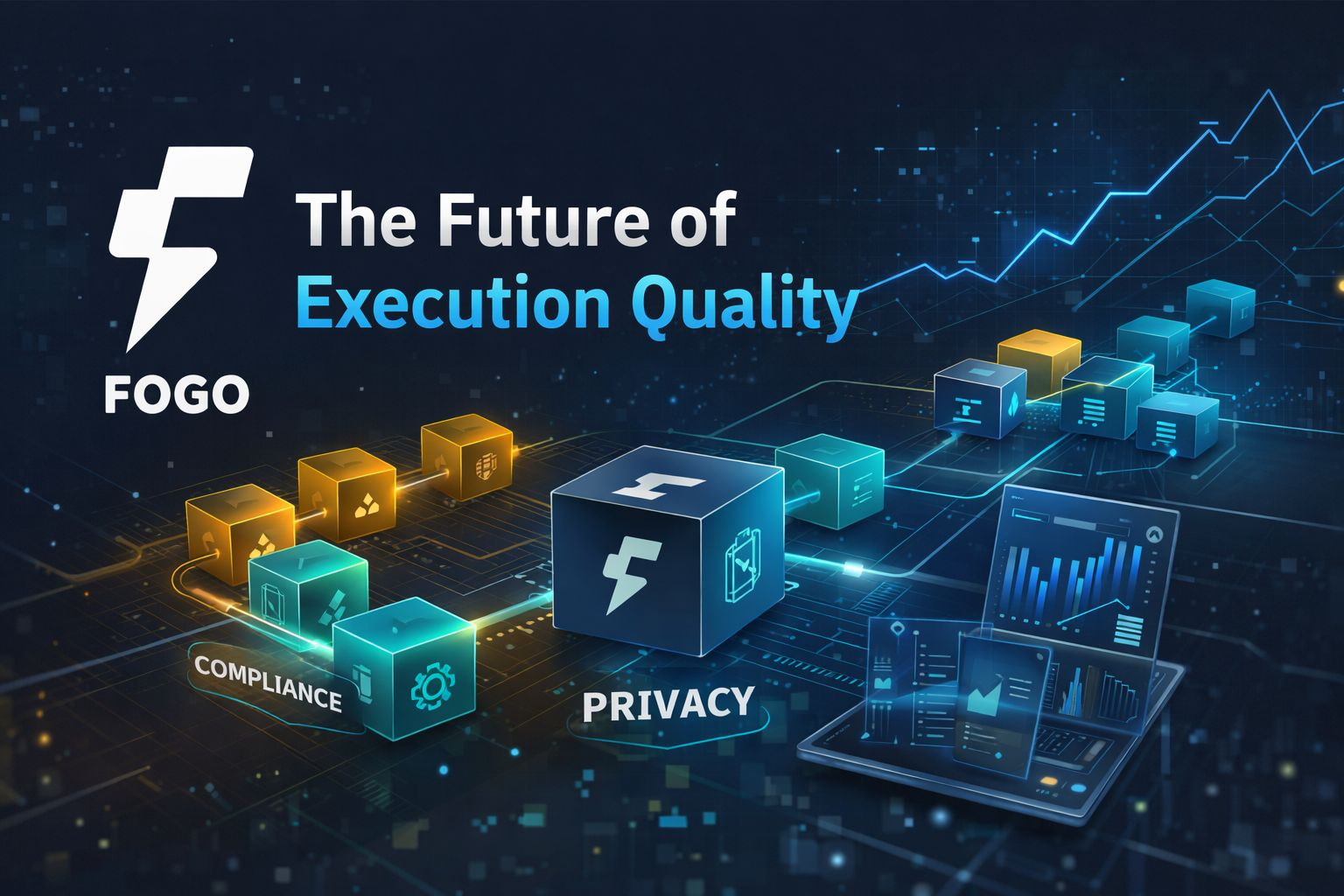
The more I study Fogo, the clearer it becomes that this chain is not competing in the usual L1 race. Most blockchains today still treat execution performance as a feature they can optimize later. They talk about TPS during calm conditions, they show testnet spikes, they talk about modularity, but when real market volatility arrives, the entire stack slows down. Congestion hits users first. Gas spikes hit traders next. Builders suffer when latency becomes unpredictable. Everything that matters in the moment of real economic activity collapses under peak load.
Fogo is built with a very different thesis. The team designed the network from the execution layer upward and not from the consensus layer downward. In simple words, they started with the hardest part first. They focused on fairness, deterministic ordering, predictable propagation, and low latency as the foundation. Only after solving these constraints did they build outward into governance, token economy, developer experience, and compliance infrastructure.
That is why Fogo is starting to attract serious attention. Traders care about speed, but what they actually want is reliability under pressure. Developers care about SVM compatibility, but what they actually want is stability during bursts of demand. Institutions care about compliance, but what they actually need is a chain that can prove data handling rules without destroying user privacy. These problems all intersect at one place: the quality of execution. And this is where Fogo has positioned itself.
Fogo And The Evolution Of Execution Quality
If you look at the design patterns of modern DeFi, almost every meaningful action involves multi step execution. A trader bridges assets to another chain. They wait. They swap. They rebalance. They deposit. Each step adds time risk. Each step adds failure risk. Each step multiplies friction. And every additional hop creates a point where something can go wrong.
Fogo flips this structure. The settlement foundation uses Wormhole as the underlying interoperability layer and then applies SVM execution on top to compress multi step flows into a single pathway. This is not just convenience. It is a structural improvement in how capital moves. The fewer the steps between intention and outcome, the fewer the ways capital can disappear, get stuck, or become mispriced.
Builders are also noticing this. Porting SVM apps into Fogo does not require rewriting entire systems. The runtime remains familiar. The environment is optimized. The tools and patterns match what developers already know. This combination of familiarity and performance acceleration is powerful because it lowers the barrier for migration. It allows existing SVM projects to launch on Fogo without months of engineering overhead.
The early liquidity expansion from Binance TH pairs is another milestone. Liquidity attracts builders. Builders attract users. Users attract markets. Markets attract institutions. The cycle is starting slowly but the foundation is visible. Fogo is moving from “interesting new chain” to “credible alternative execution layer” and that shift happens only when the architecture is correct.
Compliance As A First Class Design Primitive
Most chains treat compliance as an afterthought. They assume it can be added later through optional modules, partner services, or external auditors. But real world value cannot move at scale without clear rules of data handling, event retention, user identity protection, and selective disclosure. These are not ideas you can bolt on at the end. They must be included from the beginning.
This is where Fogo is unique. The team treats compliance as part of the network architecture itself. They integrate structures that allow regulated players to participate without sacrificing their operational requirements. At the same time they create privacy guarantees for normal users so the chain does not become an always visible surveillance system. This dual system is difficult. Most chains choose one side. Fogo attempts to balance both by using smart data pathways, segmentation of sensitive information, and policy enforcement at network level instead of app level.
To visualize this balance, here is a simple comparison:
This type of architecture matters because the next wave of value will not come from speculative tokens alone. It will come from systems that can support real world commerce, compliant liquidity, and institutional strategies while still offering users protection from unnecessary exposure. That is why compliance infrastructure must exist inside the protocol and not around it.
Privacy Without Sacrificing Functionality
The opposite side of the compliance discussion is privacy. Privacy is not secrecy. Privacy is choice. Users should be able to disclose what is needed without leaking everything. Developers should be able to build apps that comply with rules without revealing irrelevant data. Institutions should be able to verify with cryptographic proofs rather than full data dumps.
Fogo solves this with a layered approach. Sensitive information is not exposed to the entire network by default. Event trails can be selectively shared. Identity bridges can be abstracted. Infrastructure level minimization ensures the network does not collect what it does not need. This is becoming an important trend worldwide. Data minimization is not only a technical advantage. It is becoming a regulatory requirement across multiple regions.
To make this concept clearer, here is a second visualization:
These diagrams are not just graphics. They represent a deeper principle of Fogo: do not hold data that you cannot protect. Do not expose data that users did not consent to. Do not require data that is not essential to execution. This principle is becoming extremely relevant as new regulatory frameworks appear across Asia, Europe, and the Middle East.
The Human Side Of Execution Reliability
Every blockchain talks about disruption but very few talk about responsibility. What makes Fogo feel different is that the team acknowledges trade offs openly. Execution quality is powerful but it introduces operational difficulty. Multi local architecture is flexible but increases the surface area for outages. Curated validator sets improve fairness but must be maintained carefully. Bridges simplify flows but require strong security assumptions.
Instead of hiding these parts, Fogo communicates them clearly. This is what makes the project feel mature even at an early stage. Reliability does not come from branding. It comes from honest engineering. And Fogo is willing to take this route: build predictable environments, enforce fairness, accept the limitations, and iterate fast.
This also reflects in their incentive programs. Points and airdrops usually attract farmers. Fogo designs incentives to reward the right behaviors such as early bridging, consistent app usage, trading volume, and ecosystem contribution. They may not get everything perfect, but the intention is clear. They want to prevent Sybil abuse early instead of reacting later.
The Execution Future: Why Fogo Might Lead The Next Cycle
If crypto moves into a world where AI agents execute trades automatically, where cross chain strategies depend on millisecond timing, where institutions require compliance by default, and where users demand privacy as a right, execution becomes the center of everything. A fast chain is useless if unreliable. A private chain is useless if impractical. A compliant chain is useless if slow. Fogo positions itself at the intersection of these constraints.
The network is not promising magic. It is promising architecture. It is promising predictable performance under stress. It is promising an environment that respects user data while supporting regulated activity. This combination is rare because it requires both technical strength and regulatory intelligence. Very few teams truly understand both worlds.
Fogo might become the chain where high frequency DeFi, cross chain capital strategies, permissioned liquidity, institutional flows, and consumer apps coexist in one rational environment. A network where execution happens the way modern economic systems require.
Final Thoughts From My Side
As someone who studies multiple chains every day for my community, what stands out to me is not just Fogo’s speed. It is the system level thinking. They are solving problems that appear only when value becomes large, when institutions arrive, when bots dominate liquidity, when volatility spikes, and when global rules tighten.
This is where the future is going. The next era of blockchain adoption will not be driven by hype but by reliability, fairness, data minimization, compliance by design, and execution quality that does not collapse when markets become chaotic. Fogo is aiming directly at this reality.
And that is why I continue covering it for you all. This is the type of infrastructure that shapes the next cycle.