🔥 The Market is Changing Faster Than Most Investors Realize
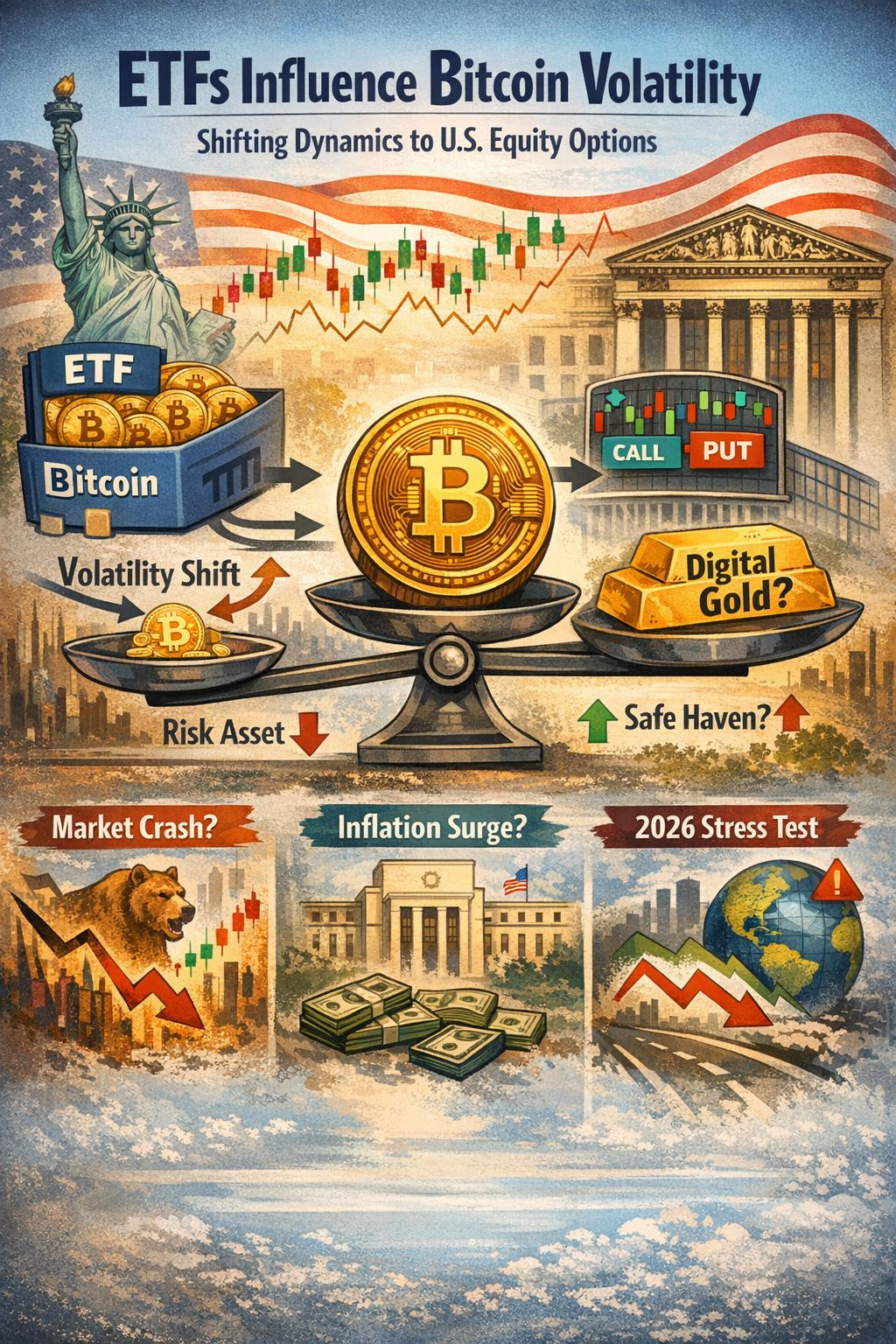
Exchange-Traded Funds (ETFs) tied to Bitcoin are reshaping market dynamics, with analysis suggesting that a significant portion of Bitcoin’s volatility is now migrating toward options markets in the United States. This shift means Bitcoin is no longer operating in isolation as it once did. Instead, institutional capital flowing through ETFs is linking its price behavior more closely to traditional financial instruments. The implication is profound: Bitcoin’s movements are increasingly influenced by risk sentiment and hedging strategies used by large investors. Rather than being driven solely by crypto-native speculation, its volatility is now intertwined with broader market structures.
📊 This transformation signals maturation. Bitcoin is evolving from a purely speculative asset into a component of institutional portfolios. The result is greater market efficiency but also new layers of correlation with traditional assets. Investors must now monitor not only crypto-specific news but also developments in equity markets and macroeconomic conditions.
💡 Is Bitcoin Still Digital Gold? The Debate Gets Harder
The idea of Bitcoin as “Digital Gold” rests on its scarcity and independence from government control, much like Gold. However, ETFs have altered the landscape. Bitcoin is now embedded within institutional investment frameworks, meaning its price is influenced by capital flows, macroeconomic sentiment, and hedging activity. The traditional narrative of Bitcoin as an entirely detached asset is evolving.
🔗 This does not mean the digital gold thesis is invalid. Scarcity remains fundamental—Bitcoin’s supply cap of 21 million units cannot be altered by policy. Yet the asset’s behavior increasingly resembles a hybrid: part store of value, part growth asset, and part risk asset depending on market conditions. Gold has historically served as a low-volatility safe haven, whereas Bitcoin offers higher potential returns but with greater price swings. The distinction is important: gold represents stability, while Bitcoin represents digital scarcity with evolving institutional adoption.
🚀 Ultimately, Bitcoin’s role is expanding rather than disappearing. It may not mirror gold in behavior, but it still embodies core principles of value storage in a digital age.
⚠️ 2026 Could Be the Ultimate Stress Test
If a global economic shock occurs in 2026, Bitcoin’s performance will depend on the nature of the crisis. History suggests that in periods of liquidity stress—such as the 2020 market downturn—investors tend to sell risk assets indiscriminately. In such a scenario, Bitcoin could decline alongside equities as capital seeks safety in cash. This does not invalidate the asset’s long-term thesis; it reflects human behavior during uncertainty.
📉 Conversely, if the crisis stems from inflation or monetary expansion, Bitcoin may benefit. Should the Federal Reserve pursue accommodative policies or if inflation erodes purchasing power, scarce assets often attract capital. In this case, Bitcoin could act similarly to Gold, serving as a hedge against currency debasement. Institutional investors might increase allocations as a diversification tool.
📊 A third scenario involves an equity-specific downturn. If indices such as the S&P 500 or Nasdaq Composite fall due to valuation corrections, the key question becomes whether institutions sell Bitcoin in tandem or retain it as a diversifier. Initial pressure is possible, but long-term outcomes depend on capital reallocation strategies.
🔎 The Bottom Line—Evolution, Not Obsolescence
Bitcoin today occupies a transitional phase. It is neither a pure speculative token nor a fully mature store of value like gold. Instead, it is evolving within the financial system as institutional participation grows. ETFs have accelerated this process by integrating Bitcoin into traditional investment structures, increasing liquidity and market depth while also linking it more closely to global risk sentiment.
💼 For investors, this means adaptation. Monitoring macroeconomic trends, understanding correlations with equity markets, and practicing disciplined risk management are essential. Bitcoin’s potential remains significant, but its behavior is shaped by an increasingly complex financial environment. The digital gold narrative persists, yet it coexists with new realities of institutional integration and market interdependence.
🚩 The true test will come during the next major economic disruption. If Bitcoin can navigate such an event and recover, its role as a long-term store of value will be further validated. Until then, the asset should be approached with both optimism and strategic caution.