
As traders, we’ve all heard the golden rule: "Buy the dip, sell the rip." But let’s be honest, how many times have you bought a "dip" only to watch it keep dipping?
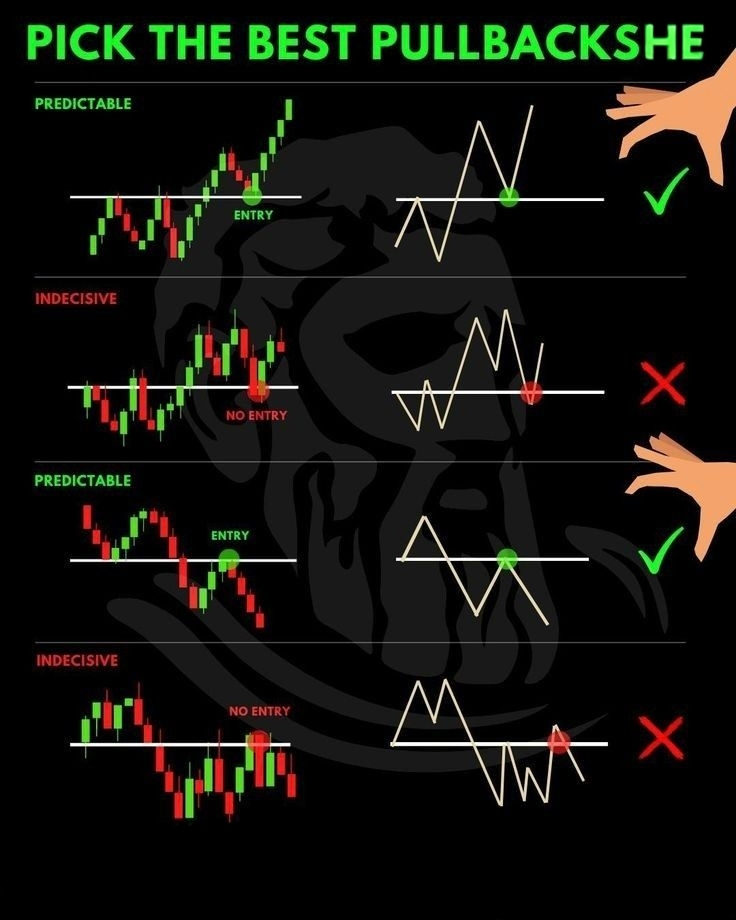
Trading pullbacks is one of the most profitable strategies in crypto, but not all pullbacks are created equal. The provided cheat sheet perfectly illustrates the difference between a high-probability entry and a trap. Let's break down how to pick the best pullbacks and save your portfolio from unnecessary losses.
✅ The "Predictable" Pullbacks (Where You Enter)
The secret to a great pullback is a clean, decisive break of a key level followed by a clean retest. You want to see the market respect the structure.
The Bullish Entry (Top Chart): Price breaks confidently above a resistance line. Instead of FOMO buying the top, you wait. The price pulls back, touches that exact same line (which has now flipped from resistance to support), and bounces. This is your green light to enter long.
The Bearish Entry (Third Chart): Price slices down through a support line. It pulls back up to retest that broken line (which is now acting as resistance) and gets rejected. This is your green light to enter short.
Why these work: They show clear market intent. The buyers (or sellers) proved their strength with the breakout, and the retest confirms that the new level is being defended.
❌ The "Indecisive" Pullbacks (Where You Stay Out)
This is where retail traders lose their money. When the price action around a key level gets messy, your best position is no position.
The Choppy Zones (Second & Bottom Charts): Notice how the price breaks the line, falls back under it, breaks it again, and creates a series of jagged, overlapping waves? The market is indecisive. It hasn't decided if that line is support, resistance, or just empty space.
The Danger: If you try to trade a pullback here, you will likely get stopped out by a fakeout before the market actually chooses a direction.
💡 Key Takeaways for Your Next Trade:
Patience Pays: Never buy the initial breakout. Wait for the retest.
Look for Clean Action: If the candles are chopping back and forth across your level, delete the line and step away.
Role Reversal: The best setups happen when old resistance clearly becomes new support (or vice versa).
Don't let the market force you into bad trades. Memorize these predictable patterns, protect your capital, and wait for the perfect pitch!
What is your favorite indicator to use alongside price action when trading pullbacks? Let me know in the comments below! 👇