
The robotics sector is evolving rapidly, blending AI advancements with physical hardware to tackle real-world labor shortages. Enter Fabric Foundation, a non-profit organization aiming to reshape how robots integrate into the economy. Through its protocol, Fabric seeks to create infrastructure where machines aren't just tools but active participants in economic activities. This piece dives into the project's core elements, with a spotlight on its vision for the robot economy. We'll break down its mechanics, economics, competitors, risks, and what's ahead—all while keeping things grounded in facts and analysis.
What is Fabric Foundation?
Fabric Foundation is building an open, decentralized network designed to coordinate, govern, and evolve general-purpose robots. Founded to address gaps in robotics infrastructure, it focuses on providing robots with onchain identities, wallets, and the ability to participate in automated labor markets. The foundation operates as a non-profit, overseeing research on human-machine alignment, interpretability, and economic frameworks for intelligent machines.
At its heart, Fabric acts as a coordination layer for robotic labor. It enables decentralized participation through pools where users can deposit stablecoins to fund robot deployment and maintenance. Employers pay for services in $ROBO, the native token, based on verified task completions. This shifts robots from siloed, company-owned assets to a global, permissionless workforce. The network starts on Base (an Ethereum L2) and plans to migrate to its own L1 as it scales.
Fabric's approach leverages crypto primitives like transparent participation and programmable incentives to solve robotics' inefficiencies. For instance, it creates an onchain registry for robot provenance, ensuring auditable identities across jurisdictions. This matters in a world where AI is getting better at navigating dynamic environments, hardware costs are dropping, and labor shortages persist in sectors like healthcare and manufacturing.
Focus: Introduction to Fabric Foundation: Building the Robot Economy
Fabric Foundation positions itself as the backbone for the "Robot Economy"—a future where robots operate as first-class economic participants. The idea is straightforward yet ambitious: robots need financial identities to handle payments, contracts, and insurance independently. Without this, they're stuck in closed systems controlled by a few corporations.
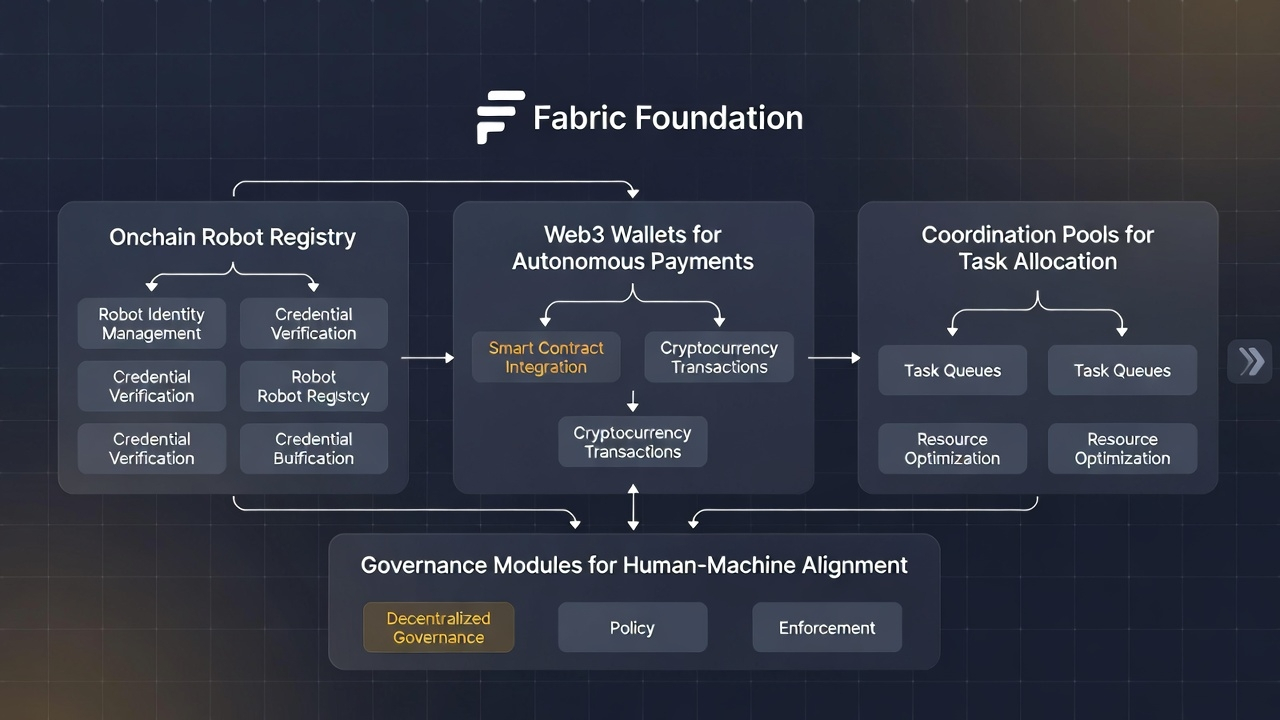
The foundation's infrastructure includes payment networks, identity systems, and capital allocation mechanisms. For example, robots get web3 wallets for autonomous transactions, like paying for compute or maintenance. Coordination happens via decentralized pools, where participants stake $ROBO for priority in task allocation during a robot's early phases. This creates a marketplace for robotic labor, settling fees in ROBO upon verified work.
Why this matters now in the DePIN and robotics vertical: As AI models advance and hardware becomes commoditized, we're seeing the first wave of humanoid robots entering markets. But scaling them requires decentralized coordination to avoid monopolies. Fabric's open system could democratize access, letting developers, operators, and even individuals contribute to and benefit from automation. In a post-labor-shortage era, this isn't just tech—it's about redistributing economic value from machine work back to humans. That's where things get interesting; it flips the script on automation fears by making participation inclusive.
Tokenomics & Economic Design:
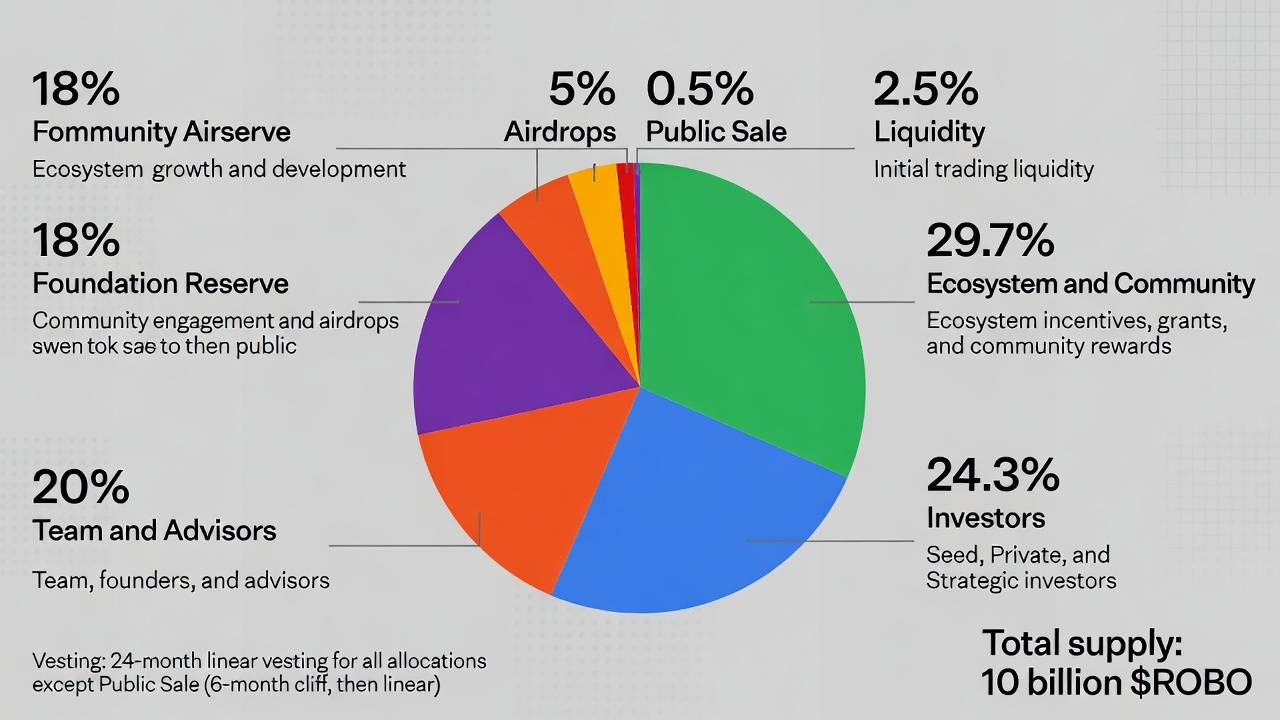
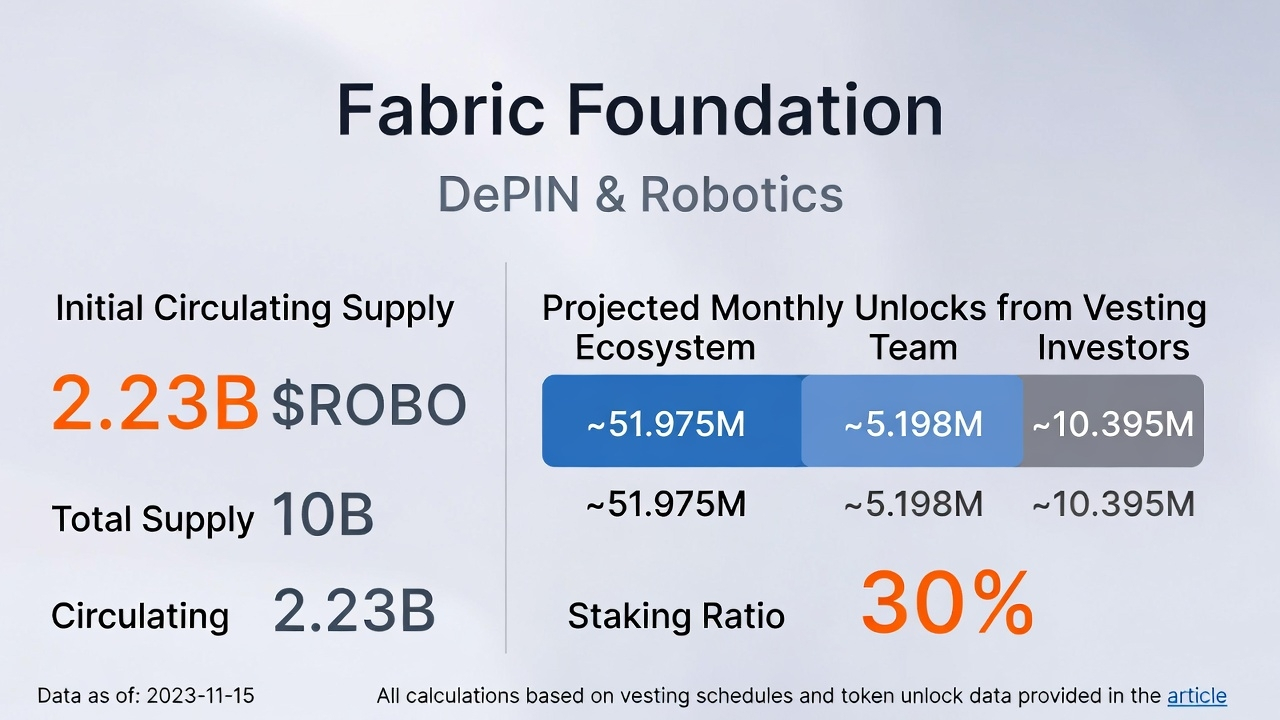
$ROBO is the utility and governance token powering Fabric's ecosystem. With a fixed total supply of 10 billion tokens, it has no inflation. At token generation event (TGE) in February 2026, the initial circulating supply was 2.23 billion (22.3%), calculated from unlocked portions across allocations.
The token allocation breaks down as follows:
Ecosystem and Community: 29.7% (30% unlocked at TGE, remainder linear over 40 months; includes Proof of Robotic Work incentives)
Investors: 24.3% (12-month cliff, then 36-month linear vesting)
Team and Advisors: 20% (same vesting as investors)
Foundation Reserve: 18% (30% at TGE, remainder over 40 months)
Community Airdrops: 5% (100% at TGE)
Liquidity Provisioning and Launch: 2.5% (100% at TGE)
Public Sale: 0.5% (100% at TGE)
This structure prioritizes long-term alignment, with heavy vesting for insiders to prevent early dumps. Utility-wise, ROBO required for network fees (e.g., payments, identity verification), staking in coordination pools, and governance votes on policies like fees. Protocol revenue partially buys back ROBO on the open market, creating buy pressure.
For an original calculation: Assuming linear vesting for the 70% locked ecosystem allocation (about 2.079 billion tokens), monthly unlocks would be roughly 51.975 million tokens over 40 months (2.079B / 40). This could add ~2.3% to circulating supply monthly post-TGE, potentially pressuring price if demand doesn't keep pace—though buybacks might offset some dilution. (Source data from official blog; calculation for illustrative purposes.)
Competitive Landscape
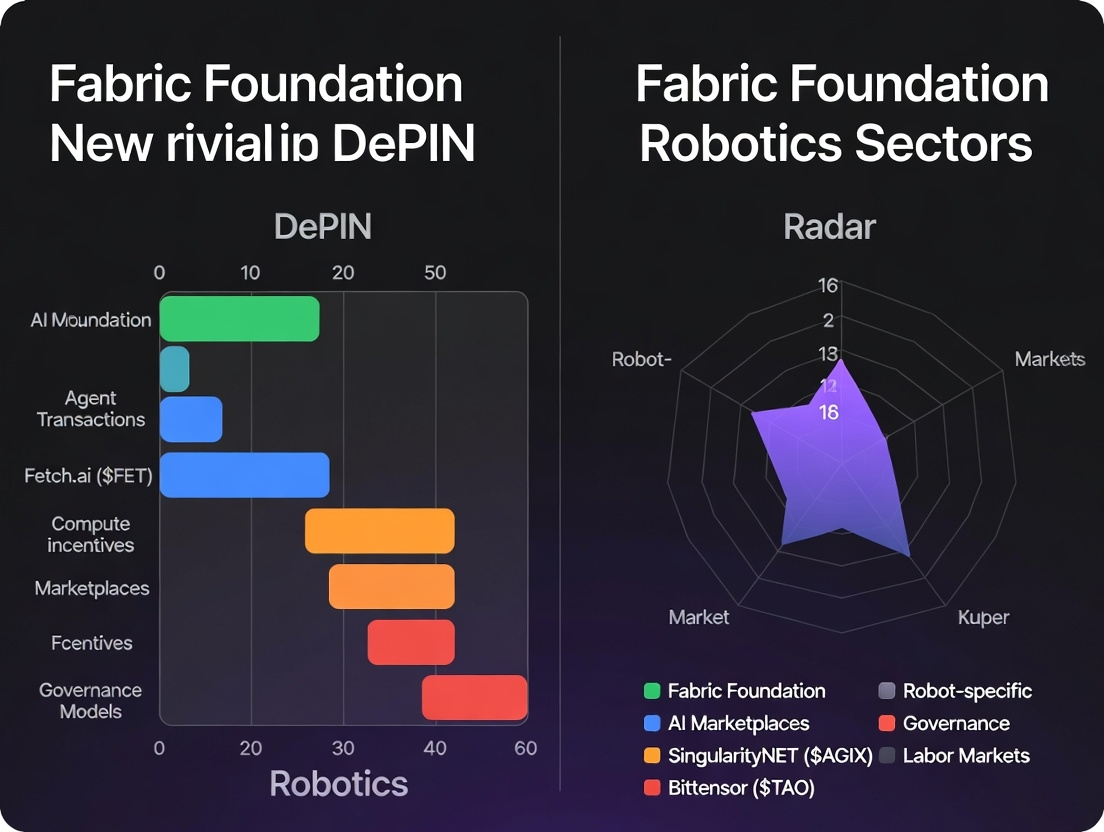
In the DePIN and robotics space, Fabric competes with projects blending AI, blockchain, and physical infrastructure. Fetch.ai ($FET) focuses on autonomous economic agents, enabling machine-to-machine transactions but lacks Fabric's emphasis on physical robot governance. SingularityNET ($AGIX) builds decentralized AI marketplaces, which could overlap in skill development for robots, but it's more software-centric. Bittensor ($TAO) incentivizes AI model training via decentralized compute, potentially complementing Fabric's data coordination for robot learning.
Fabric differentiates through its robot-specific focus: onchain identities and labor marketplaces tailored for hardware. Market share estimate: With robotics projected to grow to $210 billion by 2025 (pre-2026 data), DePIN subsets like Fabric could capture 1-2% in early stages if adoption hits, based on similar AI crypto projects' trajectories. However, established players like Boston Dynamics (non-crypto) dominate hardware, making Fabric's open network a niche disruptor.
Risks & Reality Check
No project is without hurdles, and Fabric's ambitious scope amplifies them. Competition in DePIN and robotics is fierce, with well-funded AI firms potentially outpacing decentralized efforts in hardware integration. Token dilution from vesting unlocks—over 70% of supply vests gradually—could suppress ROBO's value if network growth lags.
Execution risk looms large: Building real-world robot deployments requires partnerships for insurance, compliance, and operations, areas where Fabric is still early-stage. Market narrative shifts, like regulatory crackdowns on AI or crypto, could derail progress—especially since robots involve physical safety concerns. Overall, while the vision is compelling, success hinges on proving verifiable human-machine alignment in pilots.
Forward Outlook (6–12 months)
Over the next 6-12 months, expect Fabric to focus on network bootstrapping: launching initial coordination pools, integrating with AI models, and securing hardware partnerships. Milestones might include the first onchain robot activations or proof-of-robotic-work rewards. As the network migrates to its L1, scalability improvements could attract developers.
In a bullish scenario, rising AI hype drives adoption, with $ROBO staking ratios climbing above 30% as participants seek priority access. Watch for ecosystem grants from the 29.7% allocation to spur app development. Challenges like vesting pressure might cap growth, but if robot labor markets gain traction amid labor shortages, Fabric could emerge as a key player in DePIN. Keep an eye on metrics like active robots or transaction volume for signs of momentum.
Conclusion
Fabric Foundation offers a thoughtful approach to integrating robots into the economy via blockchain, emphasizing openness and alignment. While ROBO's design supports sustainable growth, the project's success will depend on navigating technical and market hurdles. It's a reminder that crypto's real value often lies in solving tangible problems—like automating work without centralizing power.
@Fabric Foundation #Robo