
The intersection of AI and blockchain has spawned countless projects, but few tackle the physical world as directly as Fabric Foundation. With robots poised to reshape industries from manufacturing to healthcare, this non-profit aims to create a decentralized framework where machines can operate autonomously yet remain aligned with human interests. At the core is $ROBO , the token powering the Fabric Protocol. Launched in early 2026, it's already trading on major exchanges like KuCoin and Binance, drawing attention amid a surge in AI narratives. But beyond the buzz, what's the real substance? Let's break it down without the gloss.
What is Fabric Foundation?
Fabric Foundation operates as a non-profit focused on open-source robotics and artificial general intelligence (AGI). Backed by contributors like OpenMind, it emphasizes building technology that benefits humanity broadly, steering clear of centralized control. The foundation funds research, convenes experts, and develops infrastructure for safe AI-robot interactions. Unlike profit-driven ventures, it prioritizes public goods—think transparent governance and verifiable machine behavior. Early partnerships with entities like NVIDIA and Unitree highlight its ambition to integrate hardware with software. In practice, Fabric isn't just theorizing; it's deploying tools for robot coordination, starting on the Base layer-2 network before evolving into a dedicated L1 chain. This setup allows developers and users to participate in a "robot economy" where machines handle tasks independently.
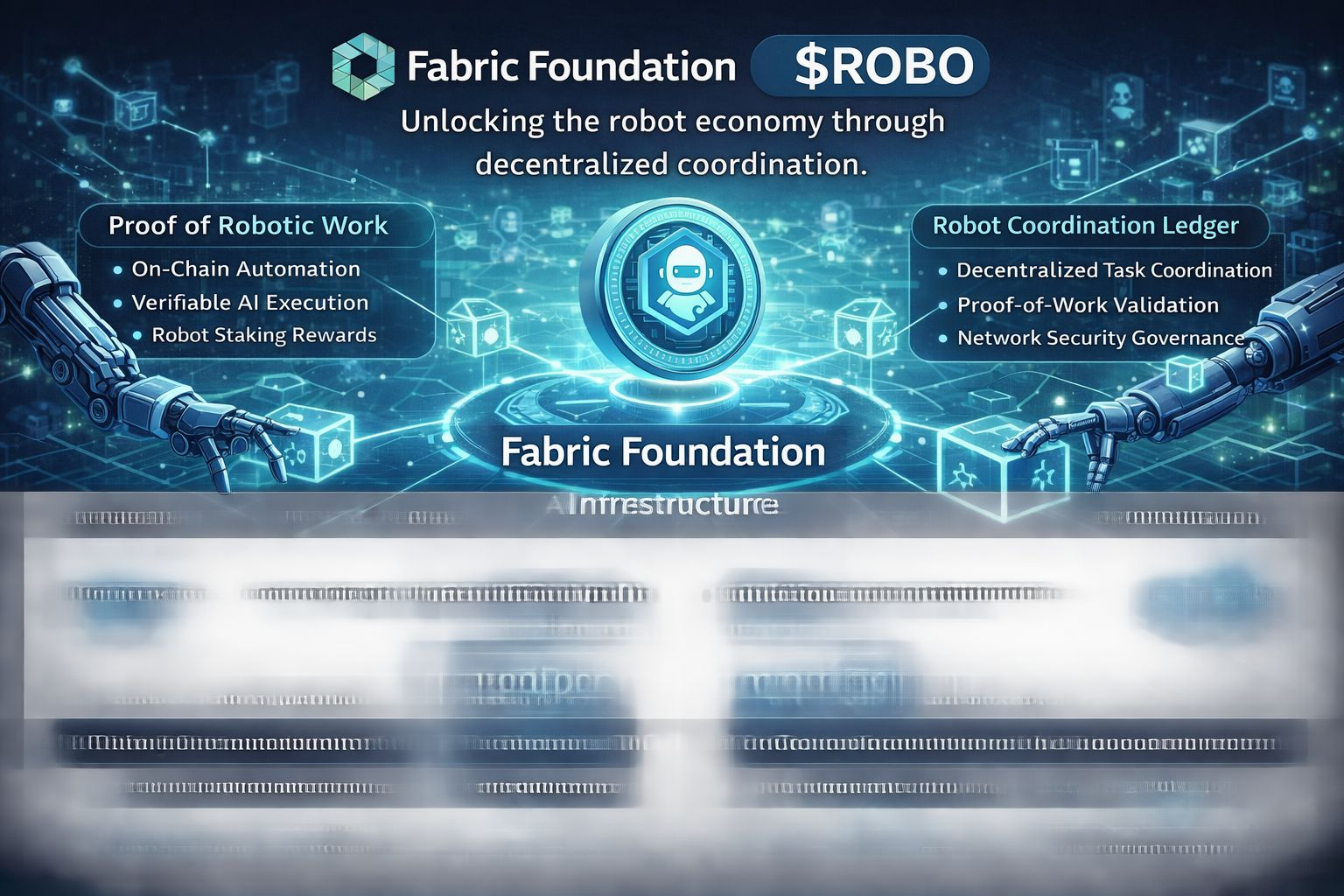
Focus: Fabric Protocol: A Decentralized Network for General-Purpose Robots.
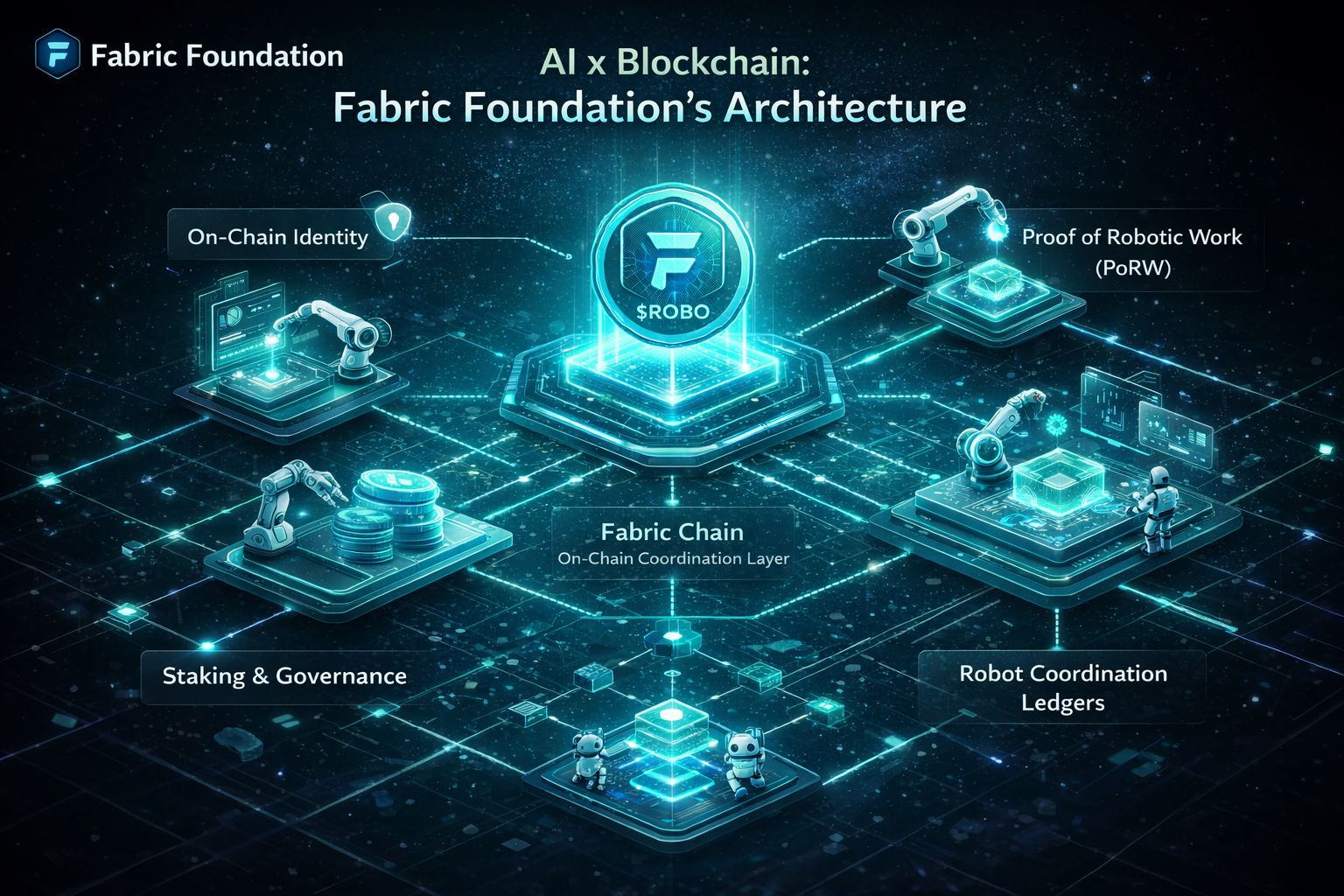
The Fabric Protocol serves as the backbone, enabling robots to identify themselves on-chain, exchange data, and process payments without intermediaries. It's designed for general-purpose machines—those adaptable to various tasks, not specialized ones like factory arms. Key features include Proof of Robotic Work, where contributions like data sharing or task completion earn rewards, and staking mechanisms for network coordination. For instance, builders must stake $ROBO to access the robot fleet, creating alignment. A standout aspect is addressing real-world gaps: robots can't open bank accounts, so Fabric provides wallets and identities. This matters now in AI x Blockchain because as embodied AI moves from labs to streets, centralized platforms risk monopolies—think one company dominating robot fleets. Fabric counters this with open ledgers, allowing anyone to contribute compute or oversight. That's where things get interesting; it flips the narrative from isolated bots to a composable ecosystem, potentially accelerating innovation through shared resources.
Tokenomics & Economic Design
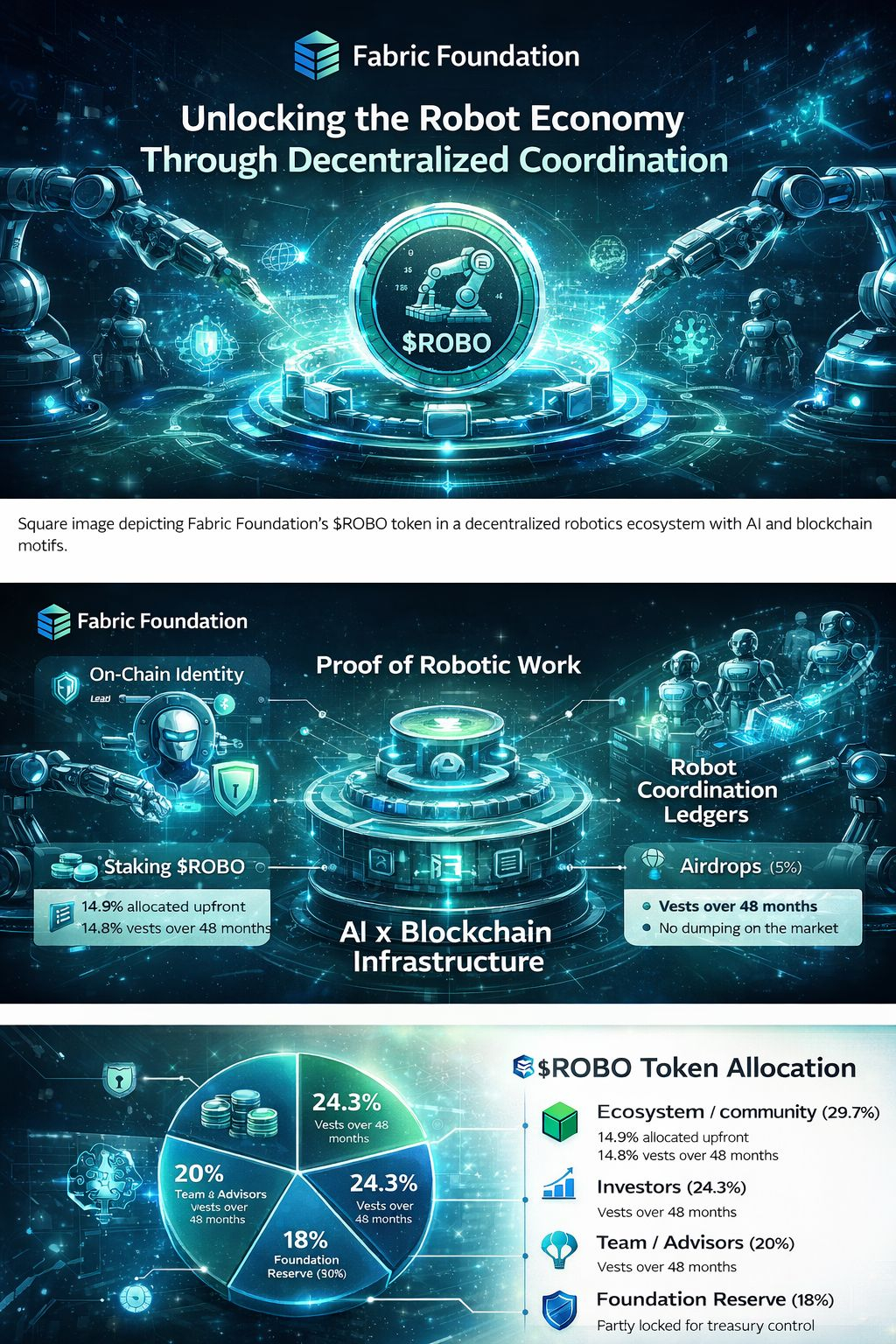
ROBO has a fixed total supply of 10 billion tokens, a cap that curbs inflation but demands careful allocation. The breakdown favors ecosystem growth: 29.7% goes to community and ecosystem (30% unlocked at token generation event, or TGE, with the rest vesting over 40 months plus emissions via Proof of Robotic Work). Investors get 24.3% with a 12-month cliff followed by 36-month linear vesting, while the team and advisors hold 20% under similar terms. The foundation reserve is 18% (30% at TGE, 40-month linear), and 5% is for community airdrops, fully unlocked at TGE.
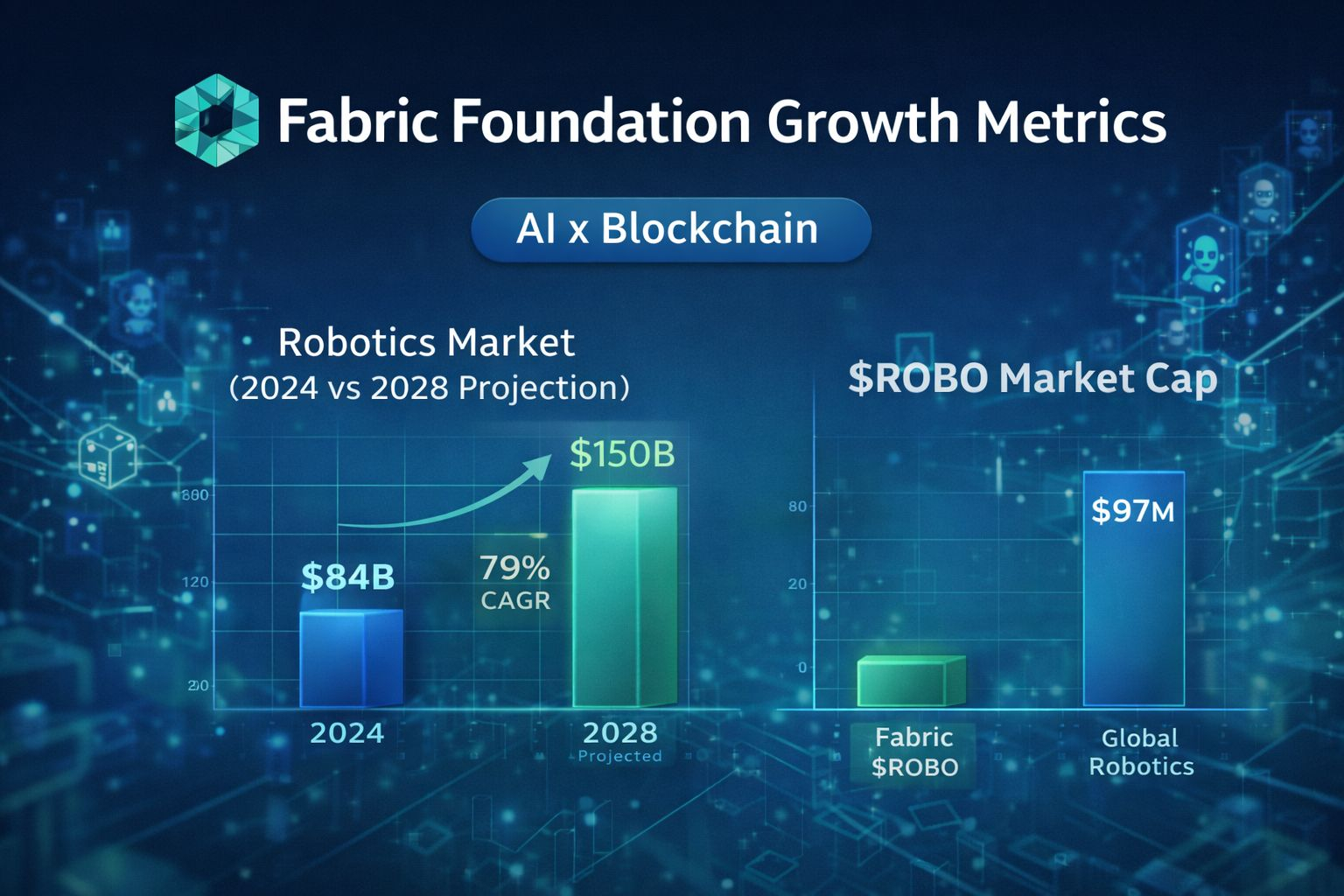
Real data points underscore the design: As of late February 2026, ROBO trades at around $0.043 with a market cap of $97 million and fully diluted value of $431 million [source: CoinGecko]. An original calculation highlights potential supply pressure—over the next four years, the combined investor and team allocations (44.3%) will unlock gradually, releasing about 1.1 billion tokens annually on average if vesting is linear post-cliff. This could dilute circulating supply by roughly 11% yearly, assuming no burns or buybacks. Economically, $ROBO covers fees for transactions, staking for coordination, and governance via vote-escrowed tokens (veROBO). Fees create buy pressure as a portion funds open-market repurchases. It's pragmatic for a nascent network, but the heavy vesting signals a focus on sustainability over quick flips.
Competitive Landscape
In the AI x Blockchain vertical, Fabric faces a mix of crypto natives and traditional robotics players. Crypto-side, projects like Virtuals Protocol (which hosted Fabric's titan launch) overlap in agent coordination, while DePIN networks such as Render or Bittensor handle compute but lack robot-specific focus. Broader competitors include ABB Robotics and Geek+, which dominate industrial automation with AI but operate centrally. Fabric's edge? Decentralized governance and on-chain interoperability, potentially outpacing closed systems in scalability. Market share estimates are tricky, but robotics is projected to exceed $150 billion by 2028 [source: Fabric Foundation blog], with AI integration driving 20-30% annual growth in segments like humanoid bots. Fabric's niche in open networks could capture 1-2% if adoption mirrors early DeFi protocols, though it's early days. Rivals like Exotec emphasize warehouse efficiency, but Fabric's protocol aims for universality, betting on composability to win.
Risks & Reality Check
No project is immune, and Fabric's ambitions amplify challenges. Competition in AI x Blockchain is fierce, with well-funded players like xAI or World Labs pouring billions into similar spaces. Token dilution from vesting schedules could suppress ROBO's price, especially if unlocks coincide with market dips—recall how similar mechanics hit other tokens post-TGE. Execution risk is high; the protocol's Layer 1 migration isn't live yet, and integrating physical robots with blockchain demands flawless tech stacks. Regulatory hurdles loom, as governments scrutinize AI safety and autonomous machines—potential bans on unaligned systems could derail progress. Market narrative shifts, like a pivot from robotics hype to another trend, add volatility. Data scarcity for training robot models remains a bottleneck, and safety guarantees are unproven. Overall, while the vision is compelling, real-world deployment could take years, testing investor patience.
Forward Outlook (6–12 months)
Over the next half-year, expect Fabric to solidify its Base deployment, with milestones like mainnet migration and expanded partnerships. Robotics adoption is accelerating—projections show the market hitting $150 billion soon, fueled by AGI advances. ROBO could benefit from this tailwind, potentially stabilizing around current levels if airdrops and incentives draw users. In 6-12 months, successful Proof of Robotic Work pilots might boost activity, but volatility persists amid broader crypto cycles. Watch for integrations with hardware like Unitree bots; if Fabric captures early robot fleets, network effects could kick in. Challenges include navigating bearish sentiment, but the foundation's capitalization provides runway. It's a high-conviction play on embodied AI, with upside tied to tangible progress.
Conclusion
Fabric Foundation represents a thoughtful stab at decentralizing robotics, using ROBO to foster an inclusive economy. Yet, the path from protocol to pervasive adoption is fraught. As machines grow smarter, the need for open alignment becomes clearer, but success depends on execution in a crowded field.
@Fabric Foundation #Robo