
AI's rapid evolution has outpaced our ability to trust it, especially when outputs can hallucinate facts or harbor biases. Enter Mira Network, a blockchain-based protocol aiming to bridge that gap by verifying AI claims through decentralized consensus. Launched in late 2025 on the Base chain, $MIRA powers this ecosystem, facilitating staking, fees, and governance. With AI integration exploding across sectors, Mira's approach feels timely—yet practical hurdles like verification speed versus accuracy loom large. Trading around $0.10 as of February 2026, it's caught investor eyes in a crowded field, but let's dig into the mechanics without the fluff.
What is Mira Network?
Mira Network functions as a trust layer for AI, breaking down model outputs into discrete claims that get validated by a network of independent nodes. Built on blockchain principles, it uses diverse AI models to cross-check information, achieving higher reliability than single-model systems. The project, backed by a $9.85 million seed round, emphasizes collective intelligence over centralized control. Nodes run inferences, stake $MIRA or participation, and face slashing for dishonest behavior. Early apps like Klok, a multi-LLM chat tool, demonstrate real-world use, verifying responses from models like GPT-4o and Llama. It's not just about crypto hype; Mira targets practical issues in healthcare, finance, and beyond where AI errors carry real costs.
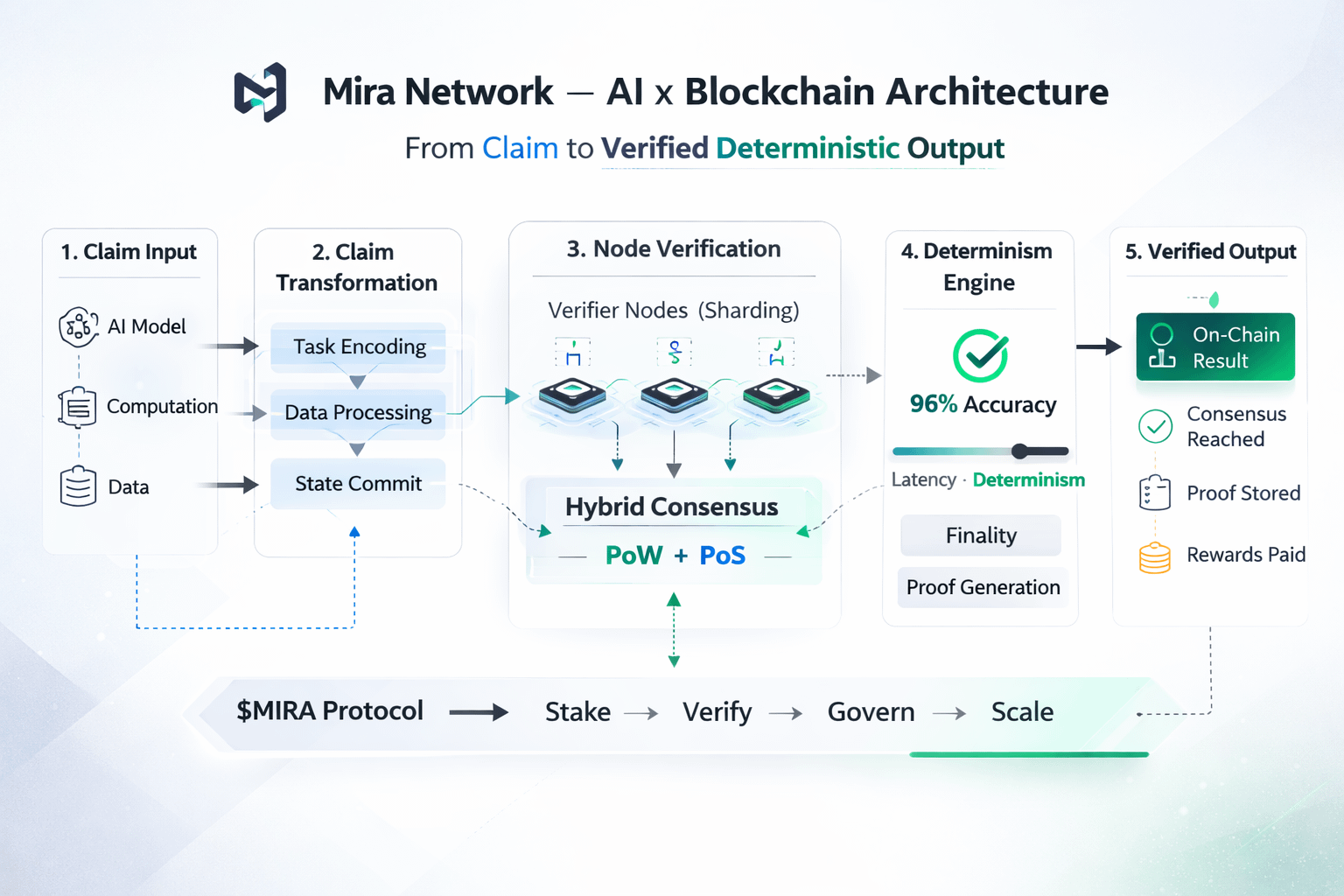
Focus: Latency vs Determinism: The Hidden Metric That Could Define Mira’s Edge
Mira prioritizes deterministic execution—ensuring AI outputs are verifiable and consistent—over chasing high transactions per second (TPS), which it views as a marketing gimmick. The protocol transforms fuzzy AI responses into structured claims, sharded across nodes for consensus via a hybrid Proof-of-Work (honest inference) and Proof-of-Stake model. This setup boasts 95%+ accuracy in verifications, but it introduces latency from sharding and duplication to prevent collusion. For instance, complex claims like multimedia require more processing, potentially delaying results compared to raw AI queries. Why this matters now in AI x Blockchain: As AI agents handle real-world tasks, from trading to diagnostics, probabilistic outputs risk chaos; Mira's determinism builds a foundation for trustless systems, especially when regulatory scrutiny demands auditability. That's where things get interesting—it shifts the metric from speed to reliability, potentially edging out competitors in enterprise adoption.
Tokenomics & Economic Design
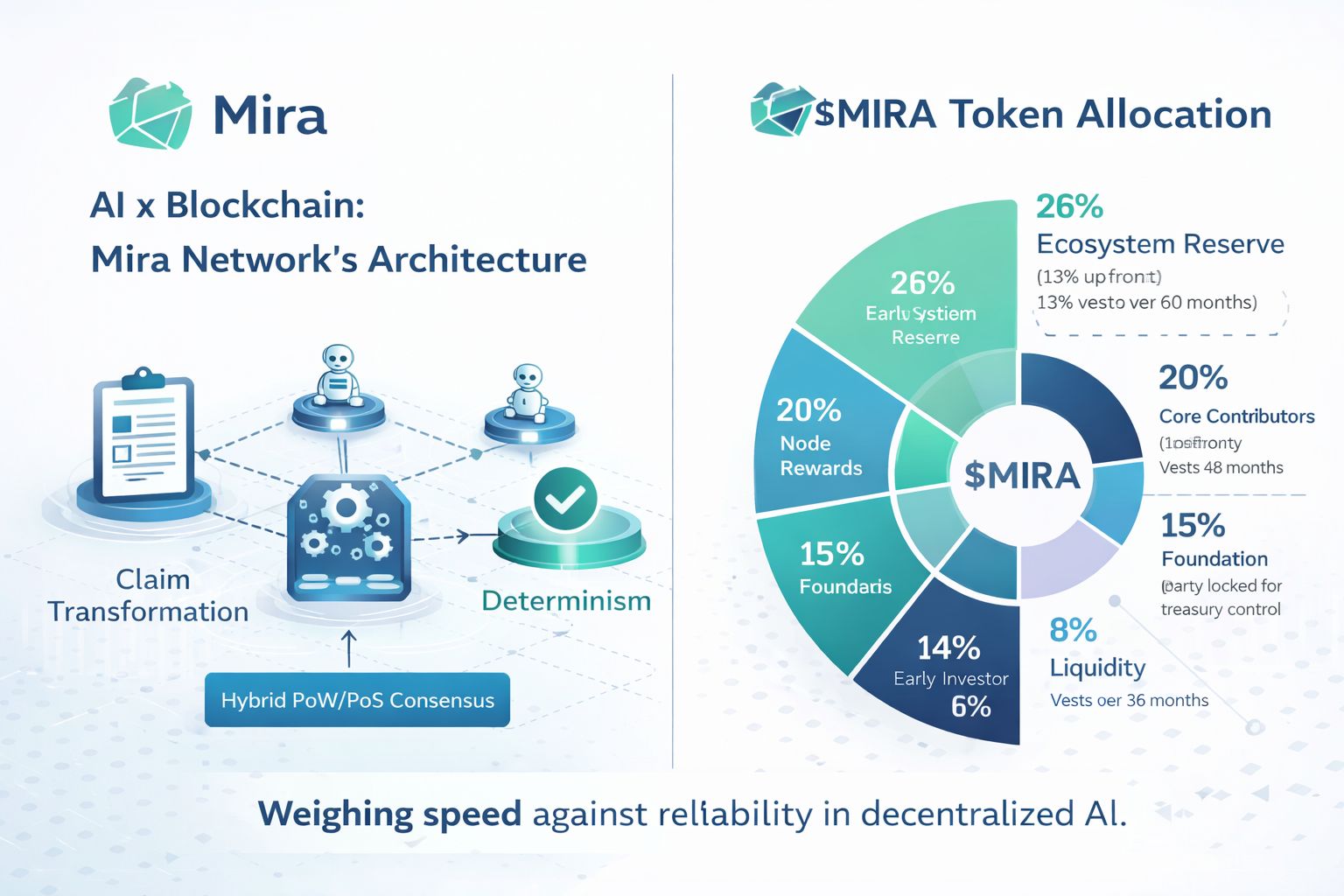
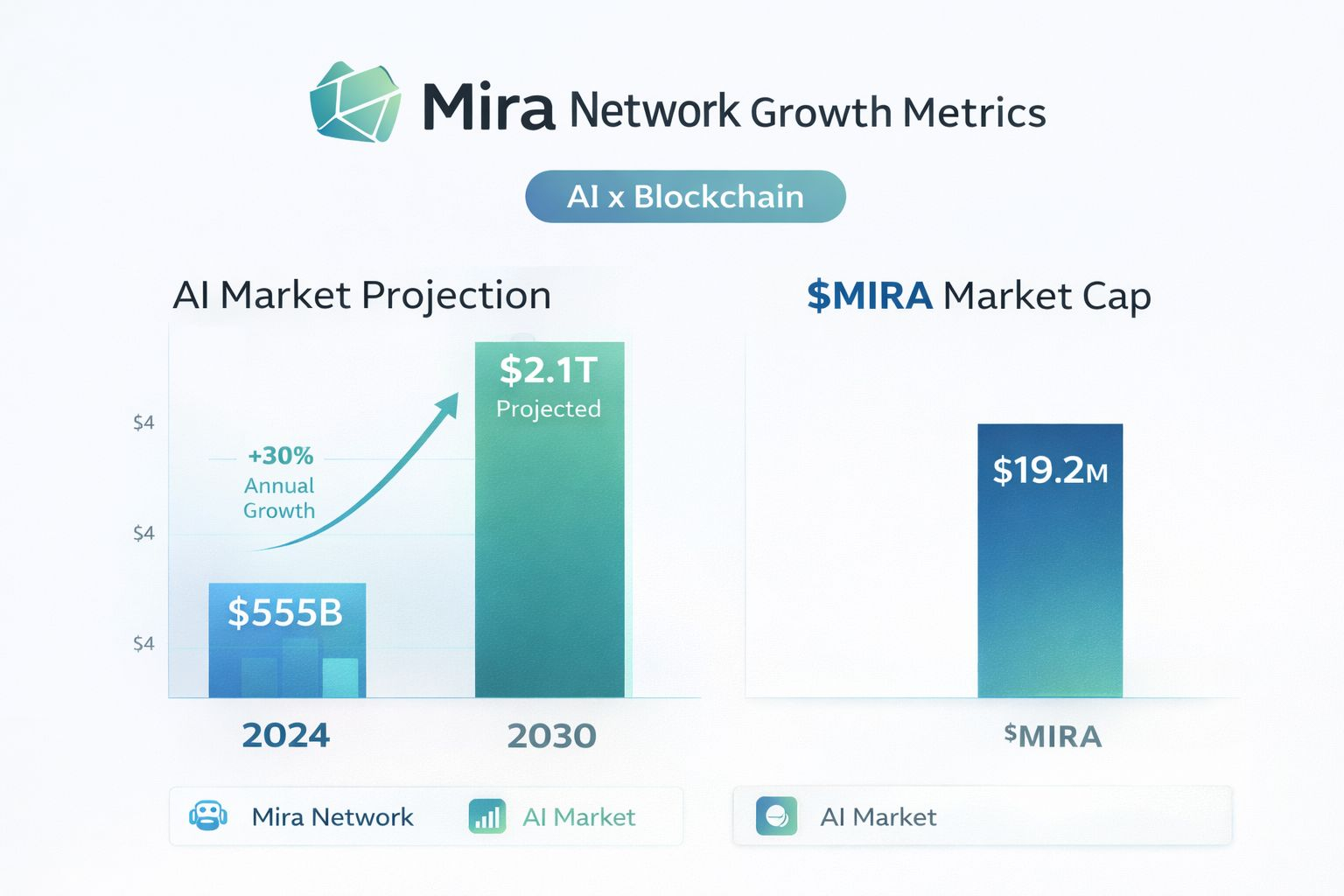
$MIRA features a fixed 1 billion token supply, avoiding inflation but requiring smart distribution. Breakdown: 26% ecosystem reserve (vesting over 24 months), 20% core contributors (36-month vesting with 12-month cliff), 16% node rewards (emitted over time), 15% foundation (24 months), 14% early investors (24 months with cliff), 6% initial airdrop (unlocked at TGE), and 3% liquidity. Initial circulation sat at 19.12%, with circulating supply now around 204 million [source: Tokenomist]. As of February 2026, MIRA trades at $0.094 with a market cap of $19.2 million and FDV of $94 million [source: CoinMarketCap]. An original calculation shows potential dilution: Over the next 24 months, investor and contributor unlocks (34% total) release about 14.17 million tokens monthly on average, potentially increasing circulating supply by 35% annually if no offsets occur. MIRA handles fees for verifications, staking for nodes, and governance via proposals. Fees partly reward honest verifiers, creating buy pressure, but the model bets on growing demand for verified AI to sustain value.
Competitive Landscape
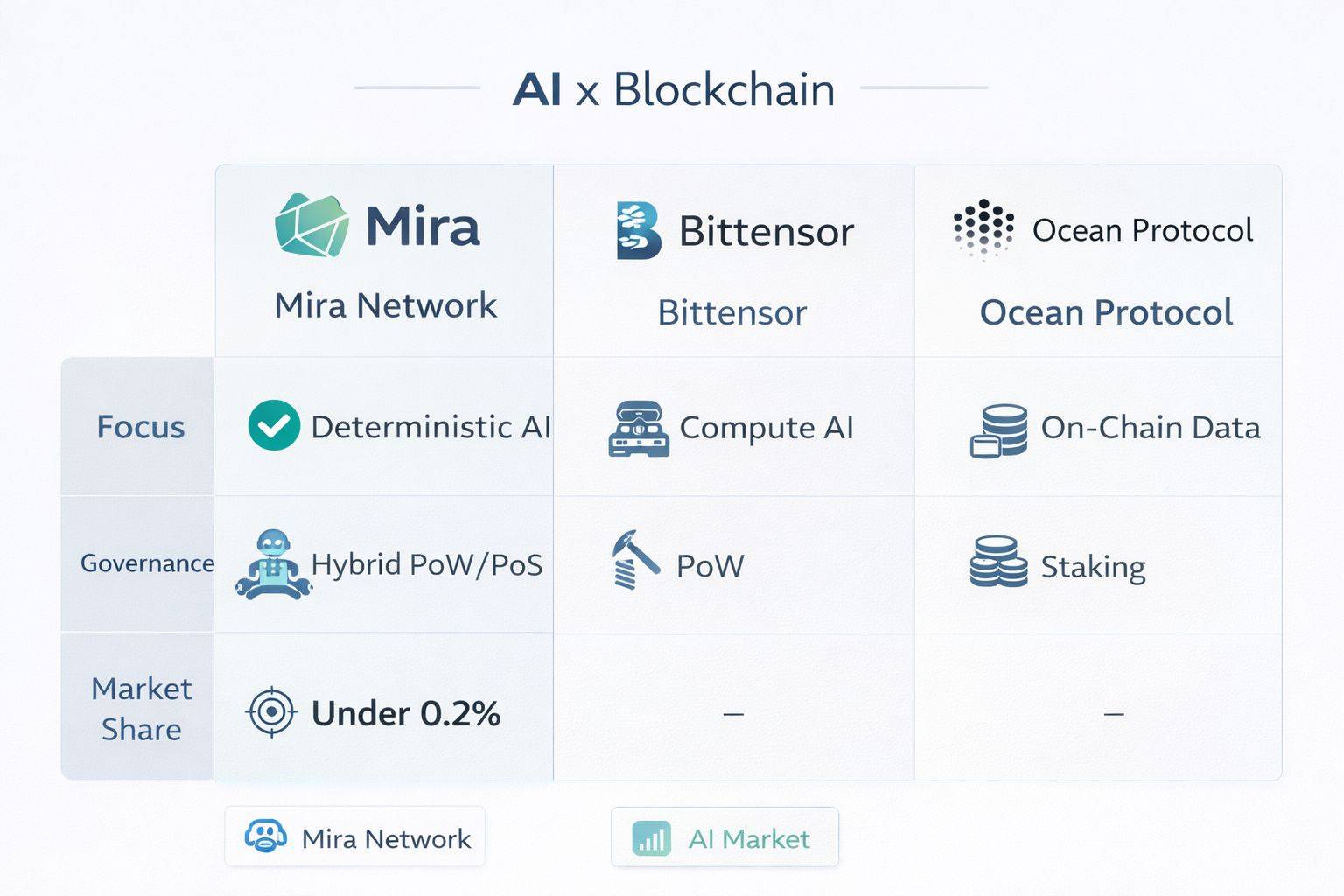
AI x Blockchain is heating up, with projects vying to make intelligence decentralized and reliable. Mira competes with Bittensor (TAO), which incentivizes machine learning contributions, and Ocean Protocol (OCEAN) for data marketplaces, but Mira's niche in output verification differentiates it. Sahara AI offers a similar blockchain for AI models, while Render (RNDR) focuses on GPU compute—areas where Mira partners, like with Aethir for infrastructure. Broader rivals include centralized players like OpenAI, but Mira's on-chain auditability appeals to Web3. Market estimates peg AI crypto at over $10 billion in cap [source: CoinMarketCap sector data], with Mira holding under 0.2% share. Its edge lies in determinism for high-stakes apps, potentially capturing more if verification becomes standard, though established networks like Bittensor boast higher liquidity and adoption.
Risks & Reality Check
Mira's vision is solid, but execution isn't guaranteed. Competition in AI x Blockchain is brutal, with well-capitalized players like Bittensor or emerging ones like Sahara AI potentially outpacing in compute or integrations. Token dilution from vesting—34% unlocking over 2-3 years—could weigh on prices, especially in bear markets; similar schedules have tanked other tokens post-TGE. Execution risk centers on scaling: verifying complex outputs demands more nodes and compute, risking higher latency or costs that deter users. Regulatory shifts around AI safety could help or hinder—bans on unverified systems might boost Mira, but overreach could stifle innovation. Market narrative swings, from AI hype to skepticism, add unpredictability; Mira's 91% drop from TGE valuation mirrors 2025's tough launches. Data for diverse models might prove scarce, and consensus failures in edge cases remain untested at scale.
Forward Outlook (6–12 months)
The next six months could see Mira expand node operations and integrations, like more apps building on its Verified Generate API. AI market growth, projected at 30%+ annually, supports tailwinds, with verification demand rising in regulated sectors. MIRA might hover near current levels if unlocks pressure supply, but successful pilots—say, in fintech—could drive uptake. In 6-12 months, as the network matures, expect focus on reducing latency while maintaining determinism, possibly through optimizations like specialized models. Broader crypto recovery could lift it, but volatility from altcoin rotations persists. Partnerships, like with Aethir for GPUs, provide runway; overall, it's a bet on AI's reliability crunch materializing soon.
Conclusion
Mira Network tackles a core AI flaw with blockchain smarts, using MIRA to align incentives around trustworthy outputs. The latency-determinism trade-off could prove its secret weapon, but only if real adoption follows. In a space full of promises, Mira's progress will tell if it delivers.
@Mira - Trust Layer of AI #Mira