
$ROBO @Fabric Foundation 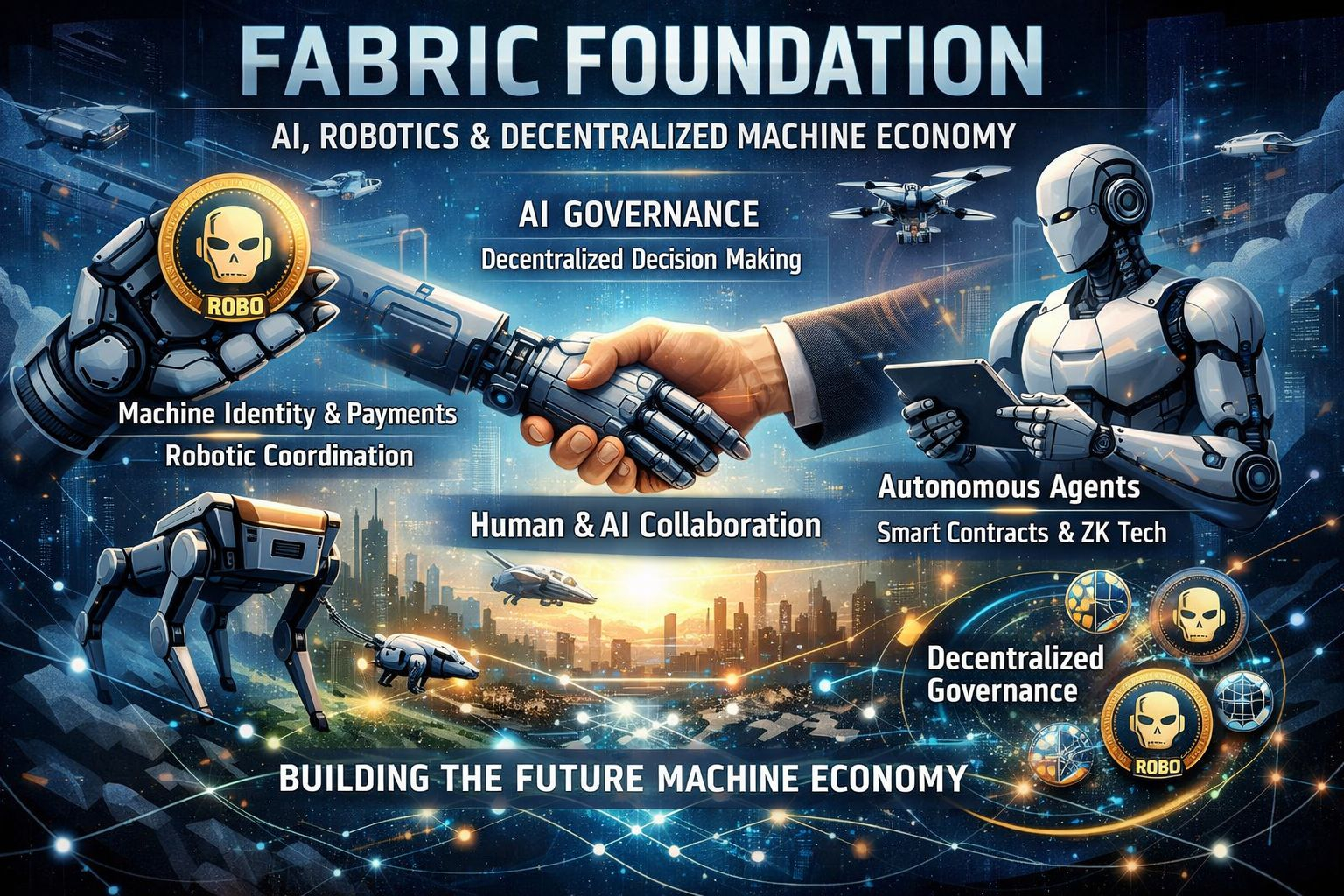 Fabric Foundation is not just another Layer-1 or DeFi token. Its core idea revolves around:
Machine identity and accountability infrastructure
Decentralized task allocation between humans and AI agents
Human-gated and location-gated payments
Open governance for robotics and AGI systems
These primitives aim to solve a future problem: How will autonomous robots safely participate in the economy?
This positions ROBO as a long-term infrastructure token rather than a short-term speculative DeFi asset.
2. Technology & Ecosystem Fundamentals
The project combines AI governance concepts with decentralized infrastructure layers:
a) Human–Machine Coordination Layer
Fabric Foundation focuses on building open systems that allow:
Predictable machine behavior
Transparent decision-making
Decentralized accountability rails
These features aim to reduce risks associated with autonomous systems operating in the physical world. �
fabric.foundation
b) Identity & Payments for Autonomous Agents
The project is exploring systems where:
Machines have verifiable identities
Payments can be tied to location or human approval
Tasks can be assigned and verified across distributed agents
Such design suggests future integration with robotics, IoT, and AI compute networks.
c) Alignment & Governance Focus
Fabric Foundation prioritizes alignment research, interpretability, and governance frameworks, which could differentiate it from purely technical blockchain projects. �
fabric.foundation
This governance-first architecture can be a strong moat if autonomous AI economies become mainstream.
3. Tokenomics & Market Structure (ROBO Token)
The ROBO token’s supply model appears structured for long-term sustainability:
Total supply: ~10 billion tokens
Investor allocation: ~24.3% with 12-month cliff + 36-month vesting
Team & advisors: ~20% with similar vesting
Foundation treasury: ~18% gradually unlocked
Ecosystem incentives: ~29.7% for growth and partnerships �
HOKANEWS.COM
Fundamental Interpretation
✔ Strong vesting schedule suggests reduced immediate sell pressure
✔ High ecosystem allocation indicates long-term development funding
⚠ However, large supply could dilute value if demand growth lags
4. Major Developments & Milestones
A) Exchange Listing & Market Discovery (2026)
A major fundamental milestone is the official listing of ROBO token across multiple exchanges including Binance Alpha, Bybit, Bitget, and KuCoin on Feb 27, 2026. �
HOKANEWS.COM +1
This marks:
Transition from airdrop/community phase to open market price discovery
Broader liquidity and investor access
Beginning of real valuation based on utility and adoption
Early pre-market trading showed high speculative interest with strong volume, signaling market curiosity around the AI-crypto narrative. �
HOKANEWS.COM
5. Partnerships & Strategic Direction
The Fabric ecosystem intersects with cryptography acceleration and zero-knowledge infrastructure development. Collaboration efforts in cryptography marketplaces and proof-generation ecosystems highlight ambitions in scalable zk-computing. �
AiCoin
This is important because:
ZK tech is essential for privacy-preserving AI agents
Hardware acceleration can enable scalable AI-on-chain interactions
Thus, Fabric is indirectly positioned at the intersection of: AI + Robotics + ZK + Decentralized Governance
6. Roadmap Outlook (Projected Based on Vision)
Although the full official roadmap is evolving, based on its mission and early milestones, the development trajectory likely includes:
Phase 1 — Token & Community Bootstrap (2025–2026)
Airdrop eligibility and contributor onboarding
Exchange listings and liquidity rollout
Early ecosystem grants and research funding
Phase 2 — Core Infrastructure Deployment (2026–2027)
Machine identity and accountability primitives
Human-gated and machine-to-machine payment layers
Pilot integrations with robotics or AI agent networks
Phase 3 — Autonomous Economy Enablement (2027+)
Full decentralized coordination between humans and intelligent machines
Governance frameworks for AI agents
Global participation tools for tele-operation and remote collaboration
These roadmap directions align with the foundation’s long-term goal of ensuring machines act as “aligned economic contributors” under decentralized governance. �
fabric.foundation
7. Competitive Positioning
Fabric Foundation operates in a niche but powerful narrative sector:
Sector
Competitors
Fabric Differentiator
AI + Crypto
Fetch.ai, SingularityNET
Focus on governance + physical-world machines
Robotics Economy
New emerging sector
First mover governance framework
ZK Infrastructure
StarkNet, zkSync ecosystem
Hardware-accelerated + coordination vision
This multi-sector positioning could be bullish if AI agents become on-chain economic actors.
8. Strengths (Bullish Case)
Strong long-term narrative: AI + Robotics economy infrastructure
Governance-focused design for real-world autonomous agents
Structured vesting tokenomics supporting sustainability
Early exchange listings increasing liquidity and adoption
#FabricFounddation #ROBO #USIsraelStrikeIran #AnthropicUSGovClash #BlockAILayoffs